High-interest robotics task pillar
Robot manipulation: learning, control and tactile feedback
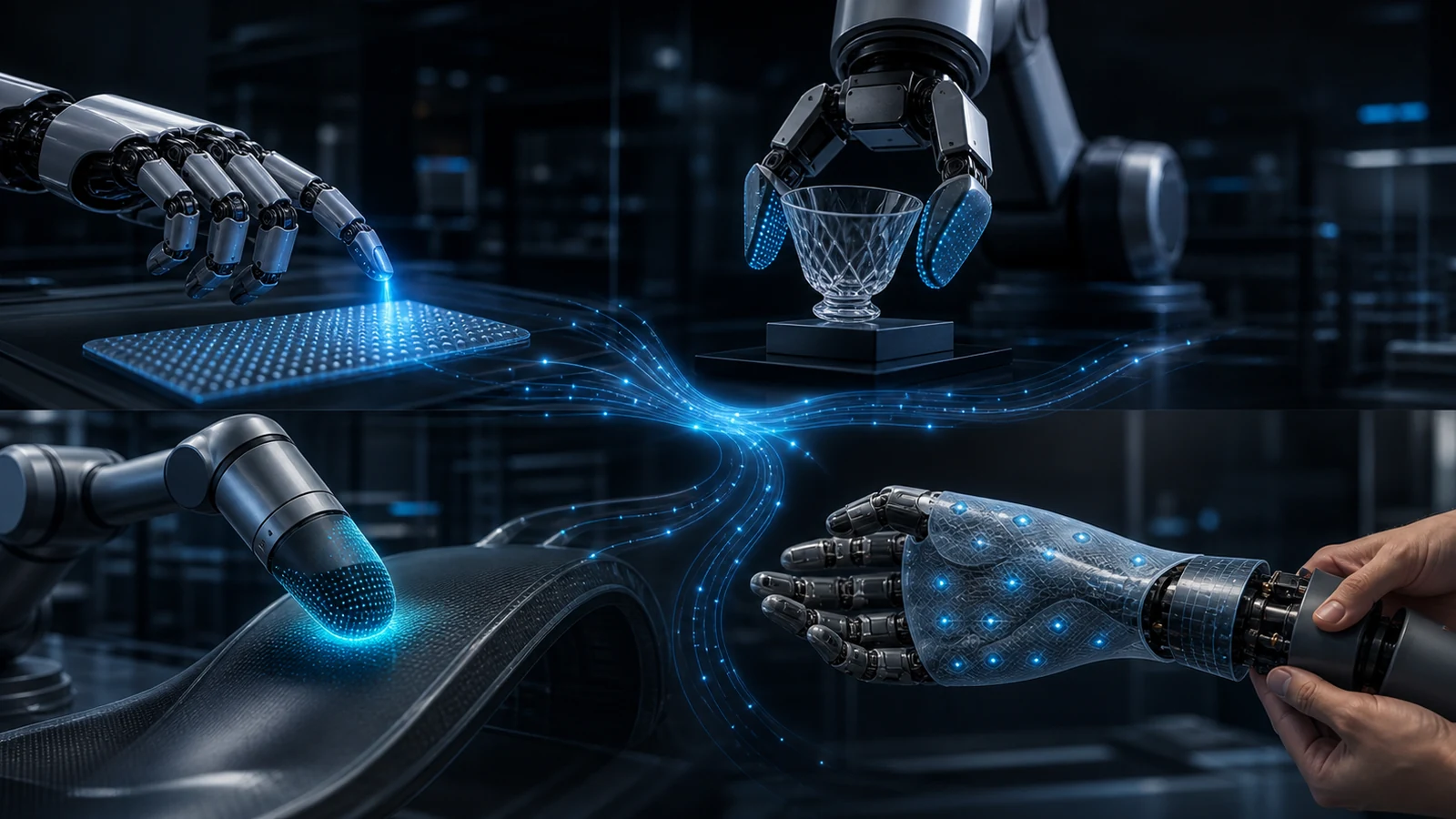
Explore robot manipulation across grasping, dexterous hands, insertion, robot learning, VLA policies, force control, tactile feedback, and evaluation.
- 6
- sections
- 4
- questions
- 10
- next routes
Short answer
What you need to know
- 1
Robot manipulation is the process of using a robot arm, hand, gripper, or whole body to change the state of an object or environment through actions such as grasping, moving, inserting, turning, folding, or tool use.
- 2
A manipulation system combines perception, state estimation, planning or policy learning, robot control, end-effector hardware, data, and evaluation. Contact-rich tasks also need evidence about force, slip, deformation, seating, and recovery.
- 3
Tactile sensing is valuable after contact begins or vision becomes occluded. It can support grasp stabilization, insertion correction, deformable-object handling, dexterity, and failure recovery when the controller can act on the signal in time.
Topic 01
The robot manipulation stack
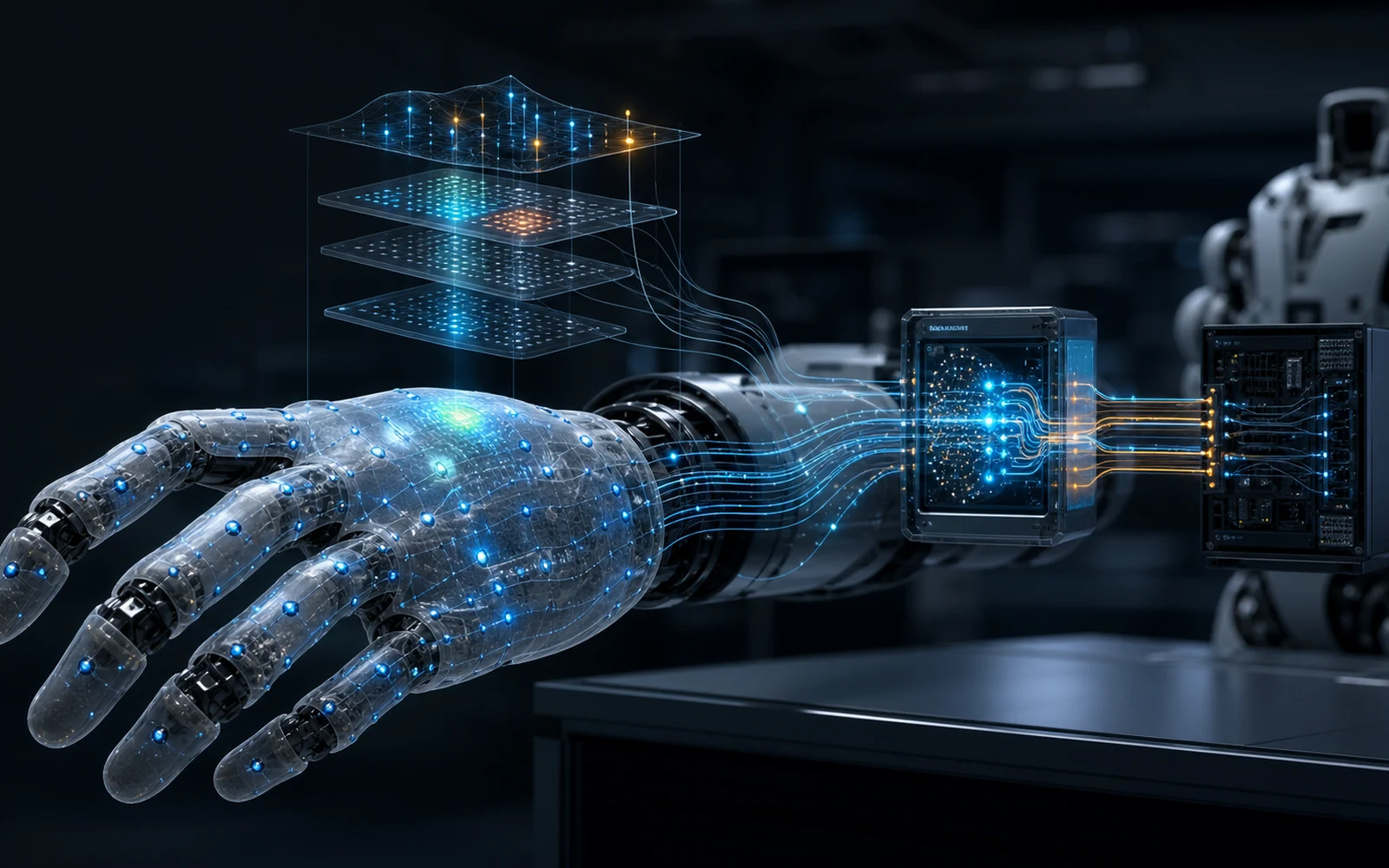
Manipulation begins before contact with scene understanding and motion planning, then becomes a contact and control problem as the hand or gripper reaches the object. A complete system needs a defined observation, action, end effector, controller or policy, task objective, and evaluation protocol.
- Perception: objects, geometry, materials, people, obstacles, and contact context
- Planning or policy: task sequence, grasp, trajectory, action chunk, or recovery choice
- Control: position, velocity, impedance, force, torque, or learned closed-loop command
- End effector: parallel gripper, suction, multi-finger hand, soft gripper, or tool
- Feedback: vision, proprioception, force or torque, tactile arrays, and task outcome
Topic 02
Manipulation task families
A model that succeeds at pick-and-place has not automatically solved insertion, deformable objects, tool use, or multi-finger dexterity. Task families create different sensing, control, and evaluation requirements.
PRISM reports 5,000+ trajectories across 25+ industrial tasks and multiple robot and teleoperation configurations, including insertion, packaging, installation, and conveyor sorting. Tactile observations cover only an unspecified subset, and the official dataset download remained pending when reviewed, so the paper is evidence of the announced collection design rather than an independently audited open benchmark.
| Task family | Physical challenge | Useful feedback | Evidence to report |
|---|---|---|---|
| Pick, place, and regrasp | Pose error, grasp stability, occlusion, and object variation | Vision, proprioception, slip, pressure distribution | Objects, poses, trials, drops, speed, and recovery |
| Insertion and assembly | Jamming, tight tolerance, seating, and hidden contact | Force, torque, contact direction, tactile state | Tolerance, clearance, forces, failures, and completion criteria |
| Dexterous in-hand manipulation | Many contacts, underactuation, rolling, sliding, and reorientation | Full-hand touch, joint state, local slip and shear | Hand, objects, contact coverage, success, and intervention |
| Deformable-object handling | State is high-dimensional and changes under contact | Vision, distributed touch, force, and action history | Material range, initial states, damage, generalization, and repeatability |
| Tool use and long-horizon tasks | Sequencing, constraints, changing contact modes, and recovery | Language, vision, contact confirmation, and task progress | Autonomy, subtask success, resets, time, and failure taxonomy |
Topic 03
Hands, grippers and whole-body manipulation
A two-finger gripper can be reliable and easier to control for many industrial tasks. Multi-finger hands add contact options and human-tool compatibility but also increase sensing, calibration, action-space, control, and maintenance complexity. Whole-body manipulation adds balance, mobility, reach, and environmental contacts.
Compare systems by the task and embodiment they actually test, not by assuming that more degrees of freedom always produce better manipulation.
Topic 04
Learning, VLA policies and world models
Modern manipulation research includes imitation learning, reinforcement learning, diffusion or flow-based policies, vision-language-action models, and predictive world or world-action models. These methods can share data and components while serving different roles.
Language can specify a task, vision can establish scene context, proprioception can expose robot configuration, and touch can ground the policy in physical contact. A world model may predict what follows an action, while a controller still needs to execute and correct the motion.
Topic 05
When tactile feedback changes the task
Tactile feedback is most defensible when the experiment isolates what changes after adding touch. A matched vision-only or no-touch baseline, synchronized inputs, latency reporting, disturbance tests, and closed-loop outcomes help show whether the contact pathway is doing useful work.
T-Rex investigates tactile-reactive VLA manipulation, while ReTouch investigates online-refined tactile prediction for contact-rich dexterity. Both are 2026 preprints with source-specific robots, datasets, baselines, and tasks. Their reported results should not be transferred to other systems without new evidence.
ADEPT provides a narrower matched example: one Flexiv-Sharpa square-and-round insertion condition reports 3/10 final success with vision only and 8/10 with visuo-tactile input, using ten physical trials per modality. That comparison is tied to one fixed-workbench hand, tactile representation, task, and training recipe; it is not a universal tactile-manipulation gain.
Topic 06
How to compare manipulation results
A credible comparison aligns the task, robot, end effector, observations, training data, action budget, controller rate, objects, environment, and evaluation procedure. It also states whether failures were retried, demonstrations were selected, or a person intervened.
- Use task success together with time, force, drops, damage, recovery, and safety constraints
- Separate perception metrics from real-robot task outcomes
- Group train and test splits by trajectory, object, scene, sensor, or embodiment when leakage is possible
- Treat a staged demonstration, benchmark score, preprint result, and production deployment as different evidence levels
Paper routes
Start with source-backed RoboSkin briefs
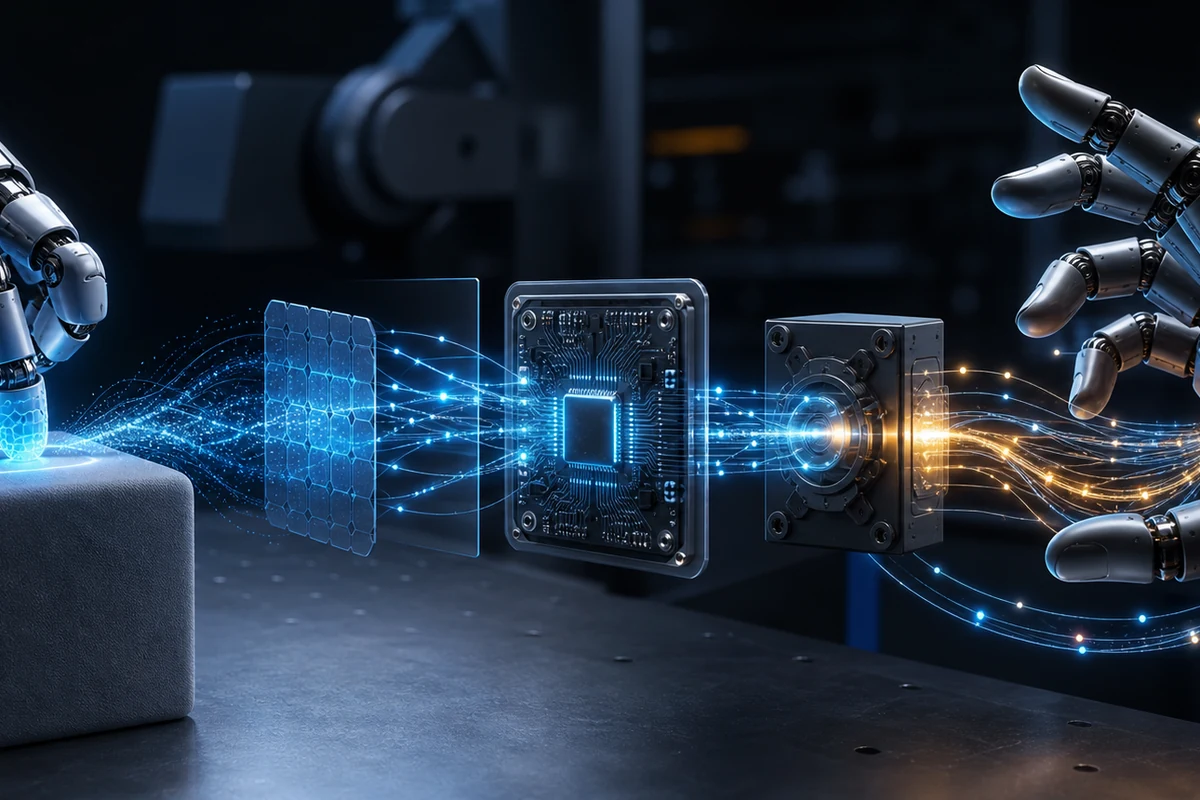 Robot learning / 2026-08-22ADEPT reports a 3/10 to 8/10 tactile ablation on dexterous insertionADEPT reports 3/10 vision-only versus 8/10 visuo-tactile final success in one matched Flexiv-Sharpa insertion condition, with ten physical trials per condition.
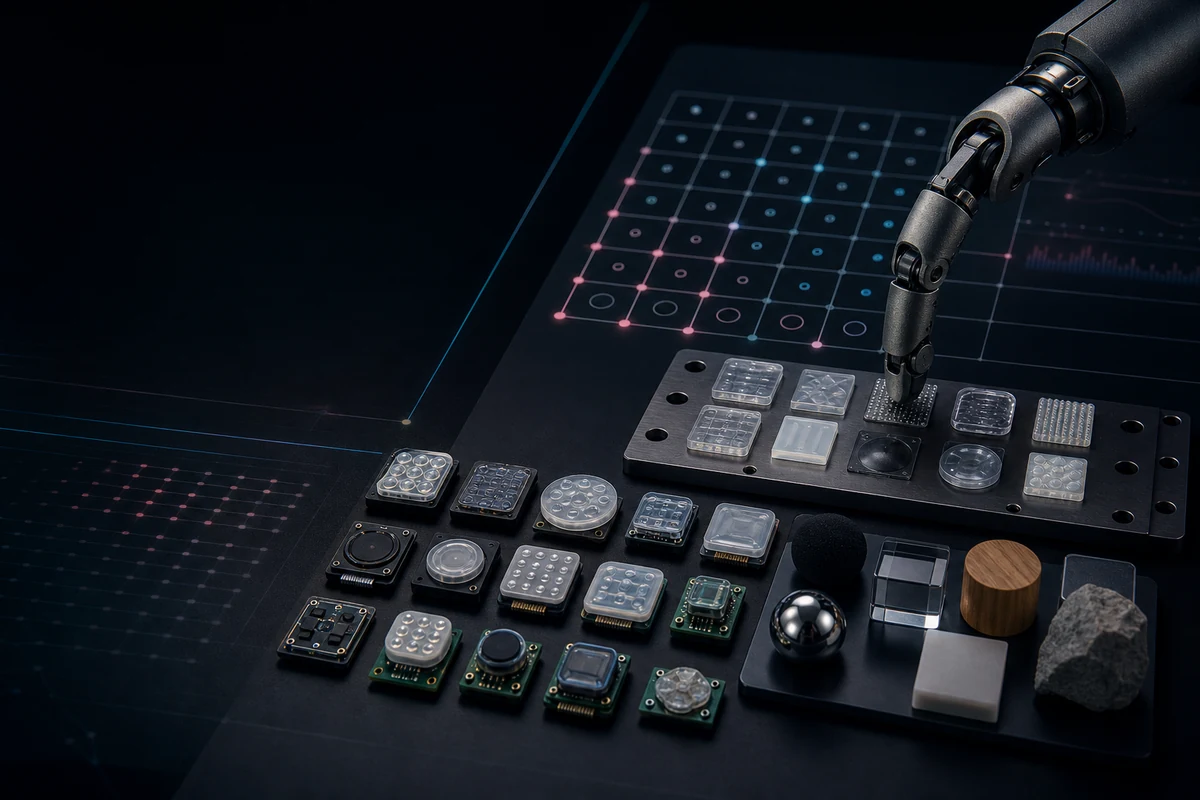 Tactile datasets / 2026-08-22PRISM maps 5,000+ contact-rich industrial robot trajectoriesPRISM reports 5,000+ robot trajectories across 25+ industrial tasks, but tactile observations cover only a subset and the announced dataset download is not yet available.
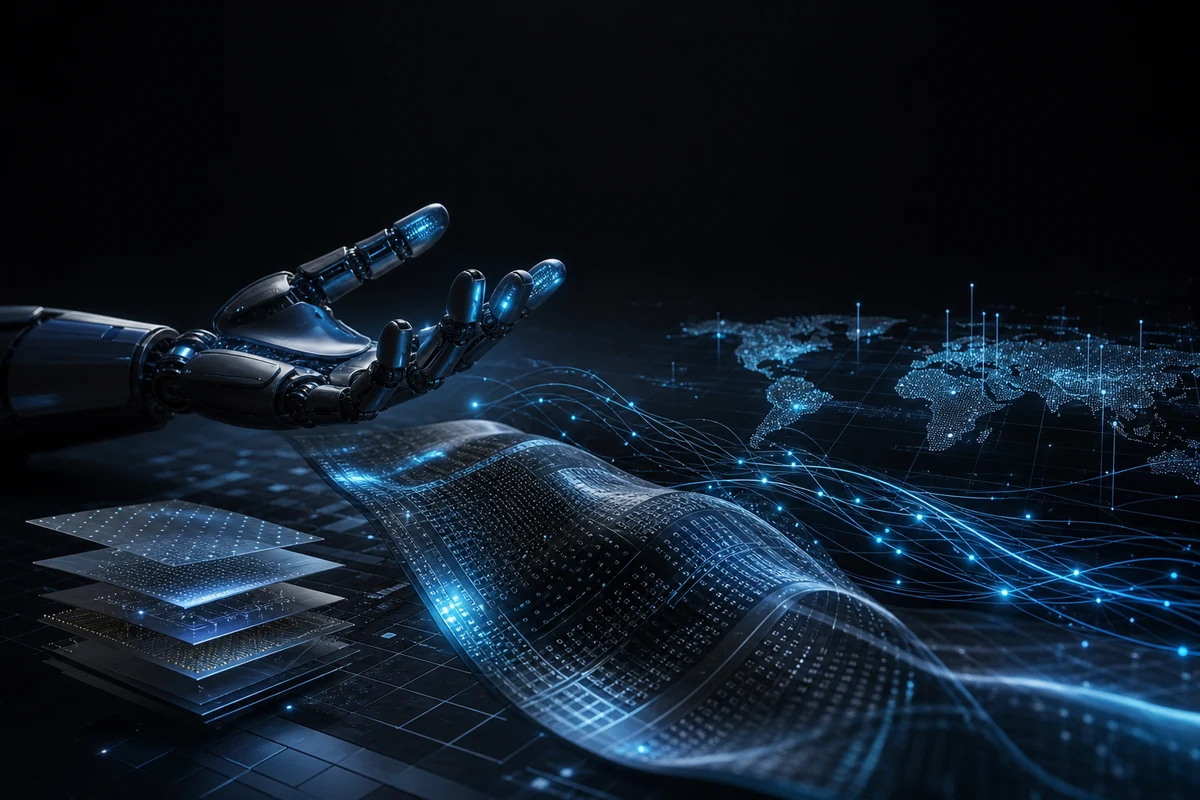 Tactile AI / 2026-08-22HT-Bench full-hand tactile benchmark for robot manipulationHT-Bench v2 pairs egocentric vision with millions of full-hand tactile frames, corrects the vision-to-tactile metric split, and adds four real-robot evaluations.
 Tactile Data / 2026-08-22FreeTacMan robot-free visuo-tactile data collection for tactile AIA research note on FreeTacMan, robot-free visuo-tactile datasets, tactile AI data collection, and why robot skin models need contact diversity.Tactile AI / 2026-08-15Dream-Tac: A Unified Tactile World Action Model for Contact-Rich Robot ManipulationDream-Tac models action-conditioned tactile futures for contact-rich robot manipulation, showing why robot skin data needs prediction, not only reaction.Tactile manipulation / 2026-08-22T-Rex adds high-rate tactile reaction to dexterous robot policiesT-Rex reports a 100-hour collection and a 30-point gap over EgoScale; its official release now provides code, checkpoints, and an approximately 50-hour public subset.Tactile world models / 2026-08-21HiTac-WAM forecasts contact, deformation, and slip before robot actionHiTac-WAM ranks candidate robot actions with hierarchical tactile forecasts, then checks predicted touch against measured touch during execution.Tactile benchmarks / 2026-08-21TactiDex benchmarks contact-level human-to-robot dexterityTactiDex aligns whole-hand tactile signals with kinematic and object states to evaluate physically grounded human-to-robot dexterous transfer.
Common questions
FAQ for this topic
What is robot manipulation?
Robot manipulation is the use of an arm, hand, gripper, tool, or whole body to intentionally change an object or environment through physical action.
What is dexterous manipulation?
Dexterous manipulation uses coordinated contacts and motion to perform tasks such as reorientation, multi-finger control, tool use, or handling objects with tight physical constraints.
Why is tactile sensing useful for robot manipulation?
Touch exposes local contact, pressure, shear, slip, deformation, seating, and hidden motion after contact begins, especially when the hand or object occludes vision.
How should robot manipulation systems be evaluated?
Align the robot, end effector, task, inputs, data, controller, objects, trials, success criteria, interventions, and failure reporting before comparing results.