Application guide
Humanoid robot skin and whole-body tactile sensing
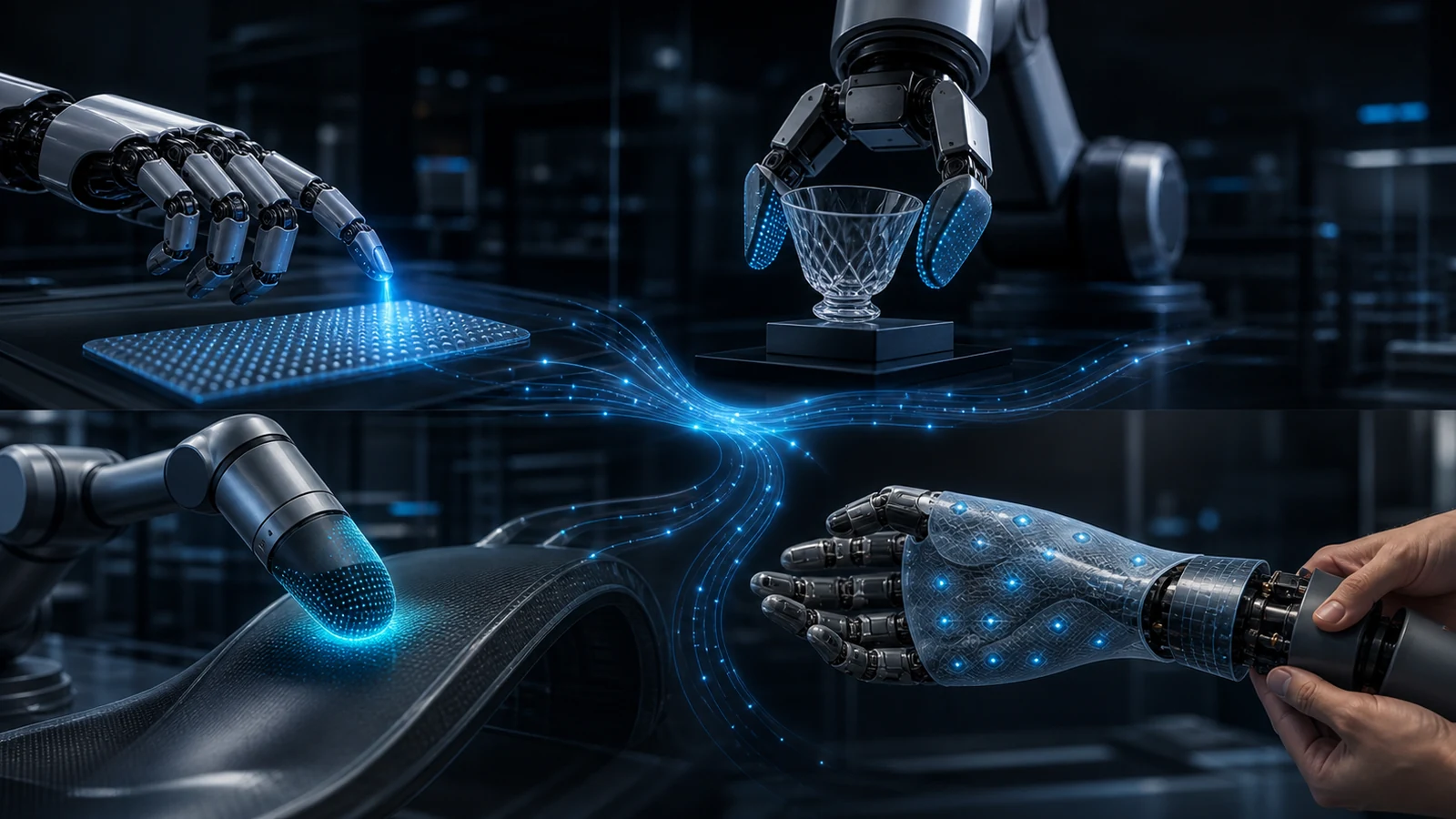
Humanoid robot skin brings tactile sensing to hands, arms, and body surfaces. Map the whole-body tactile stack, safety boundaries, sensors, datasets, and research.
Updated 2026-08-18 by RoboSkin.ai Editorial Team
- 8
- sections
- 3
- questions
- 10
- next routes
Short answer
What you need to know
- 1
Humanoid robot skin is tactile sensing applied to hands, palms, arms, feet, or other humanoid robot surfaces where contact awareness matters.
- 2
The strongest use cases include dexterous manipulation, grasp stability, handovers, safety contact, plantar support, and research evaluation for Physical AI.
- 3
A humanoid skin system must handle curved geometry, moving joints, cable routing, calibration, and synchronization with robot state.
Topic 01
Why humanoid hands need touch
A humanoid hand can move without understanding contact. Touch sensing helps it know whether an object is seated, sliding, deforming, or being pressed too hard.
This matters because hands often occlude the object from cameras during manipulation. Tactile data gives the robot a local signal at the surface where the interaction is happening.
- Detect early slip before a grasp fails
- Estimate contact location across fingertips, palm, and side surfaces
- Support safer force-limited interaction around people and objects
- Create tactile logs for evaluation, replay, and model improvement
Topic 02
Humanoid surface constraints
Humanoid surfaces are difficult because they are curved, segmented, and mobile. A skin that works on a flat coupon can fail when wrapped around a finger joint or stretched over a palm.
Teams should evaluate coverage, replacement strategy, signal drift, data rate, and how contact maps are registered to the robot model.
Topic 03
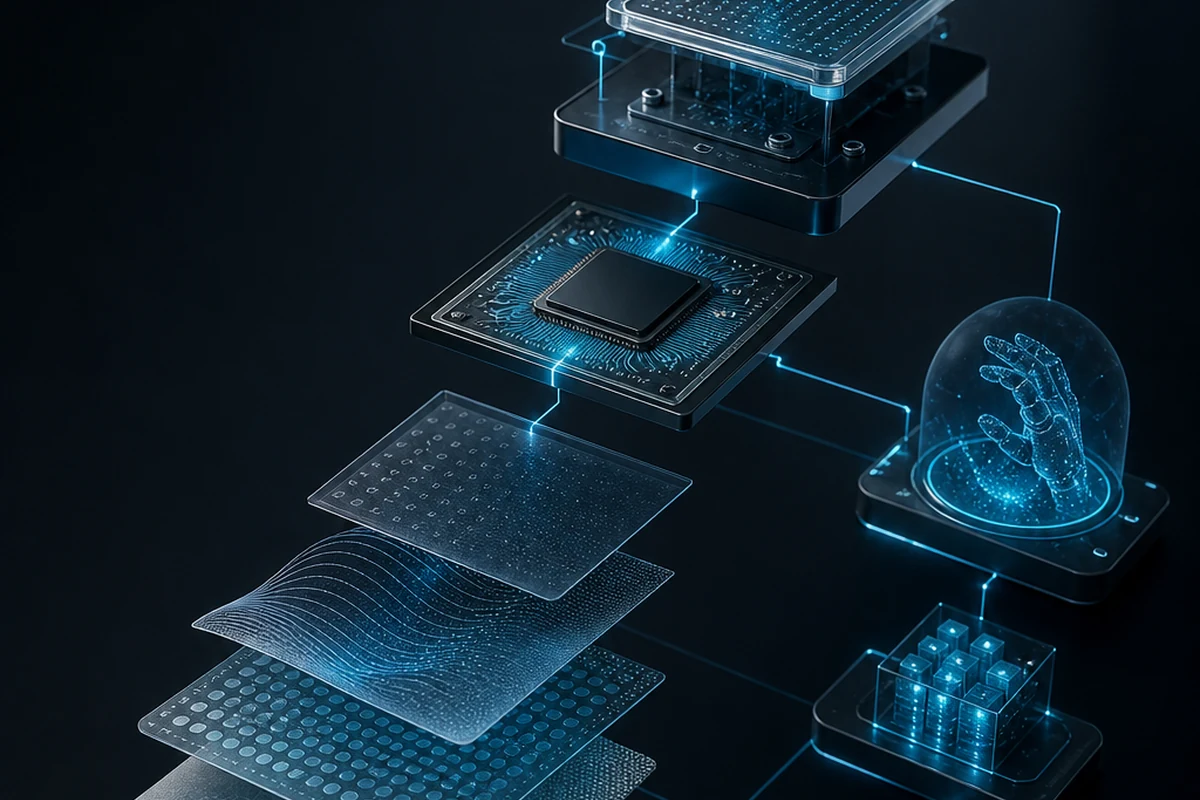
The complete humanoid tactile stack
A humanoid tactile system is a chain, not a sheet of sensing material. Contact must survive mechanical coupling, sensor readout, signal conditioning, representation learning, and control before it can improve safety or manipulation.
| Stage | System responsibility | Failure to test |
|---|---|---|
| Physical contact | Define the object, body zone, direction, duration, and disturbance. | Bench presses may not represent sliding, impact, multi-contact, or human interaction. |
| Robot skin | Conform to fingers, palms, arms, joints, or body panels while remaining serviceable. | Flat-sample performance may collapse after wrapping, stretching, wear, or replacement. |
| Tactile sensor | Measure pressure, force, shear, slip, vibration, temperature, proximity, or contact geometry. | A modality name does not establish range, resolution, repeatability, or crosstalk. |
| Signal processing | Calibrate, filter, timestamp, compress, and diagnose sensor state. | Drift or timing error can look like contact change. |
| Tactile representation | Map distributed signals into robot coordinates, graphs, images, events, or learned features. | A model can learn sensor layout artifacts instead of transferable contact. |
| AI model | Infer contact state, predict outcomes, or propose actions. | Offline accuracy may not improve real-robot behavior. |
| Robot control | Change grip, motion, compliance, recovery, or stop behavior. | Latency can make an otherwise accurate signal unusable. |
| Safety or manipulation outcome | Measure the intended task result under repeated and disturbed trials. | A research demonstrator is not automatically a certified safety system. |
Topic 04
Whole-arm tactile sensing extends coverage beyond the hand
A July 2026 Nature Sensors article reports EmArm, a robotic arm that combines large-area soft tactile skins, proprioception, and a closed-loop perception-action framework. The authors report submillimetre tactile localization, real-time feature extraction, touch-based intention recognition, contact-rich manipulation, and tactile-driven trajectory replanning under visual occlusion and environmental disturbances.
The useful systems lesson is that body-scale robot skin needs a registered sensorimotor loop. Contact location must map to the arm geometry, synchronize with joint state, and reach a controller quickly enough to change motion. The paper demonstrates one integrated route; it does not establish the same accuracy, durability, or safety performance for every humanoid surface or deployment environment.
- Register skin coordinates to links, joints, and robot frames
- Measure localization and control latency under realistic disturbances
- Test contact-aware replanning when vision is occluded
- Separate source-reported system results from broader humanoid safety claims
Topic 05
Plantar tactile sensing verifies support after touchdown
Tac4Loco extends humanoid tactile sensing to the feet. The August 2026 preprint maps 60 FSR measurements per foot into shared ordinal pressure levels, learns spatial and temporal support features, and supplies those features to a Unitree G1 locomotion policy at 50 Hz.
The reported physical comparisons include ramp edges, lateral ascent, slope transitions, a V-shaped trench, foam, and gravel. This is post-contact evidence: the insoles reveal the support realized after touchdown. They do not preview terrain, replace vision, or establish arbitrary-terrain generalization. The results remain tied to one preprint, robot, sensor layout, and small physical trial sets.
- Map foot-pressure topology instead of collapsing contact into one total force value
- Synchronize bilateral pressure, proprioception, policy inference, and low-level motor control
- Test partial support, asymmetry, compliance, transitions, and sensor dropout separately
- Keep completion, survival, tracking, drift, and qualitative terrain evidence as distinct metrics
Topic 06
How to evaluate a humanoid robot skin claim
The right question is not whether the skin detects touch in isolation. The useful question is whether it improves a humanoid task under realistic constraints.
Evaluation should include grasp changes, handovers, occluded contact, repeated loading, surface wear, and synchronization with joint state or vision.
Topic 07
Coverage should follow contact risk and task value
Whole-body tactile sensing does not require identical taxel density everywhere. Fingertips and palms may need high spatial and temporal detail for manipulation; forearms and upper arms may prioritize distributed collision localization; torso or shell panels may use lower-resolution contact events. Coverage, wiring, bandwidth, compute, replacement, and control value must be designed together.
The evidence base is still heterogeneous. Full-hand systems, modular full-body e-skin, and whole-arm skin each answer different questions, so the site keeps them as related entity types rather than implying one standard humanoid skin architecture.
Topic 08
Robot safety skin is a claim boundary, not a material label
A skin can contribute contact information to a safety strategy, but safety depends on the complete sensing, diagnostics, controller, stopping behavior, mechanical system, operating mode, and validation process. A paper showing contact localization or trajectory replanning should not be rewritten as a certification claim.
For research comparison, report contact type, body coverage, latency, fault handling, repeated trials, disturbance conditions, and the exact robot response. For deployment, separate research evidence from any application-specific safety assessment.
Paper routes
Start with source-backed RoboSkin briefs
 Humanoid tactile sensing / 2026-08-18Tac4Loco uses plantar pressure to adapt humanoid locomotionTac4Loco turns bilateral plantar pressure maps into post-contact feedback for Unitree G1 locomotion on slopes, partial support, foam, and gravel.
 Tactile AI / 2026-08-22HT-Bench full-hand tactile benchmark for robot manipulationHT-Bench v2 pairs egocentric vision with millions of full-hand tactile frames, corrects the vision-to-tactile metric split, and adds four real-robot evaluations.Tactile Data / 2026-08-22GIST humanoid visual-tactile-action dataset maps 101.9K soft-object samplesThe GIST preprint reports 101.9K visual-tactile-action samples for towel and sponge manipulation, with dense hand touch, two camera views, and explicit access limits.
 Dexterous Manipulation / 2026-05-14Full-hand tactile sensing for adaptive dexterous graspingA research-oriented explanation of why full-hand tactile coverage matters for adaptive grasping, occluded manipulation, and contact-aware robot hands.
Common questions
FAQ for this topic
Does a humanoid robot need full-body robot skin?
Not always. Hands, palms, arms, gripper-like end effectors, or high-contact body zones may matter more than uniform full-body coverage.
What is the difference between fingertip sensing and full-hand skin?
Fingertip sensing can support pinch tasks. Full-hand coverage can capture palm, side, and multi-contact patterns that appear in power grasps and handovers.
What should I read next?
Start with robot skin for the definition, tactile AI for the stack, and robot skin papers for source-backed research routes.