Physical AI: perception, reasoning, action, and feedback
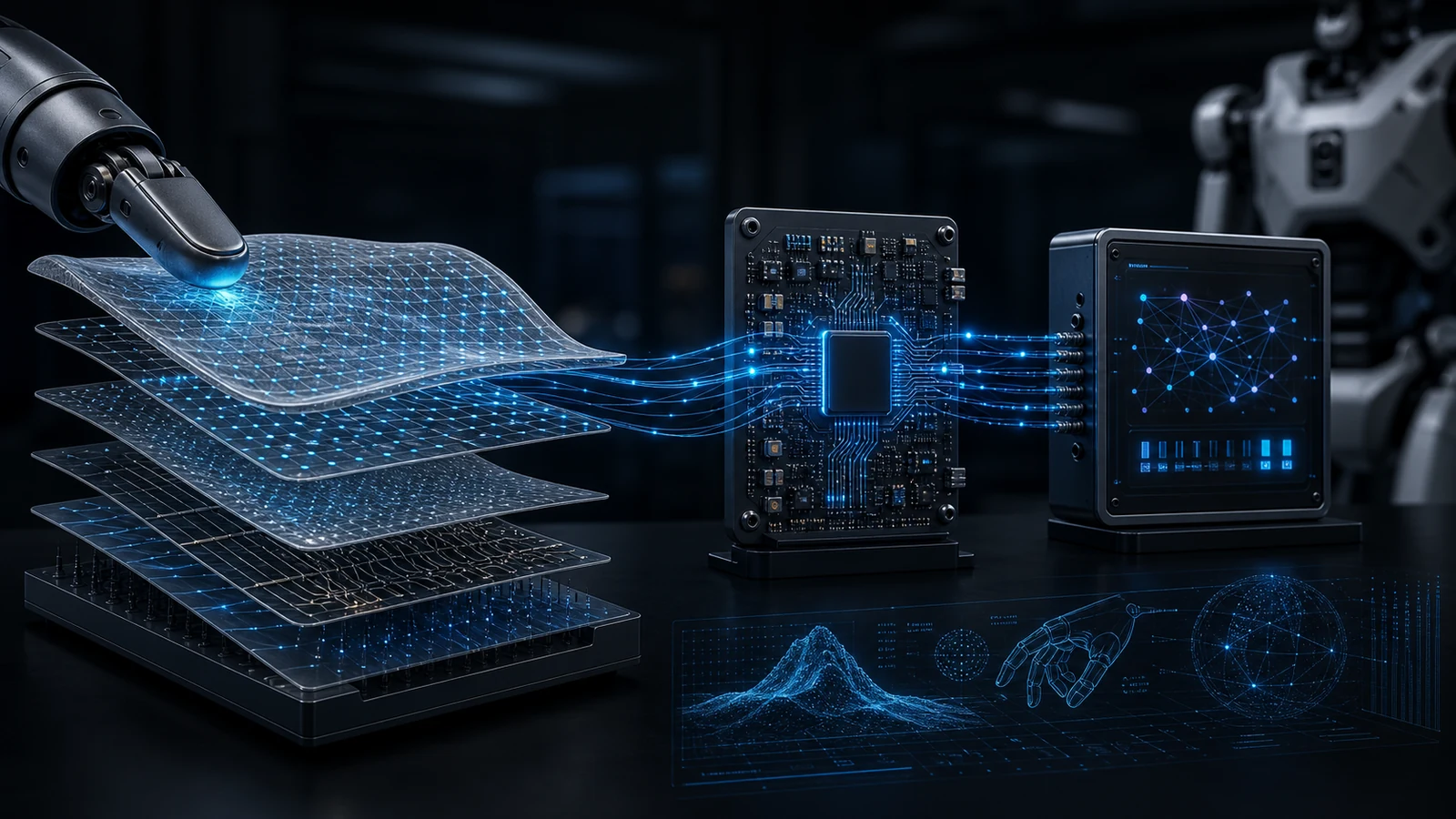
Physical AI is a broad term for AI systems that perceive, reason, and act through physical machines. The AI model is one layer; the complete system also includes sensors, embodiment, policies, control, actuators, integration, safety, and measured feedback.
RoboSkin.ai maps that full system, then follows touch into the contact-specific layer. It does not treat Physical AI as one standardized architecture or use a model label as proof of real-world capability.
Direct answer
AI supplies perception, learning, prediction, reasoning, or action selection. Robotics supplies the physical body, sensing, control, actuation, integration, and safety. Physical AI is the closed system that connects those layers to real-world action and feedback.
System loop
From observation to physical outcome
A useful map is goal → observation → state and reasoning → policy → control → physical action → measured feedback. Implementations may combine stages, but evidence should still identify each interface.
01
Perceive
Vision, depth, audio, proprioception, force, and touch provide complementary observations with hardware-specific limits.
02
Reason and predict
Representations, embodied reasoning, planners, and world models estimate state, possible futures, or useful subgoals.
03
Select and execute
A policy selects an action; controllers, actuators, and the robot body execute it within physical and safety constraints.
04
Measure feedback
New observations establish contact, motion, error, intervention, recovery, and task outcome rather than assuming success.
Architecture boundaries
What each layer does—and does not prove
| Layer | Primary role | Typical output | Evidence boundary |
|---|---|---|---|
| VLM | Connects vision with language and semantic knowledge. | Text, labels, representation, or scene interpretation. | Direct physical action is not established by the VLM label. |
| Embodied reasoning | Reasons about space, state, affordances, task steps, or plans. | Subgoal, plan, pose, code, or tool call. | A proposed plan is not evidence of safe robot execution. |
| VLA or robot policy | Maps observations and goals to actions in a documented action space. | Waypoint, pose, joint, gripper, or action chunk. | Generalization remains bounded by data, embodiment, and evaluation. |
| World model | Predicts future observations, state, contact, reward, or outcome under an action. | Predicted rollout or transition. | Prediction does not necessarily select or execute an action. |
| Robot control | Tracks motion or force commands and regulates the physical system. | Trajectory, torque, motor command, or protective response. | A high-level model does not replace the controller. |
| Touch feedback | Measures physical interaction after an action reaches an object or surface. | Pressure, force, shear, slip, vibration, tactile image, or contact event. | A sensor signal alone does not prove intelligent or safer behavior. |
Term boundary
Physical AI and embodied AI overlap
Embodied AI can include physical robots, simulated agents, and virtual bodies. Physical AI usually emphasizes AI connected to real machines and physical dynamics. Neither term identifies a single model, benchmark, control stack, or safety standard.
Compare AI and robotics roles ->Contact-specific child
Touch grounds action in physical contact
Vision and language provide scene and semantic context. Proprioception reports the robot body. Robot skin and tactile sensors can measure what happens at the contact surface. The dedicated touch page covers calibration, synchronization, tactile models, control, and evidence boundaries.
Open Physical AI and touch ->Evaluation checklist
Audit a Physical AI claim from hardware to outcome
- Which robot, sensors, end effector, action representation, and controller were used?
- Which observations entered each model, and what did each component actually output?
- What training data, simulation, demonstrations, interventions, and held-out conditions were used?
- Was evaluation performed in simulation, on physical hardware, or both—and across how many trials?
- How were resets, human corrections, failures, recovery, force, damage, time, and success recorded?
- Is the result a provider demonstration, an author-reported study, a peer-reviewed study, or independent reproduction?
Common questions
Physical AI FAQ
What is Physical AI?
Physical AI is a broad industry term for AI systems that perceive, reason, and act through physical machines. A complete system can include sensors, learned or engineered models, planning, robot policies, controllers, actuators, safety functions, and measured feedback.
How is Physical AI different from embodied AI?
The terms overlap, but they are not exact synonyms. Embodied AI can include physical robots as well as simulated or virtual agents. Physical AI usually emphasizes AI connected to real machines, physical dynamics, and real-world action.
Is a VLA model a complete Physical AI system?
No. A vision-language-action model can map observations and instructions to robot actions, but a deployed system still depends on the robot body, sensors, action interface, control, integration, safety, and evaluation protocol.
Why does touch matter for Physical AI?
Touch can measure local contact, pressure, shear, slip, vibration, or deformation that vision and language do not directly observe. It becomes useful when calibrated, synchronized signals change a model, policy, controller, or evaluation result.
Does an AI model replace robot control and safety engineering?
No. High-level perception, reasoning, or policy outputs do not remove the need for state estimation, motion and force control, actuator limits, system integration, protective functions, and task-specific safety validation.