High-interest robotics pillar
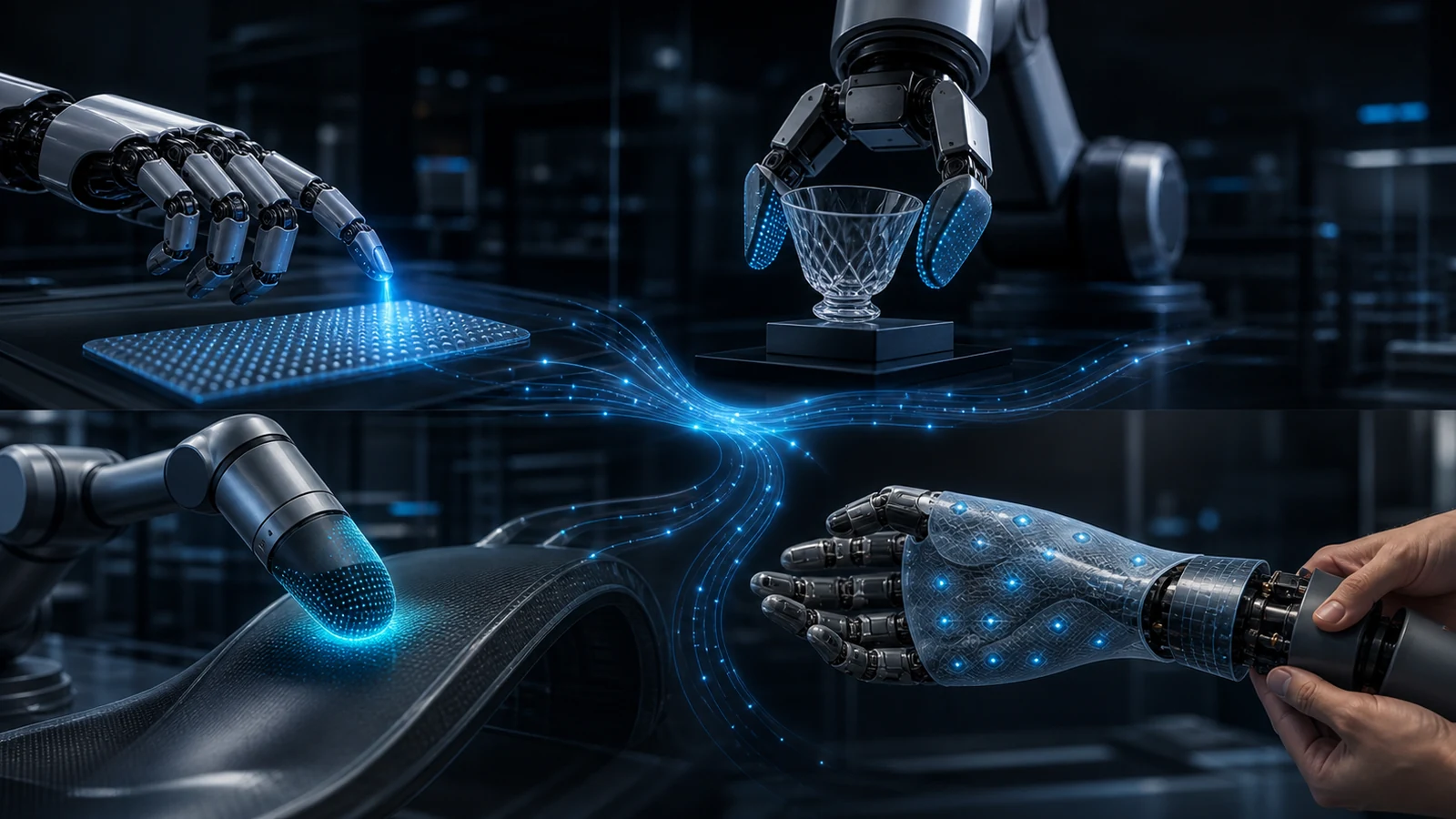
Humanoid robots: intelligence, manipulation and touch
Understand humanoid robots through perception, robot learning, whole-body control, dexterous hands, safety, tactile sensing, and Physical AI evidence.
- 6
- sections
- 4
- questions
- 9
- next routes
Short answer
What you need to know
- 1
A humanoid robot is a physical robot whose body plan or capabilities are designed around human-scale environments, often including a torso, arms, hands or grippers, and legs or another mobile base.
- 2
The humanoid robotics stack combines perception, embodied reasoning, planning, whole-body control, manipulation, hardware, data, simulation, and safety. A human-like shape does not by itself make a robot autonomous or general purpose.
- 3
Touch matters when a humanoid must grasp, insert, hand over, balance on uncertain support, or detect contact with a person or object. Robot skin and tactile sensors provide contact evidence that vision and proprioception may not expose directly.
Topic 01
What makes a robot humanoid
Humanoid usually describes embodiment rather than intelligence. A system may resemble a person in body layout while still executing narrow, pre-programmed, teleoperated, or carefully staged tasks. Useful comparisons must separate body form, mobility, manipulation, autonomy, and evidence.
Human-centered environments motivate the form factor: doors, shelves, tools, stairs, workstations, and handover spaces were designed around human reach and motion. That creates opportunities for shared infrastructure but also difficult requirements for balance, dexterity, reliability, energy use, and safe contact.
Topic 02
The humanoid robotics stack
A humanoid is a system of coupled layers. Progress in one layer does not prove readiness in the others, so research and product claims should identify the complete tested stack.
| Layer | Primary job | Questions to verify | Touch connection |
|---|---|---|---|
| Perception | Estimate people, objects, geometry, motion, and contact context | Which sensors, conditions, latency, and failure cases were tested? | Touch adds local pressure, shear, slip, and contact events |
| Reasoning and planning | Translate goals into feasible task and motion sequences | Is planning online, scripted, or assisted by a human? | Contact state can confirm whether a planned step physically succeeded |
| Whole-body control | Coordinate balance, locomotion, reach, and manipulation | Which body, terrain, speed, load, and disturbances were evaluated? | Foot and body contact can expose support and collision state |
| Hands and end effectors | Grasp, insert, reorient, operate tools, and hand over objects | Is the result gripper-level, multi-finger, bimanual, or full-body? | Fingertip and palm sensing supports grasp and slip feedback |
| Safety and evaluation | Limit hazardous behavior and measure repeatability | Are stops, recovery, human proximity, force, and failure rates reported? | Distributed contact sensing can contribute to a layered safety system |
Topic 03
High-interest research lanes
Current humanoid coverage spans foundation models, vision-language-action policies, embodied reasoning, whole-body control, dexterous manipulation, simulation, synthetic data, teleoperation, and safety. These labels describe different engineering roles and should not be collapsed into one ranking.
- Whole-body locomotion and loco-manipulation across uneven or constrained spaces
- Dexterous and bimanual manipulation with hands, grippers, tools, and deformable objects
- Robot learning from demonstrations, human video, simulation, and multi-robot datasets
- Vision-language-action models and embodied reasoning for instruction-conditioned behavior
- Safety, reliability, cycle time, recovery, maintainability, and human-robot interaction
Topic 04
Why touch is a strategic gap
Vision is valuable before contact and proprioception measures the robot’s internal configuration, but neither directly measures every event at a covered fingertip, palm, foot, arm, or body surface. Contact can be occluded, compliant, distributed, or too local to infer reliably from an external camera.
The tactile route is not touch instead of vision. It is synchronized vision, language, proprioception, force or torque, and surface touch, followed by an action or safety response whose value is tested against a matched baseline.
Topic 05
How to evaluate humanoid claims
A useful humanoid result identifies the embodiment, task, environment, autonomy level, sensing inputs, control frequency, number of trials, baseline, intervention policy, and failure modes. A demonstration video can establish that an event occurred; it does not establish generality, reliability, or deployment readiness.
- Separate tabletop manipulation, mobile manipulation, and whole-body humanoid control
- Record whether the system was autonomous, teleoperated, reset by a person, or selected from multiple trials
- Report task success with speed, force, damage, recovery, and out-of-distribution conditions where relevant
- Treat company demonstrations, preprints, peer-reviewed papers, benchmarks, and deployments as different evidence levels
Topic 06
2026 field signals and evidence boundaries
The International Federation of Robotics lists AI and autonomy among its 2026 industry trends and discusses humanoid reliability and efficiency as conditions for industrial competition. NVIDIA’s official humanoid materials emphasize data, simulation, foundation models, onboard compute, dexterous hands, and deployment workflows. Google DeepMind’s Gemini Robotics 2 announcement describes VLA, embodied reasoning, whole-body control, and manipulation across multiple embodiments.
These are important field signals, not proof that all humanoids share the same capabilities. RoboSkin.ai uses them to map the stack, then routes touch-specific claims to source-backed robot-skin, hand, dataset, benchmark, and manipulation pages.
Paper routes
Start with source-backed RoboSkin briefs
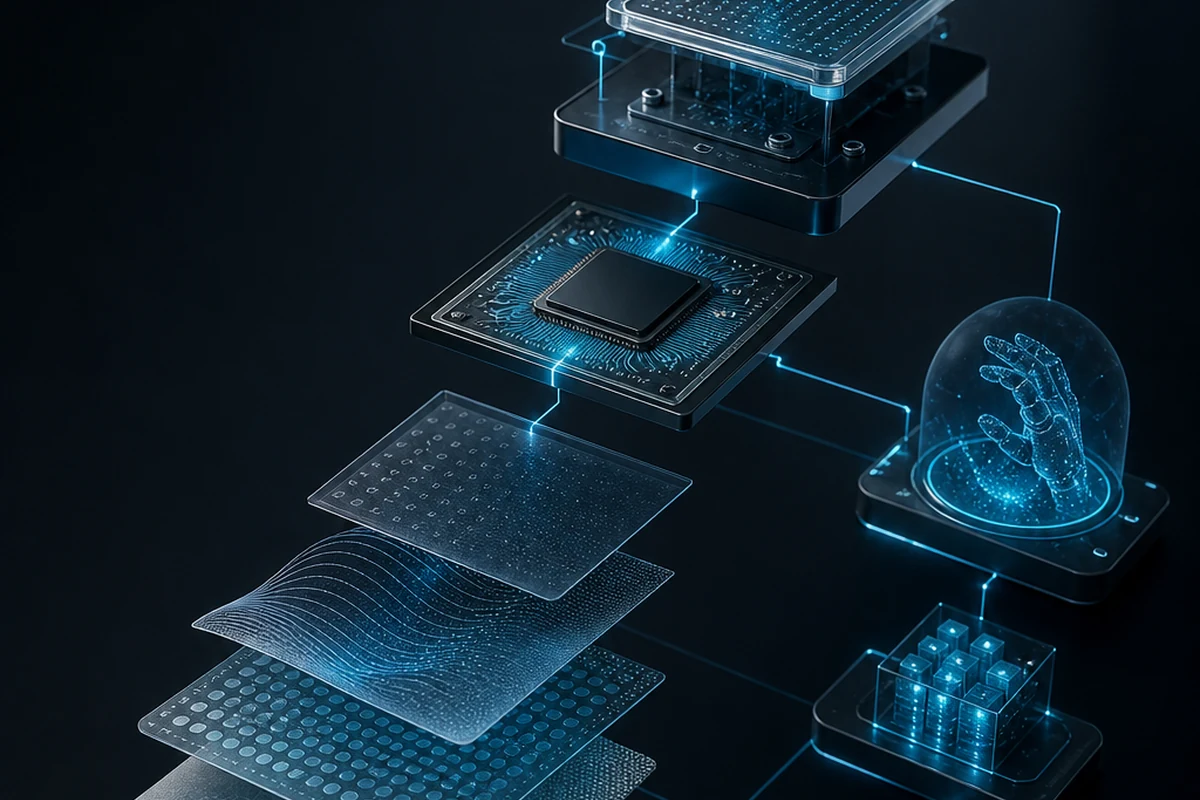 Humanoid tactile sensing / 2026-08-18Tac4Loco uses plantar pressure to adapt humanoid locomotionTac4Loco turns bilateral plantar pressure maps into post-contact feedback for Unitree G1 locomotion on slopes, partial support, foam, and gravel.
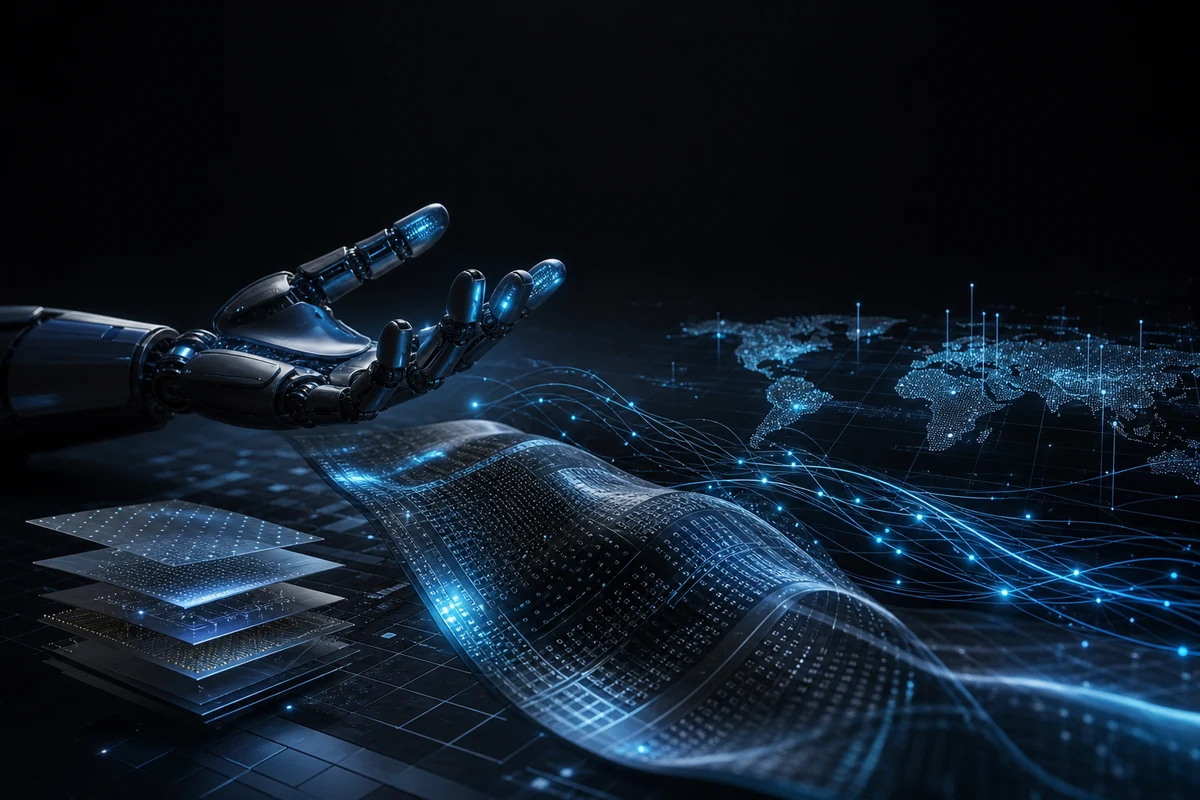 Tactile AI / 2026-08-22HT-Bench full-hand tactile benchmark for robot manipulationHT-Bench v2 pairs egocentric vision with millions of full-hand tactile frames, corrects the vision-to-tactile metric split, and adds four real-robot evaluations.Tactile Data / 2026-08-22GIST humanoid visual-tactile-action dataset maps 101.9K soft-object samplesThe GIST preprint reports 101.9K visual-tactile-action samples for towel and sponge manipulation, with dense hand touch, two camera views, and explicit access limits.
Common questions
FAQ for this topic
What is a humanoid robot?
A humanoid robot uses a human-related body plan or capability set to operate in human-scale environments. The term describes embodiment and does not automatically mean the robot is autonomous or general purpose.
Why do humanoid robots need tactile sensing?
Touch can expose contact, pressure, shear, slip, seating, support, and collision events at hands, feet, arms, and body surfaces when vision or proprioception is incomplete.
Are humanoid robots the same as Physical AI?
No. Humanoids are one embodiment of Physical AI. Physical AI also includes other robots and autonomous machines that perceive, reason, and act in the physical world.
What should a humanoid robot benchmark report?
It should identify the robot, task, environment, autonomy level, inputs, baseline, trials, success criteria, interventions, and failure modes. Hardware and software versions also matter.