Tactile AI pillar
Tactile manipulation: from contact to robot action
Learn how tactile manipulation turns contact, pressure, shear, and slip into closed-loop robot actions for grasping, insertion, dexterity, and Physical AI.
Published | Updated by RoboSkin.ai Editorial Team
- 7
- sections
- 4
- questions
- 9
- next routes
Short answer
What you need to know
- 1
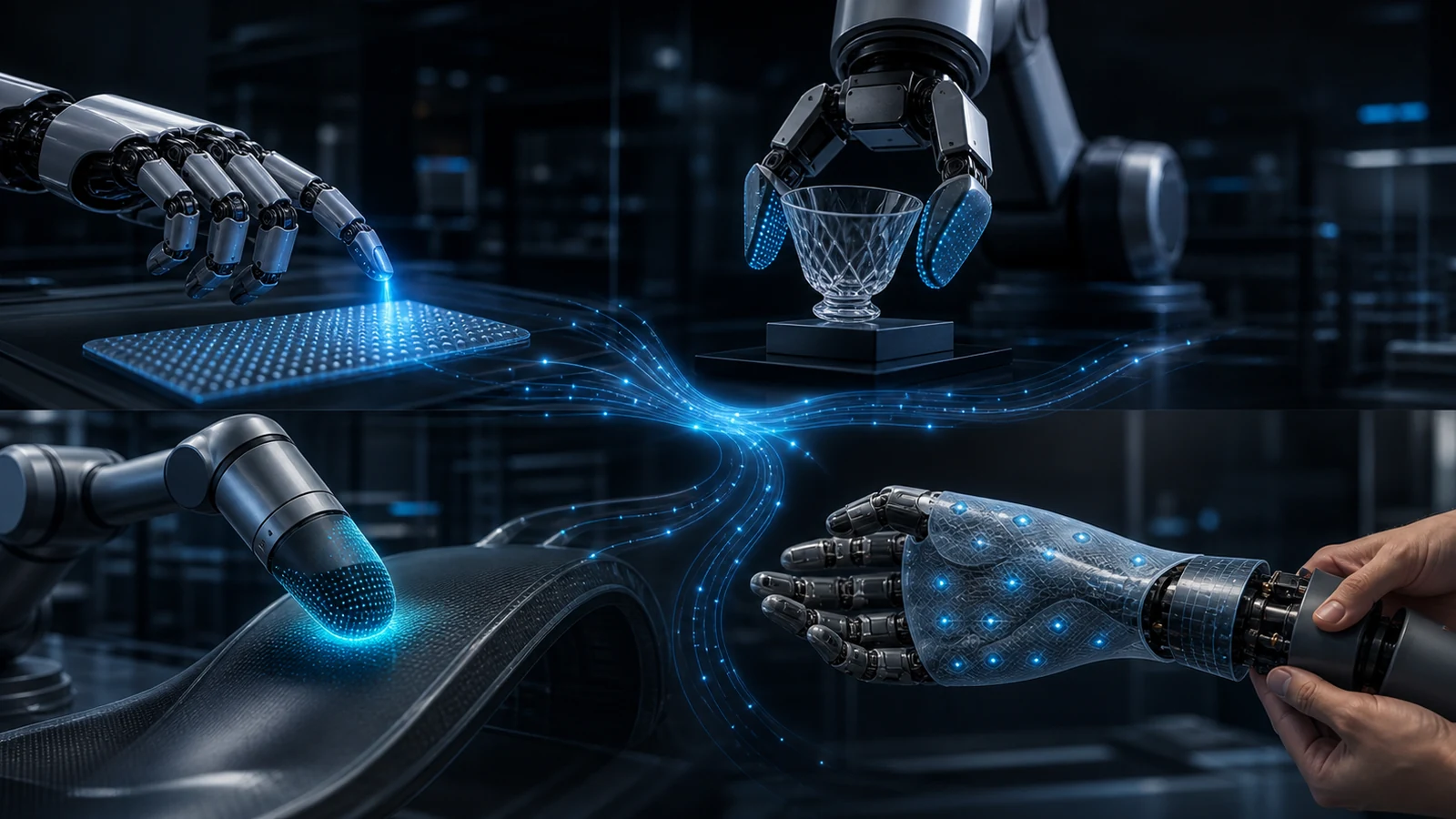
Tactile manipulation is robot manipulation that uses measured contact to estimate physical state and change an action. The loop is contact → sensor → tactile representation → state estimate or policy → robot command → new contact.
- 2
Touch is most useful after vision becomes ambiguous: during grasp closure, slip, occluded insertion, deformable-object handling, and contacts whose force or stability cannot be inferred reliably from an external image.
- 3
A tactile model is not enough. Useful manipulation requires synchronized robot state, low-latency sensing, a controller or policy that can act on touch, and task-level evidence against a no-touch baseline.
Topic 01
The tactile manipulation control loop
Physical contact changes a sensor surface or taxel array. The system timestamps and preprocesses that signal, estimates a contact state or embedding, then changes grip force, pose, trajectory, or recovery mode. The action creates the next contact observation, closing the loop.
| Layer | Question | Typical output | Failure if omitted |
|---|---|---|---|
| Contact and sensor | What happened at the interface? | Pressure, shear, slip cue, vibration, image, or contact event | The controller acts without direct physical evidence |
| Alignment and representation | Which robot state and action produced the touch? | Timestamped feature, contact map, or multimodal latent | The model learns spurious or delayed associations |
| State or policy | What does contact mean for the current task? | Pose correction, stability estimate, tactile subgoal, or action | Rich touch data never changes behavior |
| Control and recovery | How should the robot respond now? | Force, velocity, joint, gripper, or mode command | Detection arrives but cannot prevent a drop, jam, or unsafe force |
Topic 02
Where tactile manipulation changes the task
Touch should be added where it resolves a physical uncertainty. More sensor channels are not automatically useful; the controller must connect a specific tactile event to a specific action or recovery rule.
- Grasp stabilization: detect incipient slip and adjust grip before a drop
- Insertion and assembly: infer contact direction, jamming, seating, and alignment under occlusion
- In-hand manipulation: track local object motion while fingers reorient or roll an object
- Deformable and fragile objects: regulate contact without relying on appearance alone
- Surface following and tool use: maintain contact state across geometry and disturbances
Topic 03
Model roles in tactile manipulation
A tactile encoder compresses sensor observations. A state estimator predicts variables such as contact location, pose, force, or slip. A policy maps observations to actions. A world model predicts future contact under candidate actions. These roles may share a backbone, but the labels are not interchangeable.
Foundation-model language should be reserved for systems with broad pretraining and demonstrated downstream transfer. A strong policy on a small task suite can be valuable without being a foundation model.
Topic 04
Evidence ladder for touch-guided control
Evidence becomes stronger as it moves from sensor visualization to real robot outcomes. The most useful result connects a tactile signal to an action and then shows repeatable improvement under held-out objects, disturbances, sensor replacement, or other deployment-relevant variation.
- Level 1: raw signal responds to contact under controlled loading
- Level 2: perception metric on independent contacts, objects, or sensors
- Level 3: offline policy or prediction result on held-out trajectories
- Level 4: closed-loop robot improvement over a matched no-touch baseline
- Level 5: repeated transfer across tasks, hardware instances, and real operating conditions
Topic 05
Tactile feedback to a human operator
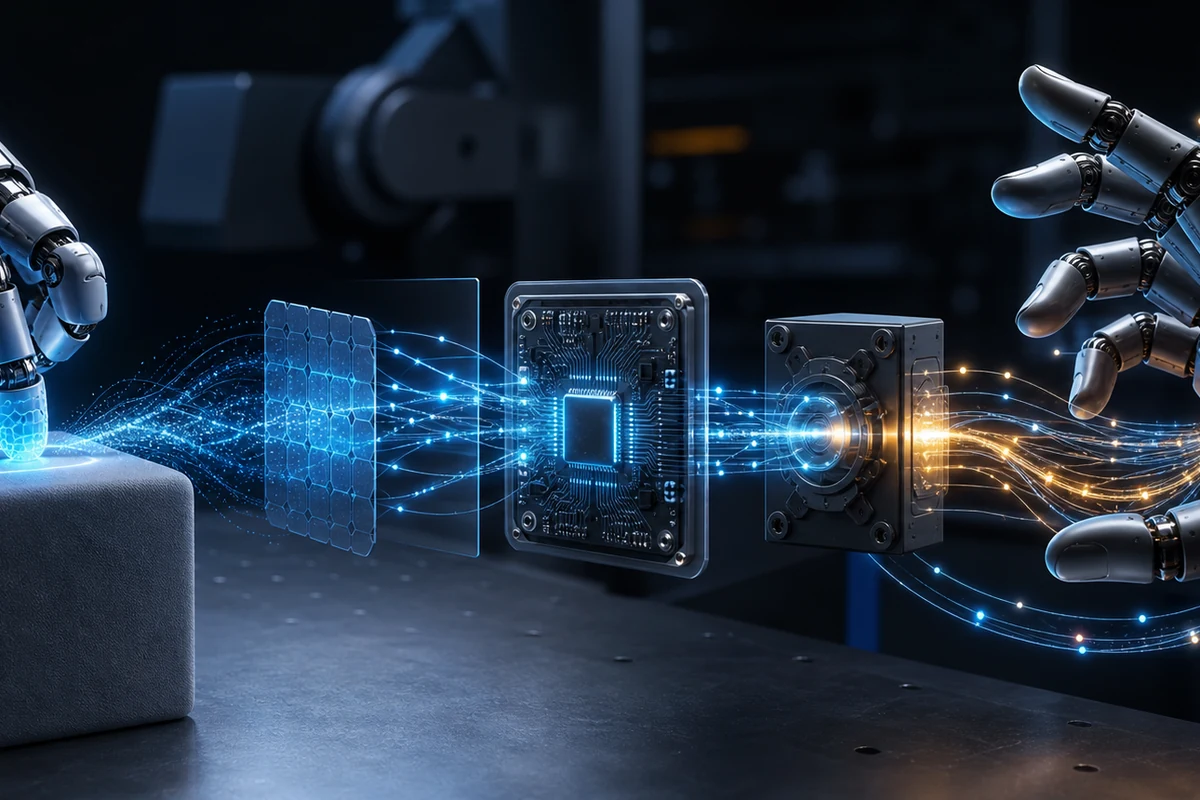
Tactile information can also close a human-in-the-loop control path. The Missing Touch study maps GelSight Mini contact images to a 32-DoF fingertip display and reports more natural, consistent motion in two 2-DoF teleoperation tasks. It measures operator trajectories, not an autonomous tactile policy, and it does not establish the same effect for multifinger robot hands or complex dexterous manipulation.
This distinction matters: feedback rendered to a human can improve how demonstrations are collected, while autonomous tactile manipulation still requires a trained model or controller and closed-loop robot evaluation.
Topic 06
Open research problems
Tactile manipulation still faces hardware diversity, limited shared datasets, inconsistent evaluation, calibration drift, contact-sequence leakage, and weak transfer across sensors and embodiments. Whole-hand and humanoid systems also add bandwidth, wiring, coverage, and safety constraints.
The practical research direction is not touch instead of vision. It is aligned vision, language, proprioception, and touch with an evaluation that shows which modality changes which physical outcome.
Topic 07
Prepare tactile feedback before a manipulation trial
For tactile sensing in robotics, a plausible heatmap is only an observation. Define the calibrated quantity, clock alignment, contact validity and task outcome before evaluating a grasp or insertion. Keep a sensor acquisition failure separate from a policy action failure.
Use reference measurements to assess the sensor, preserve missing data in processing, and record observation/action episodes for later inspection. The synthetic tutorials teach the data workflow; real manipulation outcomes still need a robot, reference protocol and repeated trials.
Paper routes
Start with source-backed RoboSkin briefs
 Robot teleoperation / 2026-08-22The Missing Touch tests spatial tactile feedback in robot teleoperationA GelSight Mini and 32-DoF fingertip display made two teleoperation tasks more natural and consistent, but no autonomous robot policy was trained or evaluated.
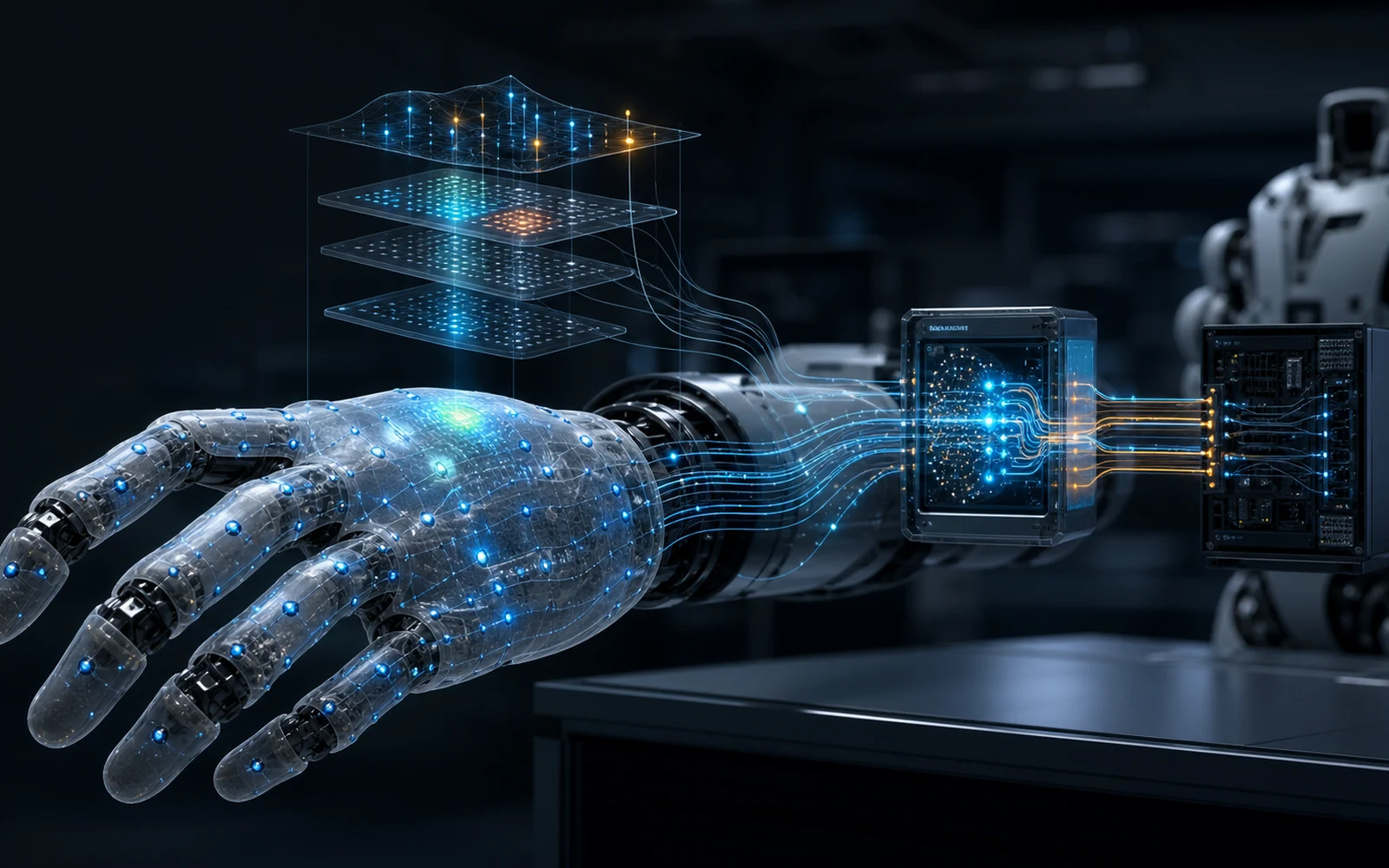 Tactile Data / 2026-08-22FreeTacMan robot-free visuo-tactile data collection for tactile AIA research note on FreeTacMan, robot-free visuo-tactile datasets, tactile AI data collection, and why robot skin models need contact diversity.Tactile AI / 2026-08-15Dream-Tac: A Unified Tactile World Action Model for Contact-Rich Robot ManipulationDream-Tac models action-conditioned tactile futures for contact-rich robot manipulation, showing why robot skin data needs prediction, not only reaction.
Common questions
FAQ for this topic
What is tactile manipulation?
It is robot manipulation that uses measured contact to estimate physical state and update actions such as grip force, pose, trajectory, or recovery mode.
Why is touch useful when a robot already has cameras?
Cameras can lose contact information under occlusion and often cannot directly observe pressure, shear, slip, seating, or hidden local motion. Touch supplies evidence at the physical interface.
Does tactile sensing always improve manipulation?
No. Improvement depends on sensor placement, signal quality, synchronization, latency, model, controller, and task. It should be shown against a matched no-touch baseline.
Is tactile manipulation the same as haptics?
They overlap but are not identical. Tactile manipulation focuses on sensing and controlling robot-object contact; haptics can also include rendering force or touch back to a human operator.