Sensor comparison guide
Tactile sensor benchmark for robot manipulation
Compare visual, acoustic, magnetic, and resistive tactile sensors by manipulation task, signal, integration constraint, and evidence boundary.
Published 2026-07-20 | Updated 2026-08-05 by RoboSkin.ai Editorial Team
- 6
- sections
- 4
- questions
- 7
- next routes
Short answer
What you need to know
- 1
There is no universal best tactile sensor for robot manipulation. The useful choice depends on the contact event, task geometry, latency, coverage, and controller input the robot needs.
- 2
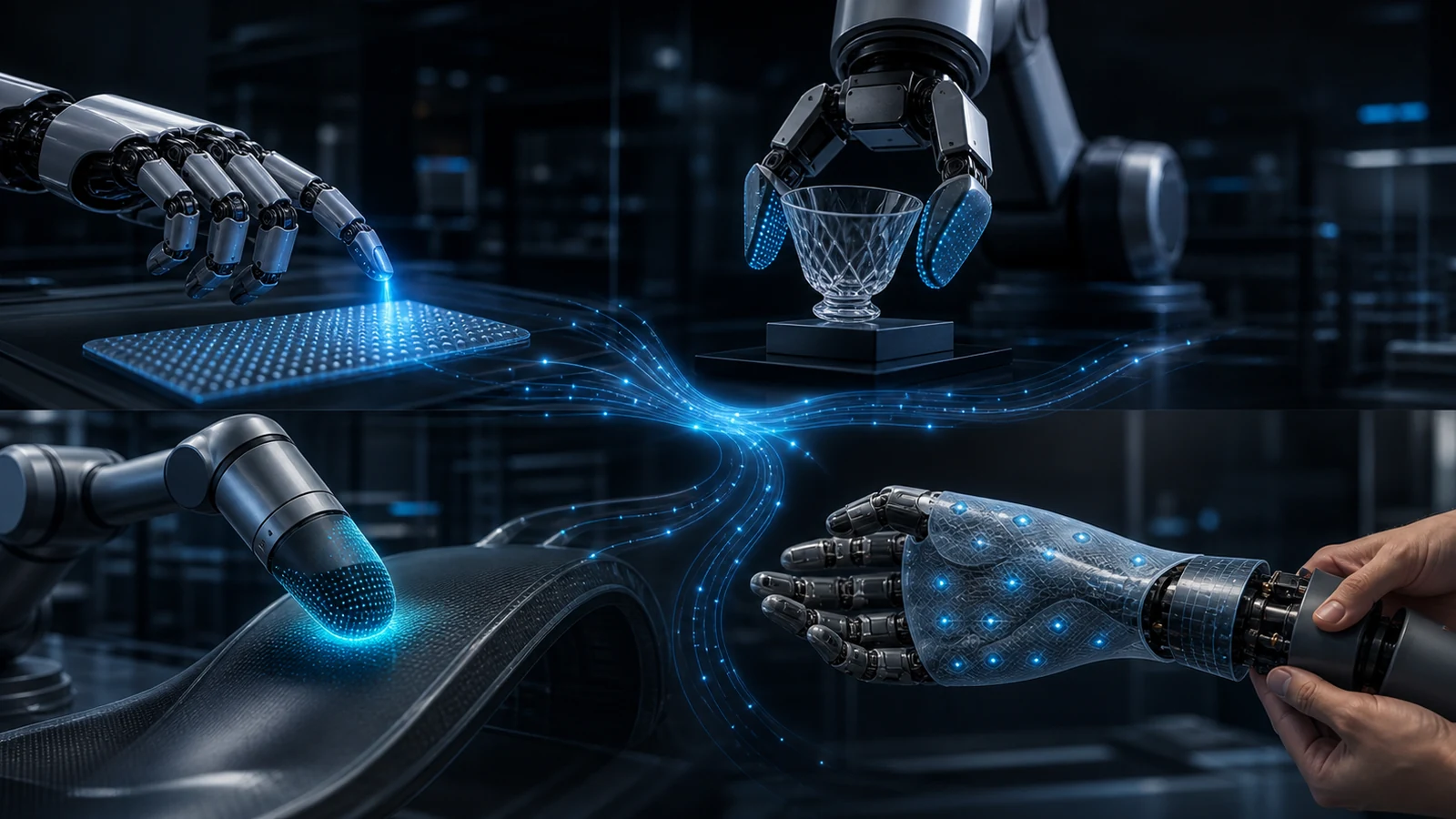
The 2026 TacO preprint compares visual, acoustic, magnetic, and resistive sensing across unknown-mass pick-and-place, object reorientation, and plug insertion. Its central result is task dependence, not one modality winning every task.
- 3
A defensible benchmark starts with the robot task, keeps mounting and control conditions visible, and measures whether tactile input changes manipulation outcomes under repeatable disturbances.
Topic 01
What a tactile benchmark should answer
A sensor specification sheet describes the component. A manipulation benchmark should show whether the resulting signal helps a robot complete a contact-rich task. That requires the sensor, mounting, calibration, data rate, controller, object set, and failure conditions to be reported together.
TacO is useful because it compares four tactile modalities within three manipulation tasks. The paper reports that usefulness varies with task requirements and properties such as spatial resolution, shear sensing, and surface friction. That finding argues for task-first selection instead of a single leaderboard.
- Define the contact event the robot must detect or regulate
- Separate sensor output quality from controller quality
- Keep object, mounting, surface, and disturbance conditions comparable
- Report task success and failure modes, not only clean sensor maps
Topic 02
Separate sensor selection from representation learning
TacO and HT-Bench use the word benchmark at different layers. TacO compares how four tactile sensor modalities affect manipulation-policy performance across three tasks. HT-Bench evaluates learned full-hand tactile representations with egocentric vision across contact-geometry, cross-modal, temporal, and unseen-task tests.
These sources should not be collapsed into one leaderboard. A sensor can produce a useful signal while a weak representation fails to preserve it, and a strong representation can still depend on a sensing layout that is impractical for another robot hand.
| Benchmark layer | Primary source | What it evaluates | Do not infer |
|---|---|---|---|
| Sensor and policy selection | TacO | Visual, acoustic, magnetic, and resistive tactile sensing across pick-and-place, reorientation, and insertion. | One modality is universally best for every task or sensor implementation. |
| Learned full-hand representation | HT-Bench | 10M RGB frames and 7.8M tactile frames across 226 tasks, evaluated through retrieval, inpainting, synthesis, and prediction. | The reported encoder or sensing layout transfers to every robot hand and contact distribution. |
Topic 03
Four tactile sensing modalities at a glance
The table describes engineering tendencies, not TacO winners. Products and research prototypes within the same modality can differ greatly in spatial resolution, bandwidth, force range, shear sensitivity, footprint, and durability.
| Modality | Primary signal route | Potential advantage | Constraint to test | Task-fit question |
|---|---|---|---|---|
| Visual | A camera observes deformation, markers, or surface appearance inside the sensor. | Dense spatial contact geometry and deformation images. | Optical stack size, illumination stability, surface wear, frame rate, and compute. | Does the task need local contact shape or a dense pressure proxy? |
| Acoustic | A microphone or vibration path records contact-generated sound. | Transient contact, vibration, impact, and texture cues at high temporal resolution. | Ambient noise, structural coupling, repeatable mounting, and signal interpretation. | Does the decision depend on fast slip, impact, or texture events? |
| Magnetic | Magnetometers measure field changes caused by deformation of an embedded magnetic structure. | Compact multi-axis deformation or force-sensitive measurements. | Calibration, magnetic interference, temperature effects, and unit-to-unit variation. | Does the controller need directional force or shear information in a compact package? |
| Resistive | Resistance changes under pressure or deformation across a sensing element or array. | Direct contact or pressure response in thin, potentially conformable layouts. | Hysteresis, drift, crosstalk, wiring density, and repeated-load behavior. | Is broad pressure coverage more important than dense contact geometry? |
Topic 04
Benchmark by manipulation task
TacO uses three tasks that stress different parts of the tactile pipeline. A team can reuse this structure even when its hardware, robot hand, or object set differs. The important step is to connect each task to a measurable tactile contribution.
| Task | Contact problem | What to measure | Failure question |
|---|---|---|---|
| Pick-and-place with unknown mass | The robot must establish and maintain a grasp without knowing object mass in advance. | Task success, grip adjustment, slip events, excess force, and response latency. | Did tactile input prevent slip or crushing when visual appearance did not reveal load? |
| Object reorientation | Contacts move across the hand while object pose changes. | Pose completion, contact continuity, shear or slip response, and recovery attempts. | Could the system distinguish intended rolling or sliding from loss of control? |
| Plug insertion | Small pose errors create contact forces that must guide alignment. | Insertion success, peak force, completion time, jamming, and corrective actions. | Did tactile input reveal useful alignment error before the controller jammed the plug? |
Topic 05
A minimum evaluation protocol
Run a vision-only or no-tactile baseline beside each tactile condition. Repeat trials across objects, starting poses, surface conditions, and disturbances that matter to deployment. Preserve raw tactile streams, calibrated values, robot state, commands, and outcomes so failures can be replayed.
A fair modality comparison also exposes non-sensor differences. If one system uses a larger model, a faster controller, different fingertips, or extra object-specific tuning, the result is a system comparison rather than isolated sensor evidence.
- Task success rate with uncertainty or trial counts
- Contact-to-feature and feature-to-action latency
- Calibration drift before and after repeated loading
- Performance on held-out objects, poses, and surface conditions
- Mounting, replacement, cleaning, wiring, and compute burden
- Replayable failures linked to tactile and robot-state logs
Topic 06
Claim boundary
TacO is a 2026 preprint. Its comparison is evidence for the reported sensors, tasks, robot setup, and protocol; it does not establish a permanent ranking for every visual, acoustic, magnetic, or resistive tactile sensor.
Use the paper as a benchmark design reference and verify code, data, hardware details, and later peer-reviewed revisions before treating a result as procurement evidence. A production decision also needs durability, replacement, environmental, and integration testing that a manipulation benchmark may not cover.
Paper routes
Start with source-backed RoboSkin briefs
 Tactile AI / 2026-08-22HT-Bench full-hand tactile benchmark for robot manipulationHT-Bench v2 pairs egocentric vision with millions of full-hand tactile frames, corrects the vision-to-tactile metric split, and adds four real-robot evaluations.
 Magnetic Tactile Sensing / 2026-06-18Open-source magnetic tactile calibration for gripper-agnostic touchA practical research note on open-source magnetic tactile calibration, three-axis force sensing, in-situ calibration, and why low-cost sensors still need repeatable setup.
 Dexterous Manipulation / 2026-05-14Full-hand tactile sensing for adaptive dexterous graspingA research-oriented explanation of why full-hand tactile coverage matters for adaptive grasping, occluded manipulation, and contact-aware robot hands.
Common questions
FAQ for this topic
Which tactile sensor modality is best for robot manipulation?
No modality is best for every task. Choose from the contact signal and task outcome required, then compare candidate sensors under the same mounting, controller, objects, and disturbances.
Can sensor resolution predict manipulation success?
Not by itself. Spatial resolution can matter, but latency, shear sensitivity, friction, force range, calibration, coverage, and controller design can change the result.
What is the most important tactile benchmark baseline?
Use the same manipulation system without tactile input or with the tactile pathway disabled. This shows whether touch changes the task outcome instead of merely producing an attractive signal visualization.
Is TacO a final industry standard?
No. It is a 2026 preprint and a useful task-based comparison framework. It should not be treated as a certification standard or universal modality ranking.