Source-reviewed model directory
Robot foundation models and the robot AI model stack
Compare OpenVLA, Octo, RT-2 and other robot AI models by training data, robot compatibility, code and weight access, tactile input, and evaluation evidence.
Published | Updated by RoboSkin.ai Editorial Team
- 5
- sections
- 5
- questions
- 9
- next routes
Short answer
What you need to know
- 1
A robot foundation model is a broadly pretrained model intended to be adapted or reused across multiple robot tasks, environments, or embodiments. The label is an architectural and training claim, not proof of general-purpose robot capability.
- 2
Robot AI systems contain different model roles. A VLM or embodied-reasoning model may interpret and plan, a VLA or policy may produce actions, and a world model may predict consequences. These roles can be combined but should not be treated as synonyms.
- 3
Compare models by their inputs, action interface, training mixture, robot embodiments, access terms, real-robot evaluation, and evidence limitations. RoboSkin.ai also records whether tactile input is documented, absent, or unclear.
Topic 01
What qualifies as a robot foundation model?
The term usually describes a model pretrained on sufficiently broad data to support adaptation across more than one narrowly fixed task. Breadth can come from multiple tasks, robot bodies, environments, sensor streams, language supervision, web data, simulation, or combinations of those sources.
There is no single universally accepted threshold for the label. A provider may call a model foundational while releasing limited training details or evaluation scope. RoboSkin.ai therefore records the claimed role separately from the evidence that readers can inspect.
- Identify the base architecture and whether the released artifact is a VLM, VLA, policy, world model, representation, or orchestration model.
- Record how many embodiments and action spaces appear in training and evaluation without assuming that training diversity guarantees transfer.
- Separate an open paper, open code, downloadable weights, reusable data, API access, and private preview; they are different availability states.
- Keep provider-reported evaluations and independent reproductions distinct.
Topic 02
Model roles in the robot AI stack
Robot foundation-model discussions often collapse several components into one list. A useful comparison starts by identifying what each artifact consumes and what it actually produces.
| Model role | Typical inputs | Typical output | Key evaluation question |
|---|---|---|---|
| Vision-language model | Images, video, text, and sometimes robot state. | Text, semantic representation, answer, or high-level decision. | Does the result remain grounded in the robot, scene, and task rather than only a language benchmark? |
| Embodied-reasoning model | Multimodal observations, instructions, history, and tools. | Plan, subgoal, state estimate, code, or tool call. | Can a documented downstream policy and controller execute the proposal and detect failure? |
| Vision-language-action model | Images or video, language, robot state, and action history. | Discrete or continuous robot actions or action chunks. | Which action space, robot bodies, task splits, interventions, and real-robot trials were tested? |
| Robot policy | Observation, state, history, and goal. | Action for the robot or controller. | Is it generalist, task-specific, learned, classical, or a hybrid, and what transfer is demonstrated? |
| World model | State or observation plus a candidate action or context. | Predicted future state, observation, reward, contact, or trajectory. | Does using the prediction improve planning or policy performance on a physical robot? |
| Tactile model | Taxels, force, vibration, tactile images, or synchronized visual-touch data. | Contact representation, property estimate, prediction, or corrective action. | Does it transfer across sensors, tasks, objects, and robot bodies under a controlled protocol? |
Topic 03
Data, embodiment, and transfer are separate claims
Robot models learn from heterogeneous mixtures that can include web vision-language data, human video, teleoperated demonstrations, autonomous rollouts, simulation, synthetic trajectories, robot state, and tactile data. Each source contributes different information and different biases.
Multi-embodiment training means that more than one robot body appears in the data. It does not automatically prove zero-shot control on an unseen robot. A transfer claim should state what was frozen, fine-tuned, adapted, remapped, or collected on the target platform.
- Training data: source, scale, licensing, curation, task coverage, and robot distribution.
- Observation contract: cameras, language, proprioception, touch, history length, and calibration.
- Action contract: joints, end-effector poses, action chunks, torques, gripper state, or tool calls.
- Transfer contract: target robot, adaptation examples, fine-tuning method, and held-out conditions.
- Evaluation contract: trials, resets, intervention policy, success criteria, failures, timing, and damage.
Topic 04
How to read the RoboSkin.ai model directory
The directory below is a source-reviewed comparison, not a leaderboard. It intentionally includes different model roles so readers can see where a model sits in the AI-to-robot loop, but it does not rank unlike tasks or reuse provider scores as a universal benchmark.
Unknown facts remain unknown. When weights, licenses, training mixtures, sensor inputs, or independent tests cannot be verified, the record states that boundary instead of inferring it from a product announcement or demonstration video.
Topic 05
Where touch fits in robot foundation models
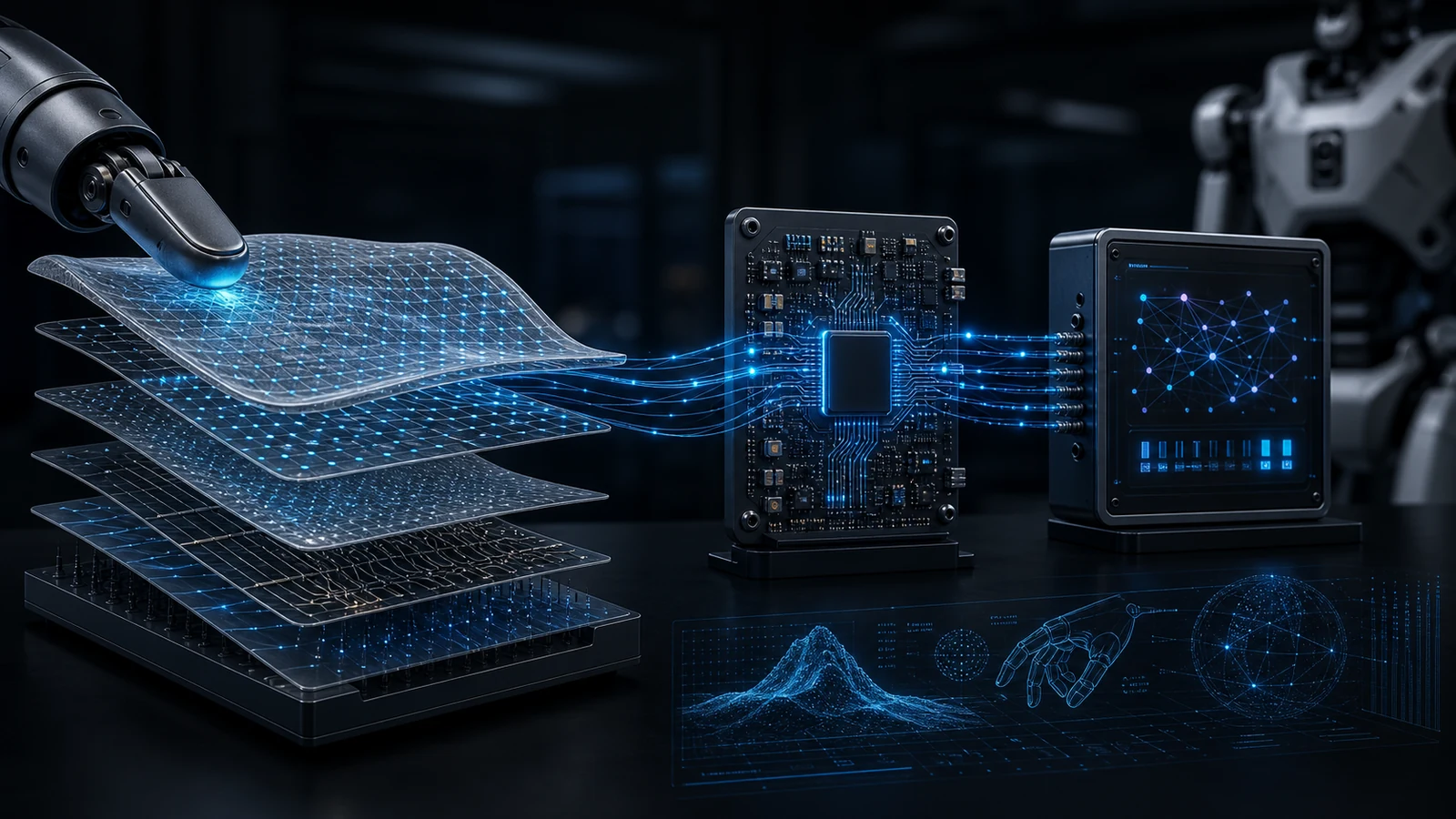
Most broadly discussed robot models are organized around vision, language, and robot state. Touch can enter as an additional observation, a learned tactile representation, a predicted contact state, a reward or success signal, or a faster corrective policy after physical contact begins.
A model should only be marked as tactile when its documented input or architecture actually uses touch, force, pressure, contact, or a tactile representation. Mounting a tactile sensor on the same robot is not enough if the model does not consume that signal.
Evidence-bounded model directory
Compare AI models used in robotics
Model labels describe different roles: a VLM interprets multimodal context, a VLA or policy produces actions, an embodied-reasoning model plans, and a world model predicts consequences. Every row keeps real-robot evidence, access terms, tactile input, verified robot-platform links, and source limitations attached to the model instead of treating unlike results as a leaderboard.
Source review: 2026-09-19 / 20 models
Showing 20 of 20 models
| Model | Role / release | Inputs / output | Training / embodiments | Real-robot evidence | Access / touch | Evidence boundary / sources |
|---|---|---|---|---|---|---|
| UniVTAC EncoderScaleLab, D-Robotics, ViTai Robotics, The University of Hong Kong, Nanjing University, Shenzhen University, Wuhan University, Fudan University, Tsinghua UniversityReviewed 2026-09-19 | Role / releaseTactile model | Inputs / outputInputs: Marker-based tactile RGB observation Output: A 512-dimensional tactile-centric representation from a ResNet-18 encoder; reconstruction, marker, depth, and 7D pose heads are used only for pretraining and discarded at deployment | Training / embodimentsThe v1 paper pretrains the encoder on 205,826 simulation samples from 14 geometric primitives with marked/marker-free tactile images, depth, projected markers and 7D relative pose. The September release lists 638 contact HDF5 files; their frame-level equivalence to that corpus is unverified. These are separate from versioned task episodes, the paper's 400 policy-training trajectories and 450 physical demonstrations. Embodiments: Simulated Franka Panda with a parallel-jaw gripper and bilateral simulated GelSight Mini observations; Tianji Marvin 7-DoF arm with a parallel gripper, wrist RGB camera, and bilateral ViTai GF225 sensors Verified platform relationships:
| Real-robot evidenceThe frozen encoder is integrated into policies evaluated by the authors on three physical tasks using one Tianji Marvin configuration. The paper reports 20 rollouts per method-task: Insert Tube improves from 55% with vision only to 85%, Insert USB from 15% to 25%, and Bottle Upright from 60% to 95%, for averages of 43.3% and 68.3%, a 25 percentage-point difference. | Access / touchCode, a hosted encoder checkpoint and separate Isaac Sim 4.5/5.1 task-file directories are public. The September 19 README associates released policy checkpoints with 4.5; it does not establish 5.1 policy compatibility. Collection and evaluation still list simulated GelSight Mini as supported, with GF225 and Xense WS planned. See the linked review for pinned files and audit limits. License: The official GitHub repository root LICENSE is Apache-2.0. The Hugging Face benchmark dataset card separately displays MIT. No separate model-weight license was verified for the hosted encoder checkpoint, so neither repository nor dataset terms are generalized to that checkpoint. Tactile input: yes | Evidence boundary / sourcesUniVTAC Encoder is a 512-dimensional ResNet-18 tactile representation encoder, not a VLA, language model, robot foundation model, or complete control policy. The 48.0% simulated and 68.3% physical averages are author-reported under different protocols and must not be combined. Public checkpoint logs reviewed separately differ from Table I averages, and the evidence does not establish independent reproduction, cross-robot transfer, universal sensor support, production safety, or equivalence with the distinct UniTacVLA model. |
| Gemini Robotics 2Google DeepMindReviewed 2026-08-21 | Role / releaseVLA | Inputs / outputInputs: Text instruction; RGB image Output: Motor-control actions | Training / embodimentsThe reviewed official model page and release post do not disclose the training-mixture composition, example count, or complete data provenance. Embodiments: Apptronik Apollo 2 humanoid with Inspire hands; Apptronik Apollo 2 humanoid with SharpaWave hand; Franka Duo Verified platform relationships:
| Real-robot evidenceGoogle DeepMind reports developer-run whole-body, multi-finger, and parallel-gripper task trials on Apollo 2 and Franka Duo configurations. | Access / touchPrivate preview; organizations can join the official early-access waitlist. License: Model weights and a reusable model license are not publicly disclosed; access is governed by private-preview terms. Tactile input: no | Evidence boundary / sourcesThe public model specification lists text and image inputs, not touch. Results are developer-reported on selected hardware and tasks; no public weights, training recipe, neutral cross-platform benchmark, or model-specific research paper was verified. |
| Gemini Robotics ER 2Google DeepMindReviewed 2026-08-21 | Role / releaseEmbodied reasoning | Inputs / outputInputs: Text; Image; Video; Audio Output: Text, structured plans, and tool or robot-function calls | Training / embodimentsThe model card says Gemini Robotics ER 2 uses Gemini 3.5 training data plus additional embodied-reasoning datasets; mixture sizes and item-level provenance are not disclosed. Embodiments: High-level orchestration for real and simulated robot policies; evaluated hardware inventory not fully disclosed | Real-robot evidenceThe official release reports task orchestration with a real VLA, a simulated VLA, and human teleoperation, plus video progress and success-detection evaluations. | Access / touchPublic preview through Google AI Studio and the Gemini API; private preview through Gemini Enterprise Agent Platform. License: API access is subject to Google service terms; model weights are not released under an open model license. Tactile input: no | Evidence boundary / sourcesThe model card lists text, image, video, and audio inputs rather than touch, and output is text rather than low-level motor action. Google advises against safety-critical use; many limitations inherit from the Gemini 3.5 Flash model card, and no model-specific paper or weights were verified. |
| RT-2Google DeepMindReviewed 2026-08-21 | Role / releaseVLA | Inputs / outputInputs: Robot-camera image; Natural-language instruction Output: Tokenized robot actions | Training / embodimentsPaLM-E- and PaLI-X-based variants were co-fine-tuned on web-scale vision-language data and RT-1 robot demonstrations gathered with 13 robots over 17 months. Embodiments: Google RT-series 7-DoF mobile manipulator (hardware model not disclosed); Language Table setup (RT-2-PaLI-3B simulation and qualitative real-world evaluation) Verified platform relationships:
| Real-robot evidenceThe paper reports 6,000 evaluation trials covering seen and unseen task conditions on the authors’ real-robot setup, alongside Language Table simulation tests. | Access / touchPaper and official technical description are public; model weights and a runnable training implementation were not released. License: No public model-weight license was disclosed because weights were not released. Tactile input: no | Evidence boundary / sourcesRT-2 is a closed research model evaluated mainly within the authors’ mobile-manipulation environment. Its image-and-language interface does not document tactile input, and reported generalization should not be transferred to untested robots, sensors, tasks, or safety conditions. |
| PaLM-EGoogle Research, Technische Universität BerlinReviewed 2026-08-21 | Role / releaseVLM | Inputs / outputInputs: Text; RGB image; Robot state; Neural scene representation Output: Autoregressive text, answers, and high-level robot decisions | Training / embodimentsPaLM-E jointly trains embodied-task data with language, vision, and vision-language data by injecting continuous sensor encodings into a pretrained language model. Embodiments: Google mobile manipulator in the kitchen environment (hardware model not disclosed); Language Table setup (real and simulated); Simulated task-and-motion-planning agent Verified platform relationships:
| Real-robot evidenceThe paper and Google Research post describe evaluation in three robot environments, two using real robots, with a separate low-level language-to-action policy executing generated decisions. | Access / touchPaper and research description are public; model weights and a public inference endpoint were not released. License: No public model-weight license was disclosed because weights were not released. Tactile input: no | Evidence boundary / sourcesPaLM-E produces text or high-level decisions and relies on a separate low-level policy for physical execution. The documented modalities do not include touch, weights are closed, and results from two real-robot environments do not establish deployment reliability across arbitrary embodiments. |
| OpenVLA 7BStanford University, University of California, Berkeley, Toyota Research Institute, Google DeepMind, Physical Intelligence, Massachusetts Institute of TechnologyReviewed 2026-08-22 | Role / releaseVLA | Inputs / outputInputs: Natural-language instruction; RGB robot observation Output: Discretized robot actions | Training / embodimentsThe flagship 7B model was trained on 970,000 real-world robot trajectories from the Open X-Embodiment mixture. Its published mixture includes DROID at 10% before DROID is removed for the final third of training, plus a 13.3% Bridge bucket that combines Bridge V1 and BridgeData V2 rather than reporting a V2-only share. Embodiments: Trossen WidowX 250 6-DoF (zero-shot evaluation); Google RT-series mobile manipulator (zero-shot evaluation); Franka Emika Panda tabletop setup (fine-tuned-policy evaluation); DROID Franka setup (fine-tuned-policy evaluation; exact arm variant not disclosed) Verified platform relationships:
| Real-robot evidenceThe paper reports real-world evaluation across 29 manipulation tasks and multiple robot embodiments, comparing task success with generalist-policy baselines. | Access / touchTraining and inference code plus pretrained checkpoints are public through the official project and repository. License: Repository code is MIT; the maintainers state that pretrained models can inherit restrictions from their underlying base models, so each checkpoint’s terms must be checked. Tactile input: no | Evidence boundary / sourcesThe released flagship model is vision-language-action rather than tactile. Reported task success is tied to the paper’s action representation, data mixture, platforms, and protocol; “open source” does not remove inherited base-model license restrictions. |
| OctoUniversity of California, Berkeley, Stanford University, Carnegie Mellon University, Google DeepMindReviewed 2026-08-22 | Role / releaseRobot policy | Inputs / outputInputs: Natural-language instruction; Goal image; Camera-observation history; Optional task-specific observations after fine-tuning Output: Continuous robot-action distributions through a diffusion head | Training / embodimentsOcto was pretrained on 800,000 robot trajectories from 25 datasets in Open X-Embodiment. Its appendix assigns 17% to a combined Bridge V1 and BridgeData V2 bucket, without disclosing a V2-only share; the mixture also contains Berkeley Autolab UR5 data. Embodiments: Trossen WidowX 250 6-DoF (zero-shot evaluation); Universal Robots UR5 (zero-shot evaluation; not normalized to UR5e); Universal Robots UR5 (represented in the Open X-Embodiment pretraining mixture); Google RT-series mobile manipulator / proprietary RT-1 Robot (zero-shot evaluation); Trossen ViperX and ALOHA configurations (fine-tuned-policy evaluation); Five additional real-robot setups with incomplete or family-level hardware disclosure Verified platform relationships:
| Real-robot evidenceThe paper evaluates zero-shot control and approximately 100-demonstration fine-tuning across nine real-robot setups, including new observations, action spaces, and embodiments. | Access / touchOcto-Small and Octo-Base checkpoints, training code, fine-tuning code, and data loaders are public. License: MIT License for the official repository; upstream datasets retain their own licenses and terms. Tactile input: no | Evidence boundary / sourcesThe released pretrained interface is camera-based and does not document touch. One fine-tuning experiment adds force-torque input, which is not evidence of a general tactile model. Zero-shot performance degrades on novel scenes and behaviors in the paper’s own analysis. |
| π0 (Pi Zero)Physical IntelligenceReviewed 2026-08-22 | Role / releaseVLA | Inputs / outputInputs: RGB images; Natural-language instruction; Low-dimensional robot state Output: Continuous robot-action chunks generated by flow matching | Training / embodimentsThe original report combines a pretrained vision-language backbone with 903 million steps of proprietary robot data plus a 9.1% open-source mixture containing an Open X-Embodiment subset, BridgeData V2, and DROID; it does not disclose separate weights for those three sources. Current OpenPI base checkpoints report pretraining on more than 10,000 hours of robot data. Embodiments: Universal Robots UR5e (single and bimanual configurations); Trossen ViperX arms (bimanual and mobile configurations); Franka arm (exact variant not disclosed); ARX and AgileX bimanual or mobile configurations; Mobile Fibocom configuration; ALOHA and DROID-compatible adaptations in the current OpenPI release Verified platform relationships:
| Real-robot evidenceThe original release evaluates five complex real-world task families, including laundry folding, table bussing, grocery bagging, box assembly, and object retrieval. | Access / touchOpenPI publishes Apache-2.0 code, base checkpoints, and selected task-specific checkpoints; the maintainers warn that adaptation to a new platform may fail. License: Apache-2.0 for the OpenPI repository; users must also follow the licenses attached to checkpoints, base-model components, and training datasets. Tactile input: no | Evidence boundary / sourcesThe published input schema uses images, language, and robot state rather than touch. Original comparisons use the authors’ scoring rubric and platforms; current open checkpoints and code have evolved since the 2024 report and do not guarantee reproduction on other hardware. |
| Isaac GR00T N1NVIDIAReviewed 2026-08-21 | Role / releaseVLA | Inputs / outputInputs: Natural-language instruction; RGB image; Robot state Output: Robot actions from a vision-language module and diffusion-transformer action module | Training / embodimentsNVIDIA reports a mixture of egocentric human video, real robot trajectories, simulated robot trajectories, and synthetic data; complete example counts and item-level provenance are not disclosed in the research page. Embodiments: Fourier GR-1 humanoid; 1X humanoid; Multiple simulated robot embodiments Verified platform relationships:
| Real-robot evidenceThe N1 research page reports language-conditioned bimanual household manipulation on Fourier GR-1 and 1X humanoids, plus simulation benchmarks across embodiments. | Access / touchThe Isaac-GR00T repository publishes code and model checkpoints; the maintained family has advanced beyond the paper’s N1 release. License: Repository code is Apache-2.0 and model weights use the NVIDIA Open Model License; exact terms must be checked for the selected version. Tactile input: no | Evidence boundary / sourcesThe N1 report does not document tactile input. Real-robot evidence is developer-reported on named humanoids and household tasks; current repository defaults may implement later N1-family versions, so version-matched checkpoints and evaluations are required. |
| T-RexUniversity of California, Berkeley, NVIDIA, Stanford University, Panasonic, Sapienza University of Rome, ItalAI LabsReviewed 2026-08-22 | Role / releaseVLA | Inputs / outputInputs: Natural-language instruction; Head and bilateral wrist RGB video; Robot state; Ten fingertip tactile deformation streams and 6D wrench estimates Output: Bimanual robot-action chunks with approximately 5 Hz slow action generation and 20 Hz tactile refinement | Training / embodimentsThe authors report three stages: large-scale tactile-free egocentric pretraining, tactile-reactive midtraining on the full 100-hour T-Rex collection, and task-specific post-training. The current public dataset card specifies 5,464 episodes and 5,473,459 frames at 30 FPS, approximately 50 hours, rather than the complete 100-hour training corpus. Embodiments: Fixed-base bimanual Dexmate Vega-1 with two 22-DoF Sharpa Wave hands Verified platform relationships:
| Real-robot evidenceThe official project reports a 65% macro-average for T-Rex versus 35% for EgoScale across 12 contact-rich tasks, with 16 randomized rollouts per task on one fixed-base bimanual setup. | Access / touchPaper, project page, MIT-licensed repository, pretrained and midtrained checkpoints, post-training and inference code, full-pipeline branch, and an approximately 50-hour LeRobot v3.0 dataset subset are public. License: The official repository, Hugging Face midtraining checkpoint, and public dataset card are marked MIT; upstream models, dependencies, hardware assets, and any unbundled corpora retain their own terms. Tactile input: yes | Evidence boundary / sourcesT-Rex is a June 2026 arXiv preprint with developer-run results on one Dexmate Vega-1 and dual Sharpa Wave configuration. The 65% score uses source-defined progress rubrics, and the released approximately 50-hour subset is not the complete 100-hour corpus used for tactile-reactive midtraining; no independent reproduction or cross-platform evaluation was verified. |
| ViTaRBeijing Institute of TechnologyReviewed 2026-08-22 | Role / releaseVLA | Inputs / outputInputs: Natural-language instruction; Primary scene or head RGB image; Wrist RGB image; Robot proprioception; Marker-derived contact descriptor; Bilateral tactile-image summary Output: Frozen OpenVLA-OFT action chunk plus an optional bounded 7D end-effector residual selected and scaled from current contact evidence | Training / embodimentsThe frozen OpenVLA-OFT reference is fine-tuned on 50 UniVTAC trajectories per task across seven tasks. ViTaR additionally uses 20 restored decision groups per task and short local branches to supervise effect ranking and residual modulation; trajectory, decision-group, branch, and preference-pair counts are different units and are not combined here as one demonstration total. Embodiments: UniVTAC simulated manipulation benchmark with bilateral simulated GelSight Mini observations; 6-DoF RealMan RM65-B with a DH Robotics PGIA-series parallel-jaw gripper, dual 9DTact sensors, and wrist plus third-person RealSense D455 cameras Verified platform relationships:
| Real-robot evidenceThe authors report binary end-to-end success on three physical tasks with 20 trials per method-task pair: 40% on Insert Hole, 65% on Lift Bottle, and 40% on Wiping the Board, or 48.3% across those tasks. A separate seven-task UniVTAC protocol uses 100 episodes per method-task pair and reports a 61.3% average. | Access / touchPaper, official project page, video, figures, and project-page source are public. The official page marks code as “Coming soon”; no runnable ViTaR implementation, model weights, EGM or RAM checkpoints, exact branch corpus, or ViTaR-specific dataset download was verified. License: No separate software, model-weight, checkpoint, or ViTaR-specific dataset license was published because those artifacts were not released. The upstream UniVTAC terms do not license ViTaR artifacts. Tactile input: yes | Evidence boundary / sourcesViTaR is an August 2026 v1 preprint with author-reported evidence. Its 61.3% UniVTAC binary-success average and 48.3% physical average use different cohorts and must not be combined or ranked against unlike VLA protocols. Imported, adapted, and author-evaluated baselines do not share identical upstream data, seeds, or interaction budgets, and ViTaR receives additional branch supervision. Physical evidence is limited to one RM65-B configuration, three tasks, and 20 trials per task; no independent reproduction, cross-robot transfer, or public implementation was verified. |
| ReTouchUniversity of Science and Technology of China, iFLYTEK, The Chinese University of Hong KongReviewed 2026-08-22 | Role / releaseVLA | Inputs / outputInputs: Natural-language task instruction; One wrist-mounted RGB view; Two fixed external RGB views; 18-dimensional robot proprioception; Current frame plus the preceding nine frames from five fingers with 120 three-axis force taxels per finger (a ten-frame input window) Output: Sixteen-step chunks of 18-dimensional absolute joint-position commands, with the remaining suffix regenerated from updated tactile observations during execution | Training / embodimentsXHT-Dataset contains 900 retained successful demonstrations across seven real-world tasks. The paper holds out 100 trajectories from tactile-encoder and policy training and uses the remaining 800 as a common training pool; it does not disclose the per-task distribution or publish the split manifest or dataset files. Embodiments: UR7e arm with an XHand five-finger tactile dexterous hand, one wrist RGB camera, and two fixed external RGB cameras Verified platform relationships:
| Real-robot evidenceThe standard protocol uses 20 real-robot rollouts per method on each of seven tasks and reports an 83.6% macro-average normalized task score. Button Press is binary, while the other six tasks award weighted partial credit. Four separate challenging settings also use 20 rollouts per method-setting and report a 73.1% macro-average for ReTouch. | Access / touchThe current arXiv v2 paper is public. No paper-linked official project page, source-code repository, model weights, checkpoints, XHT-Dataset download, or exact split manifest was verified on 2026-08-22. License: No separate ReTouch software, model-weight, checkpoint, or XHT-Dataset license was verified because those artifacts were not publicly released. Tactile input: yes | Evidence boundary / sourcesReTouch is an August 2026 preprint evaluated by its authors on one XHand–UR7e setup. The paper calls the primary quantity “Success Rate,” but Appendix B defines it as a normalized task score and only one of seven tasks is binary; 83.6% therefore must not be described as 83.6% fully completed trials. One on-site evaluator applies the rubric, each task or challenge has 20 rollouts per method, and no confidence intervals, public logs, independent replication, artifact release, or cross-platform evaluation was verified. |
| τ (Touch-Augmented VLA)Beijing Jiaotong University, Beijing Institute for General Artificial IntelligenceReviewed 2026-08-22 | Role / releaseVLA | Inputs / outputInputs: Natural-language instruction; Multi-view RGB observation; Robot proprioception; Bilateral vision-based tactile deformation Output: Future robot-action chunks generated by a π0.5-based conditional flow-matching policy; exact action dimension and semantics are not reported | Training / embodimentsTacAura supplies 100 human-teleoperated demonstrations per task across plug insertion, USB insertion, stamp pressing, and whiteboard erasing. A JEPA-style auxiliary branch uses current touch and subsequent actions to predict future visual-feature changes during training; that predictive branch is removed at inference, while tactile input remains part of the deployed policy. Embodiments: Franka Research 3 with a Franka Hand whose fingers are replaced by bilateral DM-Tac WS sensors, two RealSense D435i cameras, and one wrist RealSense D405 Verified platform relationships:
| Real-robot evidenceEach fixed model variant is evaluated for 20 trials per task across four physical tasks. The best fixed variant by the paper’s reported mean is τ-Wrist at 71.25%, with full-task success of 60%, 40%, 90%, and 95%; a separate sentence mixes best task values from different variants and is not treated as one checkpoint result. | Access / touchThe arXiv v3 paper and project page are public. The project labels code “Coming Soon,” but its button points to a separate STOLA placeholder; no τ implementation, model weights, TacAura download, data-conversion tools, or reusable artifact license was verified. License: No software, model-weight, or TacAura dataset license was verified because the promised artifacts were not released. Tactile input: yes | Evidence boundary / sourcesτ is a July 2026 preprint with author-run results on one Franka Research 3 and bilateral DM-Tac WS configuration. Baselines marked with a dagger were adapted to the authors’ tactile setup; results do not establish cross-embodiment or cross-sensor transfer. The paper does not report exact action semantics or deployment rate, omits tactile-aware world-model comparisons for computational reasons, and had not released code, weights, or TacAura by 2026-08-22. “No deployment overhead” applies only to removing the training-only predictive branch, not to the tactile sensing and encoding path used at inference. |
| UniTacVLAHarbin Institute of Technology, Great Bay University, Shanghai Jiao Tong University, Fudan University, Nanjing University, Daimon RoboticsReviewed 2026-08-22 | Role / releaseVLA | Inputs / outputInputs: Natural-language instruction; Wrist and first-person RGB observations; Robot state; Bilateral depth and shear tactile deformation; Predicted future tactile latents Output: Low-frequency π0.5 action chunks plus bounded high-frequency residual corrections conditioned on current and predicted tactile latents; exact action dimensions and rates are not reported | Training / embodimentsThe paper reports approximately one hour of 30 Hz demonstrations per subtask across eight subtasks, with 80% normal expert demonstrations and 20% disturbance-recovery demonstrations. It does not disclose trajectory or frame counts, a named public dataset, an exact split manifest, or a downloadable corpus. Embodiments: RealMan RM75B with a 3D-printed parallel gripper, bilateral DM-Tac W fingertip sensors, a wrist RealSense D405, and a first-person RealSense L515 Verified platform relationships:
| Real-robot evidenceEight subtasks are evaluated in clean and perturbed settings with 50 trials per subtask-setting. The paper publishes all 16 task-setting success rates but not an aggregate number, so RoboSkin preserves the per-task protocol rather than presenting a calculated mean as a paper-reported score. | Access / touchThe arXiv v1 paper is public, while the official repository contains only a “coming soon” project-page placeholder. No implementation, checkpoint, training dataset, release, tag, or reuse license was verified. License: No public software, model-weight, or dataset license was verified because the repository remains a project-page placeholder without released artifacts. Tactile input: yes | Evidence boundary / sourcesUniTacVLA is a June 2026 v1 preprint evaluated by its authors on one RM75B, one custom gripper, and two DM-Tac W sensors. The table reports 50 trials for each clean or perturbed subtask setting but no aggregate mean; calculated averages must not be presented as author-reported. Exact action dimensions, backbone and controller rates, trajectory count, tactile pixel resolution, severe-occlusion performance, explicit force or torque modeling, code, checkpoints, public data, and independent reproduction remain unavailable. |
| VLA-TouchNational University of SingaporeReviewed 2026-08-22 | Role / releaseVLA | Inputs / outputInputs: Natural-language task goal; Overhead and wrist RGB observations; Robot proprioception; GelSight Mini tactile images; Octopi tactile-language descriptions; Marker-tracked low-dimensional tactile state Output: High-level primitive instruction plus an RDT-1B 64-step action chunk refined by a tactile and vision-conditioned interpolant controller | Training / embodimentsThe base RDT-1B policy is first aligned to the Franka action space and then fine-tuned per task without tactile input. The interpolant controller is trained on paired VLA-generated and expert action sequences from 380 demonstrations across the Cup, Wipe, and Peel task pipelines; the exact RDT task-checkpoint release is not verified. Embodiments: Franka Emika Panda with a Robotiq 2F-140 gripper, one GelSight Mini on one gripper finger, and overhead plus wrist RealSense cameras Verified platform relationships: | Real-robot evidenceThe complete planning-and-manipulation system is evaluated for 20 trials on each of three tasks and reports 9/20 complete Cup trials, 12/20 complete Wipe trials, and 7/20 complete Peel trials. Separate component tables also use 20 trials per condition and must not be merged with these end-to-end counts. | Access / touchThe official MIT-licensed repository publishes partial controller and Octopi code and links a public processed dataset plus controller checkpoints. The modified RDT inference implementation is still marked for future release, no complete task-fine-tuned RDT checkpoint was verified, and the repository has no GitHub release. License: MIT applies to files in the official GitHub repository. No separate license was verified for the linked dataset, Drive-hosted controller checkpoints, Octopi data, or upstream RDT-1B artifacts. Tactile input: yes | Evidence boundary / sourcesVLA-Touch is a modular wrapper rather than a released tactile-native foundation model. Evidence is limited to one single-arm Franka setup, one unilateral GelSight Mini, three tasks, and 20 trials per task. The authors test source-defined environmental variations rather than cross-task, cross-robot, or cross-sensor generalization. Octopi, GPT-4o, RDT-1B, BRIDGeR-derived control, data, and checkpoints have separate boundaries; the repository MIT license must not be generalized to those external or hosted artifacts, and the complete modified RDT deployment path remains unreleased. |
| Dream-TacResearch team listed in the primary paperReviewed 2026-08-21 | Role / releaseWorld model | Inputs / outputInputs: Visual observation; Tactile observation; Robot state and action context Output: Robot actions plus predicted future visual and tactile observations | Training / embodimentsThe preprint describes task-specific synchronized visual, tactile, and action demonstrations for six contact-rich tasks; the abstract does not disclose a universal dataset or total trajectory count. Embodiments: Franka Emika Panda with dual RealSense D435i cameras and two Xense Photon fingertip sensors Verified platform relationships:
| Real-robot evidenceThe authors report six real-world contact-rich manipulation tasks and action-prediction comparisons, together with training and inference speed measurements. | Access / touchThe official code repository is public; a separately licensed, generally reusable model checkpoint was not verified. License: Apache-2.0 for the official code repository; model-weight and dataset licenses were not separately disclosed in the reviewed sources. Tactile input: yes | Evidence boundary / sourcesDream-Tac is a 2026 preprint evaluated on six source-specific tasks and one research pipeline. Action accuracy and speed do not establish cross-sensor or cross-robot reliability, independent replication, safe deployment, or general-purpose foundation-model behavior. |
| TouchWorldHarbin Institute of Technology, Shenzhen and PHANES AIReviewed 2026-08-22 | Role / releaseTactile model | Inputs / outputInputs: Natural-language instruction; Multi-view RGB image; Proprioceptive state; Tactile pressure observation; High-level task memory Output: Executable subtasks, predicted visual-tactile subgoals, nominal robot-action chunks, and high-frequency residual action corrections | Training / embodimentsThe preprint reports 128,866 subtask-planner supervision records, tactile-world-model pretraining on EgoTouch, and fine-tuning on 10 hours or about 1.08 million frames of robot demonstrations. Each of the six evaluated tasks uses 200 teleoperated training trajectories; no reusable TouchWorld dataset release was verified. Embodiments: Unnamed humanoid platform with Wuji dexterous hands and a JQ-Industries tactile glove | Real-robot evidenceThe authors report 100 real-robot evaluation rollouts per task across clean and human-perturbation settings for six contact-rich tasks, with average success of 65.0% and 53.7%, respectively. | Access / touchThe paper and official project page are public. Public model weights, training code, dataset files, and an artifact license were not verified in the reviewed sources. License: No public license for model weights, code, or robot demonstration files was verified; the arXiv article license does not establish reusable artifact terms. Tactile input: yes | Evidence boundary / sourcesTouchWorld is a July 2026 preprint evaluated on one unnamed humanoid platform, one tactile-glove layout, and six author-defined tasks. The reported success rates and prediction metrics are not independent benchmarks, do not establish transfer to other hands or sensors, and should not be compared as a common leaderboard with unlike tactile models. |
| Tac4LocoHong Kong University of Science and Technology (Guangzhou), University of Hong Kong, and Nanyang Technological UniversityReviewed 2026-08-22 | Role / releaseRobot policy | Inputs / outputInputs: Robot proprioception; Bilateral 60-element plantar pressure arrays; Pressure and proprioception history Output: Twenty-nine residual whole-body joint-position targets | Training / embodimentsTac4Loco is trained with reinforcement learning in MJLab using a Unitree G1 model. Each simulated foot has 60 contact geometries aligned with the physical insole taxels, and pressure-specific augmentation models measurement variation, timing distortion, and temporary sensing failures. Embodiments: Unitree G1 model in MJLab simulation with 60 contact geometries per foot; Physical Unitree G1 with bilateral 60-element FSR pressure insoles Verified platform relationships:
| Real-robot evidenceThe trained actor is deployed on one physical Unitree G1 with bilateral 60-element FSR insoles at 50 Hz. The preprint reports simulation and physical comparisons on inclined, partial, asymmetric, compliant, and granular support conditions. | Access / touchThe preprint is public and says code and experimental configurations will be released. No dedicated Tac4Loco repository, model weights, dataset package, or artifact license was verified on 2026-08-22. License: No public code, model-weight, or dataset license was verified; the arXiv article license does not license future artifacts. Tactile input: yes | Evidence boundary / sourcesTac4Loco is a v1 preprint tied to one simulated and physical Unitree G1 configuration and one bilateral insole design. Training occurs in simulation, physical comparisons generally use ten trials per configuration, the gravel result is qualitative, and “zero-shot” is limited to the source-defined unseen foam and gravel conditions. |
| ADEPTNVIDIA, University of MichiganReviewed 2026-08-22 | Role / releaseRobot policy | Inputs / outputInputs: Two calibrated RGB camera observations; Robot proprioception; Five per-finger TacMap contact and penetration-depth representations on the Flexiv-Sharpa branch only; Five fingertip positions on the Flexiv-Sharpa branch only Output: Full-joint relative action targets mediated by a joint-configuration-space geometric fabric | Training / embodimentsADEPT pretrains generic object reposing over 16 primitive shapes in simulation, then trains each embodiment and each downstream task independently. For the reported KUKA accounting, the source describes 8B pretraining and 3B downstream environment steps; these simulation rollouts are not a released dataset. Embodiments: 23-DoF KUKA iiwa7 plus 16-DoF Allegro Hand workbench configuration with two RGB cameras (vision-only student); 29-DoF Flexiv Rizon plus 22-DoF Sharpa hand workbench configuration with two RGB cameras and five fingertip vision-based tactile sensors Verified platform relationships:
| Real-robot evidenceThe preprint reports five ten-trial physical conditions across two fixed-workbench arm-hand systems. In the matched Flexiv-Sharpa square-and-round insertion condition, final success was 3/10 with vision only and 8/10 with visuo-tactile input. | Access / touchThe paper and official project page are public. The project page labels code “Coming soon”; no training implementation, checkpoint, model weights, or reusable robot dataset was verified on 2026-08-22. License: The arXiv article is CC BY 4.0. No separate code, model-weight, checkpoint, or dataset artifact license was verified. Tactile input: yes | Evidence boundary / sourcesTouch is documented only for the Flexiv-Sharpa student and the matched tactile ablation covers one square-and-round insertion condition with ten trials per modality. KUKA experiments are vision-only, tasks and embodiments are trained independently, both robots are fixed workbenches, and the preprint does not establish cross-hand, cross-sensor, mobile, humanoid, long-duration, independently replicated, or safety-validated performance. |
| SparshMeta Fundamental AI Research (FAIR), University of Washington, Carnegie Mellon UniversityReviewed 2026-08-21 | Role / releaseTactile model | Inputs / outputInputs: Short temporal window of vision-based tactile images Output: Reusable tactile latent representation for downstream decoders and policies | Training / embodimentsThe current project page describes about 661,000 curated tactile samples, while the initial paper abstract reports pretraining on more than 460,000 images; the difference reflects source/version scope and is retained explicitly. Embodiments: DIGIT and GelSight-family tactile sensors in TacBench; Franka robot arm in the bead-maze policy demonstration | Real-robot evidenceSparsh is evaluated through six TacBench tasks; the project also demonstrates frozen representations feeding a diffusion policy for a Franka bead-maze task. | Access / touchOfficial code, dataset links, paper, and model resources are public through the project page and repository. License: CC BY-NC 4.0 in the official repository; downstream datasets and dependencies can have additional terms. Tactile input: yes | Evidence boundary / sourcesSparsh is a representation family, not an end-to-end general robot controller. TacBench aggregates heterogeneous task metrics, so its reported average is not one universal score; evidence focuses on vision-based tactile sensors and does not prove transfer to arbitrary robot skin. |
Common questions
FAQ for this topic
What is a robot foundation model?
It is a broadly pretrained model intended for reuse or adaptation across multiple robot tasks, environments, or embodiments. The term does not by itself prove generalization, safe deployment, or access to weights and training data.
Are all robot foundation models VLA models?
No. A robot foundation-model ecosystem can include VLMs, embodied-reasoning models, VLA policies, world models, reward models, and tactile representations. A VLA specifically produces robot actions from multimodal context.
What makes a robot model generalist?
Generalist is a claim about breadth across tasks, objects, environments, instructions, or robot embodiments. It should be evaluated against explicit held-out conditions rather than inferred from model size or dataset scale.
Does open source mean a robot model is fully reproducible?
No. Code, weights, datasets, hardware, licenses, calibration, action mappings, and evaluation protocols can have different access states. Reproduction requires enough of the complete system, not only a public repository.
How does tactile input change a robot AI model?
Tactile input can add local contact evidence such as pressure, force, slip, vibration, or deformation. It may support representation learning, contact prediction, policy correction, or evaluation, but each use must be verified from the model interface and experiment.