High-interest robotics pillar
Robot learning: data, models and real-world evaluation
Learn how robots learn from demonstrations, reinforcement, datasets, simulation, and touch, with source-backed guidance for real-world evaluation.
- 7
- sections
- 5
- questions
- 14
- next routes
Short answer
What you need to know
- 1
Robot learning is the use of data and experience to train robots to perceive, predict, or act instead of specifying every behavior as a fixed rule. The training signal may come from demonstrations, rewards, self-supervision, simulation, human feedback, or combinations of these sources.
- 2
A useful robot-learning claim must name the robot, observations, action space, data, task, training method, evaluation split, autonomy level, and real-world trial protocol. Model size or dataset size alone does not establish physical capability.
- 3
Touch matters when success depends on hidden contact state. Tactile observations can expose pressure, shear, slip, seating, deformation, and contact transitions that vision and proprioception may not measure directly.
Topic 01
The robot-learning loop
Robot learning connects observations to actions through a training objective and an evaluation protocol. Observations may include cameras, depth, language, proprioception, force, torque, or tactile signals. Actions may be joint commands, end-effector motion, gripper state, trajectories, or action chunks.
The loop is only as reliable as its data and evaluation. Demonstration quality, timing, calibration, resets, interventions, failed attempts, and hardware changes can all alter what the learned policy actually represents.
- Collect synchronized observations, robot state, actions, task context, and failure metadata
- Train a policy, representation, reward model, dynamics model, or reusable foundation model
- Evaluate on held-out tasks, objects, scenes, robots, sensors, or physical conditions
- Measure real-robot success, speed, recovery, force, damage, and intervention instead of only offline loss
Topic 02
Major learning paradigms
Robot-learning labels describe different supervision and optimization choices. Many practical systems combine several of them, so comparisons should identify the exact training and deployment role.
| Approach | Learning signal | Typical strength | Evidence boundary |
|---|---|---|---|
| Imitation learning | Expert or teleoperated demonstrations | Directly learns behaviors represented in the demonstrations | Sensitive to demonstration coverage and distribution shift |
| Reinforcement learning | Reward from interaction or simulation | Can optimize behavior through trial and feedback | Reward design, safety, sample cost, and sim-to-real transfer must be reported |
| Offline robot learning | Previously collected trajectories | Reuses data without new online exploration during training | Cannot assume the logged data covers every useful action or failure |
| Self-supervised representation learning | Structure inside unlabeled or weakly labeled observations | Can create reusable visual, tactile, or multimodal features | Representation scores do not automatically prove closed-loop task value |
| Vision-language-action policy | Robot trajectories paired with images and instructions | Connects task language and observations to actions | Embodiment, action interface, data mix, and real-robot evaluation determine scope |
Topic 03
Data is part of the robot system
Open X-Embodiment, DROID, and the LeRobot ecosystem illustrate different routes toward reusable robot data: cross-embodiment aggregation, a large real-world manipulation dataset, and a standardized open data and tooling ecosystem. They are complementary examples, not interchangeable benchmarks.
A dataset record should expose the robot, sensor streams, control interface, task labels, trajectory unit, timing, calibration, collection policy, train-test split, access path, and license. Without those fields, scale is difficult to interpret and reuse is harder to audit.
Topic 04
Simulation and sim-to-real transfer
Simulation can generate experience, perturbations, labels, and repeatable evaluation without exposing hardware to every trial. Transfer to a physical robot still depends on geometry, dynamics, contact, sensing, latency, control, and observation differences between the simulator and the deployed system.
Report what was randomized, adapted, calibrated, or fine-tuned, and separate simulation success from repeated physical trials. A simulator benchmark can test a method under controlled conditions; it does not by itself establish real-world reliability.
ADEPT is a current source-bounded example: it pretrains generic object reposing in simulation, then trains each embodiment and downstream task independently before transferring student policies to two physical workbench systems without real-world fine-tuning. Its use of “zero-shot sim-to-real” does not mean zero-shot transfer to a new hand, sensor, task, or robot.
Topic 05
Tactile robot learning
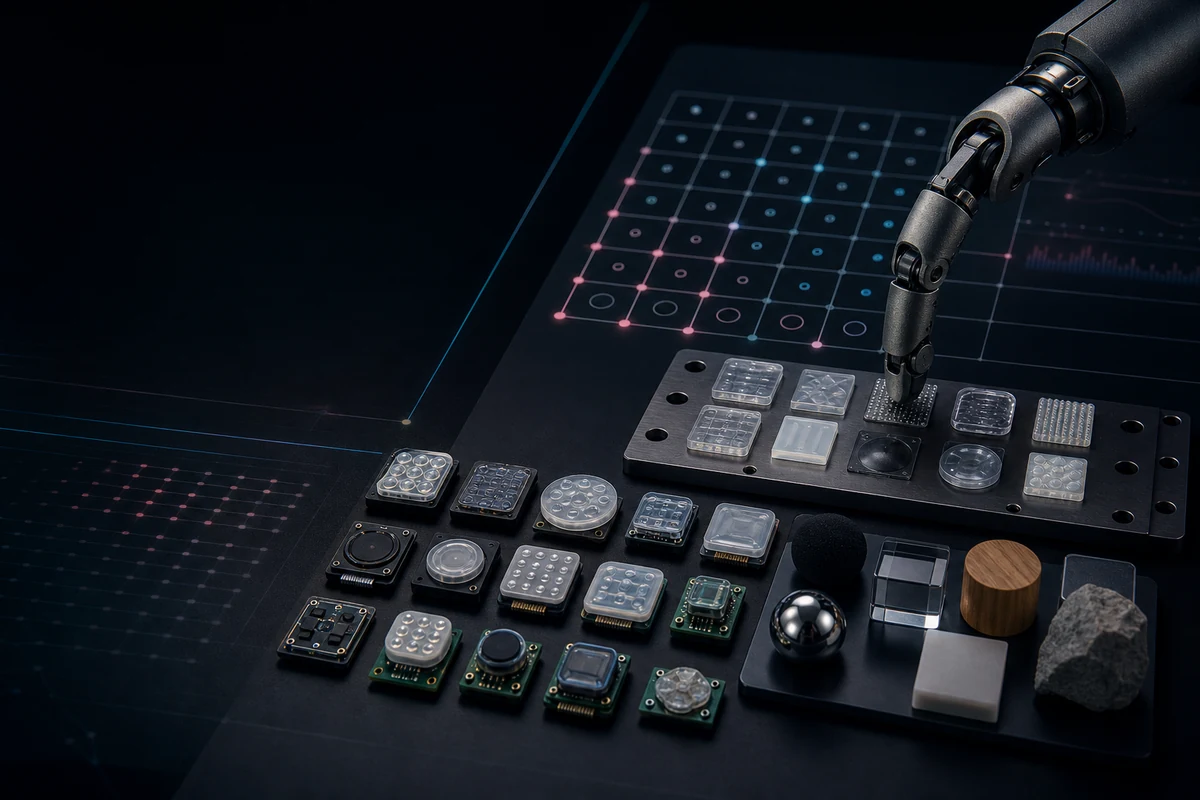
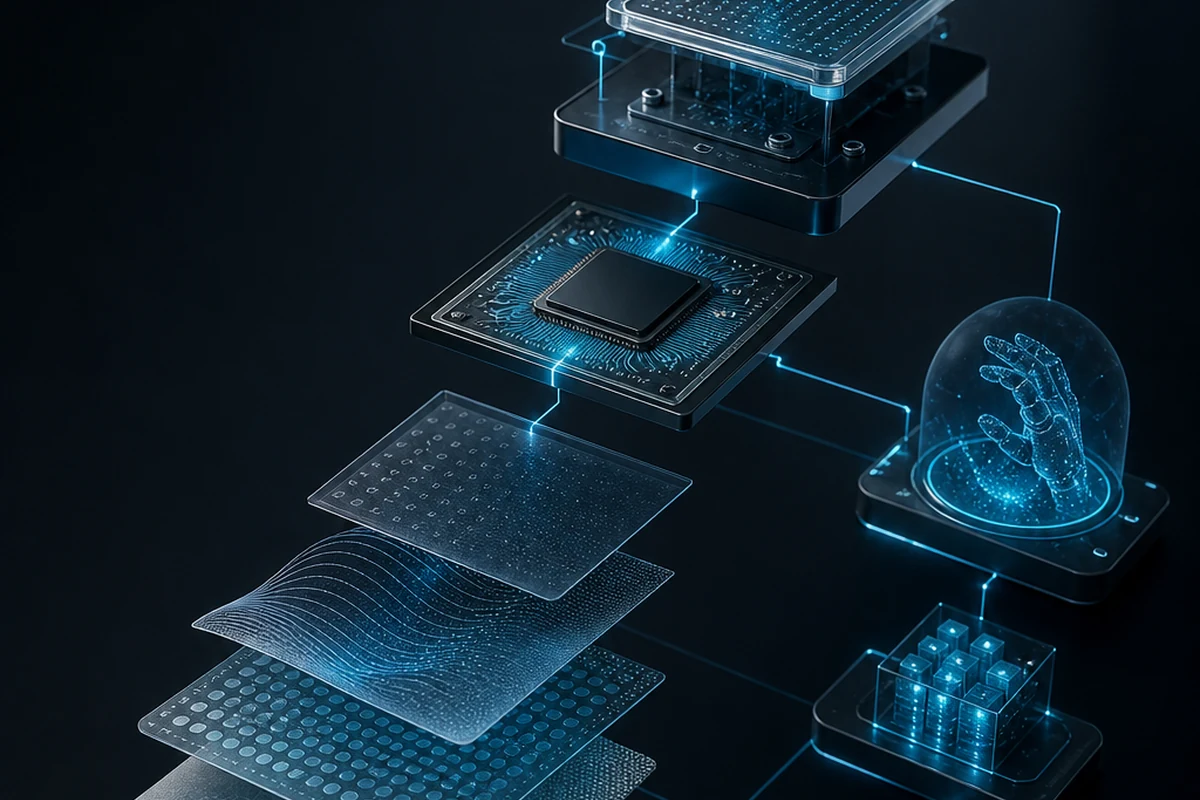
Touch can enter robot learning as raw tactile images, force or pressure arrays, compact contact representations, predicted future observations, a reward signal, or a fast correction pathway. The right representation depends on the sensor, task, controller rate, and data available.
ManiSkill-ViTac provides a primary-source example of a simulation benchmark focused on visuo-tactile manipulation. Physical tactile datasets and full-hand benchmarks add different evidence. Results should stay attached to their robot, sensor, task, split, and protocol.
UniVTAC makes those units explicit: 205,826 samples pretrain a tactile encoder, 400 paper-reported trajectories train eight task policies, the September inventory lists 800 task HDF5 files for each of Isaac Sim 4.5 and 5.1, and 450 physical demonstrations support three real-world tasks. Evaluation rollouts are outcomes rather than additional training data.
In ADEPT, the tactile pathway is limited to five vision-based fingertips on one Flexiv-Sharpa student. The paper reports 3/10 vision-only versus 8/10 visuo-tactile final success in one matched insertion condition with ten trials per modality. This is useful causal evidence inside that condition, not proof of cross-sensor or cross-hand transfer.
- Synchronize touch with camera frames, pose, joint state, action, and contact events
- Compare against matched no-touch or shuffled-touch baselines where tactile value is claimed
- Test occlusion, slip, insertion, deformable objects, or disturbances that make contact information relevant
- Report sensor calibration, wear, drift, replacement, and latency when they can affect the learned behavior
Topic 06
How to evaluate robot-learning claims
Evaluation should make the claimed generalization axis explicit. A new object, background, instruction, robot, sensor, task, or dynamics setting tests a different kind of transfer. Combining them into one broad label hides the actual boundary.
| Question | What to record | Why it matters |
|---|---|---|
| What was learned? | Policy, representation, reward, dynamics, plan, or controller role | Prevents different model roles from being ranked as if they were identical |
| What data was used? | Robots, tasks, trajectories, modalities, failures, licenses, and splits | Defines the experience available to the model |
| What changed at test time? | Object, scene, instruction, embodiment, sensor, task, or physics | Names the actual generalization claim |
| How physical was the evidence? | Replay, simulation, staged demo, repeated real-robot trials, or deployment | Separates offline performance from physical reliability |
| What happened when it failed? | Retries, resets, intervention, damage, safety stops, and recovery | Exposes operational cost and robustness |
Topic 07
Open tooling and the 2026 ecosystem
Hugging Face describes LeRobot as an open robotics ecosystem for models, datasets, and tools. Its official v0.6.0 release expands policy evaluation and model-development workflows. These releases are useful infrastructure signals; any capability claim still needs the named policy, dataset, robot, task, and evaluation result.
Google DeepMind’s Gemini Robotics materials represent another branch of the field: models intended to connect multimodal understanding and robot action. RoboSkin.ai keeps those broad model developments connected to the narrower question of when tactile evidence improves contact-rich behavior.
Paper routes
Start with source-backed RoboSkin briefs
 Tactile AI / 2026-09-19UniVTAC separates tactile simulation, representation learning, and policy evaluationChoose the matching code branch and dataset before using UniVTAC. This guide separates its tactile encoder, simulation benchmark, public downloads and paper-reported physical results.
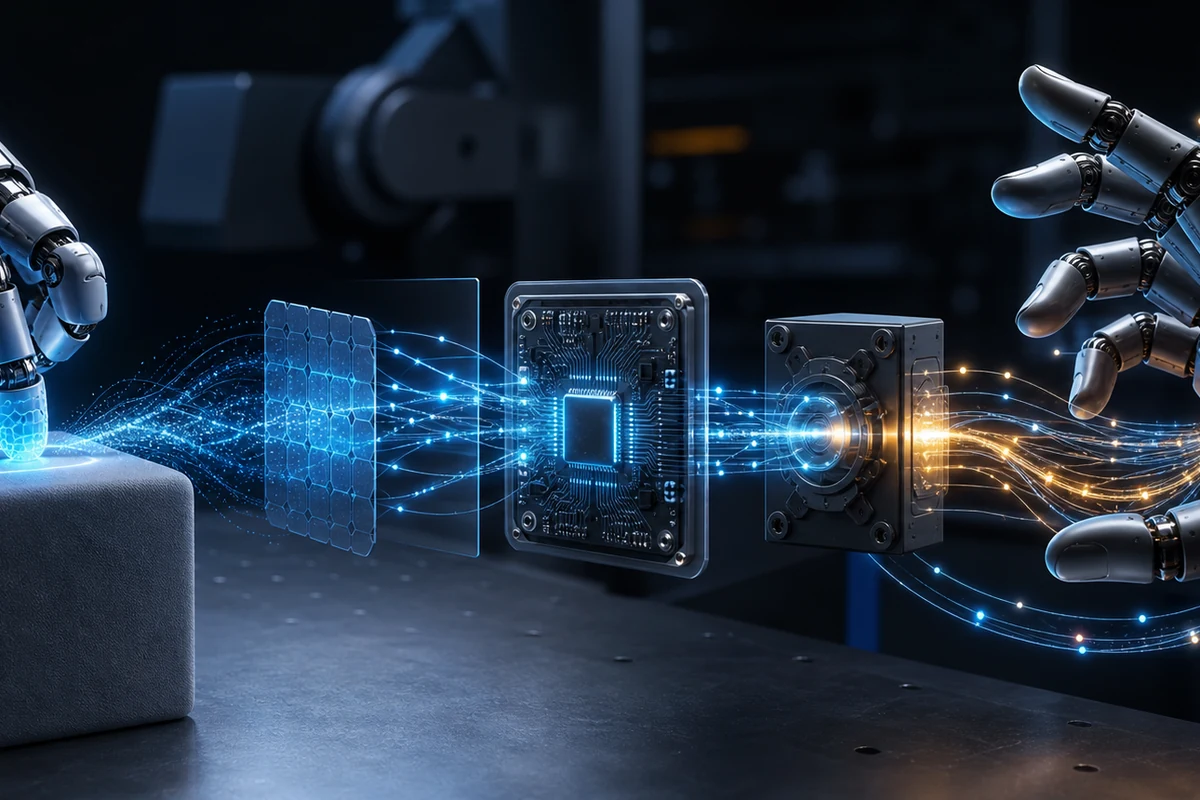 Robot learning / 2026-08-22ADEPT reports a 3/10 to 8/10 tactile ablation on dexterous insertionADEPT reports 3/10 vision-only versus 8/10 visuo-tactile final success in one matched Flexiv-Sharpa insertion condition, with ten physical trials per condition.Tactile AI / 2026-08-22HT-Bench full-hand tactile benchmark for robot manipulationHT-Bench v2 pairs egocentric vision with millions of full-hand tactile frames, corrects the vision-to-tactile metric split, and adds four real-robot evaluations.
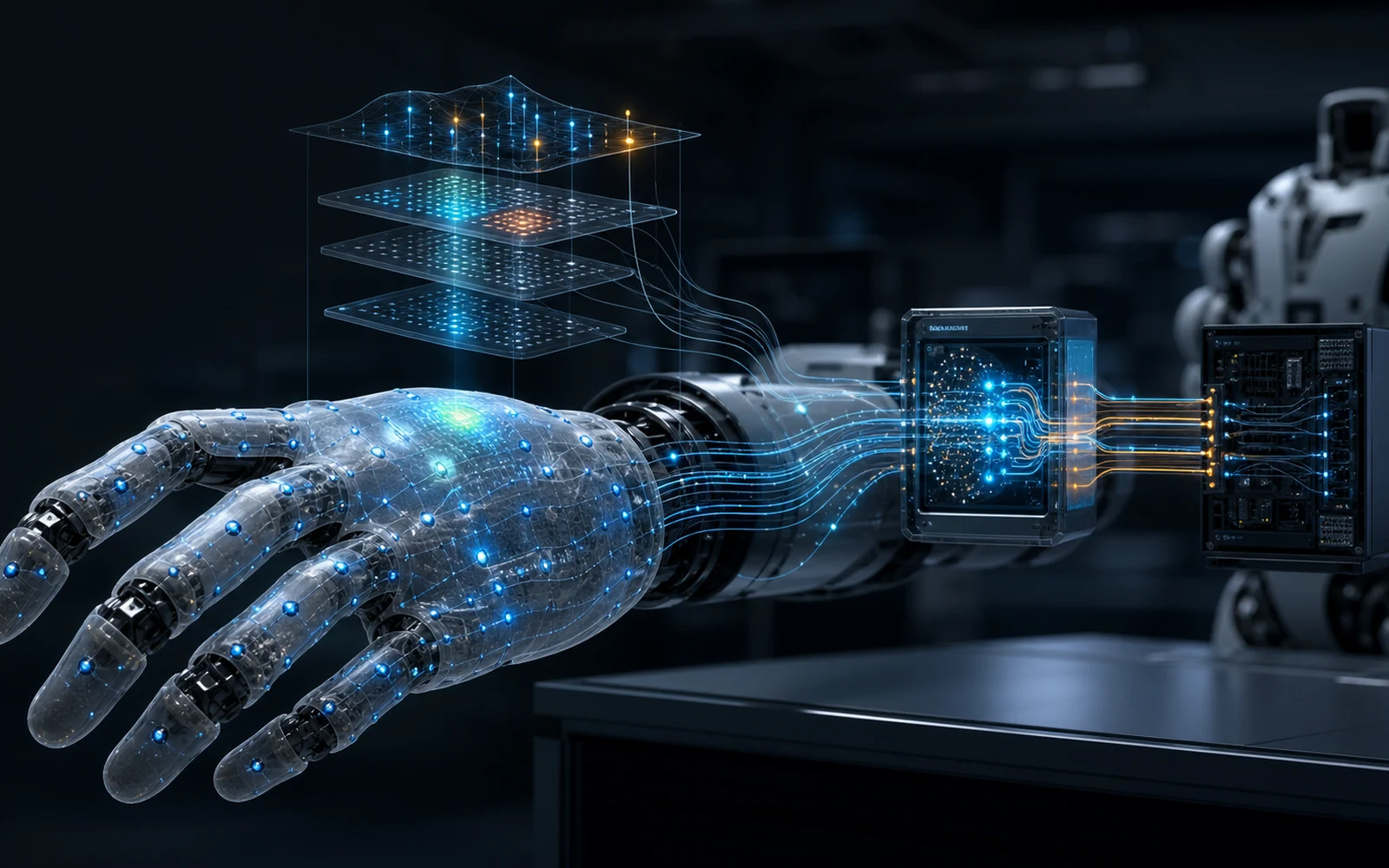 Tactile Data / 2026-08-22FreeTacMan robot-free visuo-tactile data collection for tactile AIA research note on FreeTacMan, robot-free visuo-tactile datasets, tactile AI data collection, and why robot skin models need contact diversity.Tactile AI / 2026-08-15Dream-Tac: A Unified Tactile World Action Model for Contact-Rich Robot ManipulationDream-Tac models action-conditioned tactile futures for contact-rich robot manipulation, showing why robot skin data needs prediction, not only reaction.
 Tactile manipulation / 2026-08-22T-Rex adds high-rate tactile reaction to dexterous robot policiesT-Rex reports a 100-hour collection and a 30-point gap over EgoScale; its official release now provides code, checkpoints, and an approximately 50-hour public subset.
 Tactile datasets / 2026-08-22RoboTacDex maps 6,000+ humanoid visual-tactile trajectoriesRoboTacDex reports 6,000+ Unitree G1 trajectories across 19 tasks, an author-reported 23 skills, and 22 objects, but public dataset access remains pending.
Common questions
FAQ for this topic
What is robot learning?
Robot learning uses data or experience to train robot perception, prediction, or action instead of specifying every behavior as a fixed rule.
What is the difference between imitation learning and reinforcement learning for robots?
Imitation learning learns from demonstrated behavior. Reinforcement learning improves behavior using a reward signal from interaction or simulation. Systems can combine both.
What makes a robot-learning dataset useful?
It should identify the robot, observations, actions, task context, timing, calibration, trajectory unit, collection policy, splits, access path, and license.
Why does robot learning need tactile data?
It needs tactile data when physical success depends on pressure, shear, slip, seating, deformation, or contact transitions that other sensors do not measure directly.
How should sim-to-real results be judged?
State what was trained in simulation, what was randomized or adapted, which physical robot and tasks were tested, how many trials were run, and which failures or interventions occurred.