HiTac-WAM forecasts contact, deformation, and slip before robot action
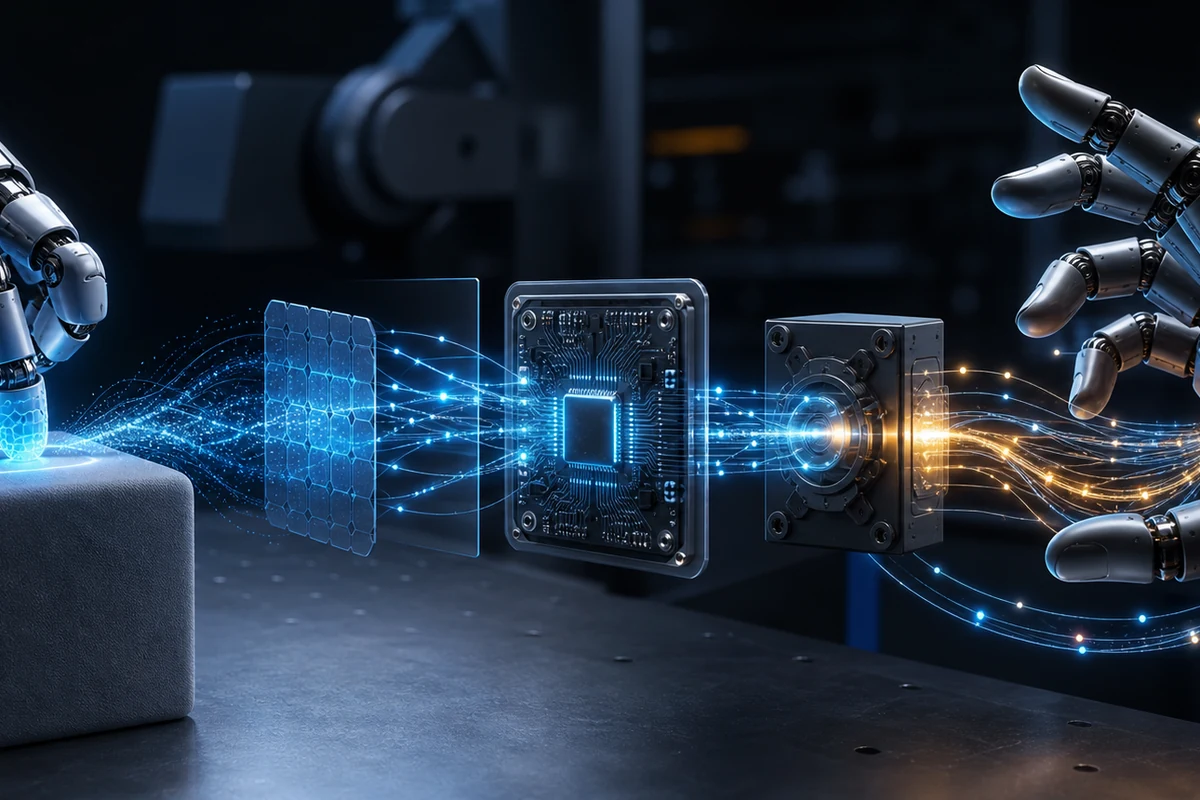
HiTac-WAM ranks candidate robot actions with hierarchical tactile forecasts, then checks predicted touch against measured touch during execution.
Evidence review - August 2026
HiTac-WAM is an August 20, 2026 arXiv preprint about predicting the tactile consequences of an action before a robot executes it. The model forecasts contact state, a three-dimensional deformation field, and slip risk for each candidate action chunk. It then keeps the selected forecast as an execution-time reference so persistent disagreement with measured touch can trigger corrective replanning.
The paper reports 61.1% mean real-robot success when hierarchical tactile forecasts are used for candidate selection and 72.2% for the full system with online forecast verification. These are author-reported results from three tasks on one fixed experimental platform, not independent validation of a general-purpose tactile world model.
What the model predicts
HiTac-WAM does not treat future touch as one undifferentiated image or latent vector. Its forecast follows a directed physical hierarchy.
| Forecast stage | Question it answers | Dependency in the paper | Control role |
|---|---|---|---|
| Contact state | Will the selected action establish or release contact? | First stage of the hierarchy | Reject candidates with the wrong contact pattern. |
| 3D deformation | How may the tactile interface deform under contact? | Conditioned on contact | Rank actions by the expected contact geometry. |
| Slip risk | Is the resulting contact likely to become unstable? | Conditioned on contact and deformation | Penalize candidates associated with predicted slip. |
| Online discrepancy | Does measured touch match the retained forecast? | Evaluated during execution | Abort the remaining action prefix and replan after persistent deviation. |
A directed attention mask lets tactile queries use the video-action context for each candidate, while preventing video and action queries from attending back to the tactile tokens. The purpose is to augment candidate evaluation without changing the pretrained visual action generator through the tactile branch.
Reported experimental evidence
The real-robot evaluation covers chip grasping, blackboard erasing, and USB insertion. All experiments use an IMETA-Y1 robot, bilateral DM-Tac W2 tactile sensors, and three synchronized RGB views. The paper reports 200 complete episodes for each task, partitioned before temporal-window extraction into 160 training, 20 validation, and 20 test episodes. The tactile prediction modules are trained separately for each task.
| System setting | Mean success across three tasks | Evidence boundary |
|---|---|---|
| Single-candidate execution | 31.1% | Baseline reported by the authors under the same task protocol. |
| HiTac-WAM selection | 61.1% | Forecast-guided selection without the full online verification loop. |
| Full HiTac-WAM | 72.2% | Selection plus execution-time forecast verification and corrective replanning. |
Each method is evaluated in 30 trials per task. The source also reports a mean contact F1 of 0.921. Under matched training budgets, the directed hierarchy reduces 3D displacement L2 error by 17.6% relative to a deformation-only predictor and improves slip AUPRC by 60.4% relative to a slip-only predictor. These comparisons are bound to the paper's data, baselines, definitions, and hardware.
Why this matters for tactile AI
The paper links two roles for robot touch that are often studied separately. Forecasting supports prospective action selection: the robot can compare likely contact outcomes before acting. Verification supports reactive control: the robot can compare the retained prediction with the tactile state that actually occurs.
That loop fits the broader tactile AI stack: sensing produces measured contact, a learned model represents and predicts tactile state, planning selects an action, and closed-loop control checks whether reality matches the forecast. It also connects to tactile manipulation, where contact timing, deformation, and slip have different operational meanings.
For the broad distinction between prediction, policy, planning, and control, start with robot world models. For a comparison with other approaches that predict touch alongside video and action, use the visuo-tactile world model guide. The tactile foundation model guide explains why a task-specific predictor should not automatically be described as a foundation model.
What this does not prove yet
HiTac-WAM is an arXiv v1 preprint. Its prediction modules are trained separately for each of the three tasks, and all main experiments use the same IMETA-Y1 robot and bilateral DM-Tac W2 sensor configuration. The source does not establish transfer to new robots, tactile hardware, task families, object distributions, or longer autonomous deployments.
The reported percentages are not an external leaderboard. They come from the authors' protocol and include task-specific thresholds calibrated on successful validation episodes. The arXiv record and paper did not provide an official code or dataset link when this brief was reviewed on August 21, 2026, so reproducibility artifacts and reuse terms remain unconfirmed.
Evaluation checklist
- Keep contact, deformation, slip, action selection, and recovery metrics separate.
- Report whether tactile predictors and verification thresholds are shared or task-specific.
- Preserve episode-level train, validation, and test splits before extracting overlapping windows.
- Test new objects, tasks, embodiments, sensors, contact materials, and action horizons.
- Measure false corrections and missed failures, not only successful recoveries.
- Confirm code, data, sensor calibration, and license availability from an official release before reuse.
Primary source
arXiv: HiTac-WAM - A Hierarchical Tactile World Action Model for Contact-Rich Robot Manipulation
Continue the topic