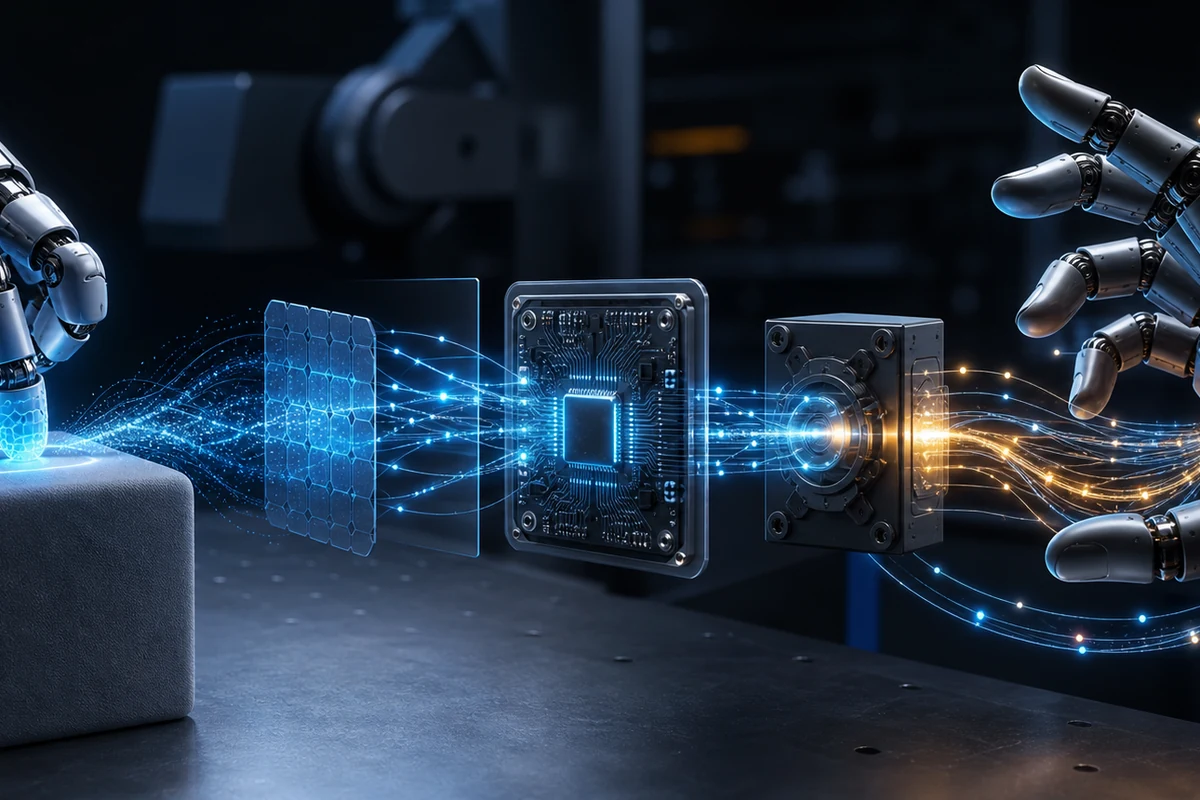
T-Rex adds high-rate tactile reaction to dexterous robot policies
T-Rex reports a 100-hour collection and a 30-point gap over EgoScale; its official release now provides code, checkpoints, and an approximately 50-hour public subset.
Evidence review - August 2026
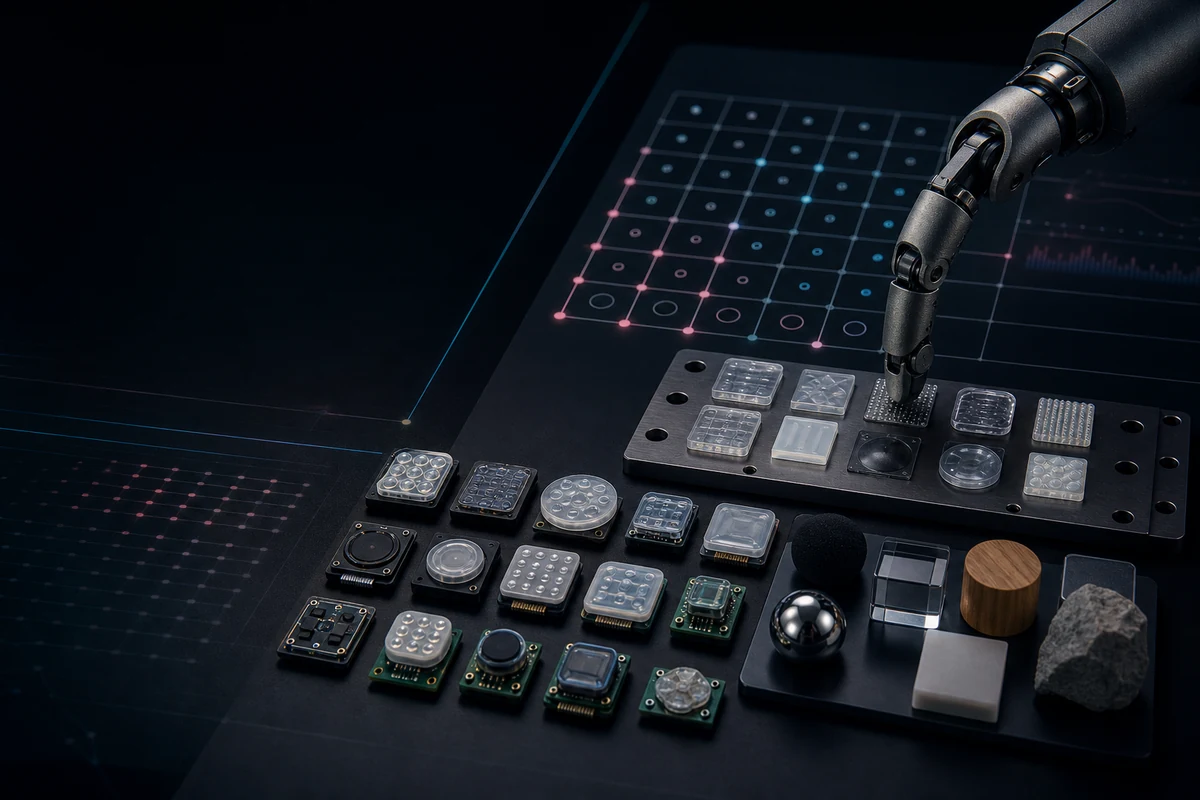
T-Rex is a June 2026 arXiv preprint about making dexterous manipulation policies react dynamically to tactile signals. The authors report a 100-hour tactile-rich collection, a temporal tactile VQ-VAE encoder, and a variable-rate Mixture-of-Transformers architecture. The official dataset card now exposes 5,464 episodes and 5,473,459 frames at 30 FPS, approximately 50 hours; that public subset is not the complete 100-hour corpus used in the reported training recipe. The authors evaluate the system on 12 manipulation tasks that require delicate force control or deformable-object manipulation.
The paper's Table 1 reports 65% average success for T-Rex and 35% for EgoScale, the strongest listed baseline. That is an absolute gap of 30 percentage points in the authors' 12-task protocol. Each task is evaluated with 16 rollouts. The figures are not independent validation or evidence of the same gain on other robot systems.
The problem T-Rex addresses
Many vision-language-action models process observations and produce action chunks at one policy rate. Touch can change faster than vision-language reasoning: incipient slip, local deformation, or a sudden contact transition may require an update before the next slow action cycle.
T-Rex treats this as both a data and architecture problem.
| Component | Source-reported role | Evidence question |
|---|---|---|
| Reported 100-hour tactile-rich collection | Supplies tactile-action trajectories built around 22 reported motor primitives and more than 200 objects | Which portions, tasks, and splits are represented in the public subset? |
| Approximately 50-hour public subset | Exposes 5,464 episodes and 5,473,459 frames at 30 FPS in LeRobot v3.0 through the official release | Can the published subset reproduce only post-training or also the full reported midtraining recipe? |
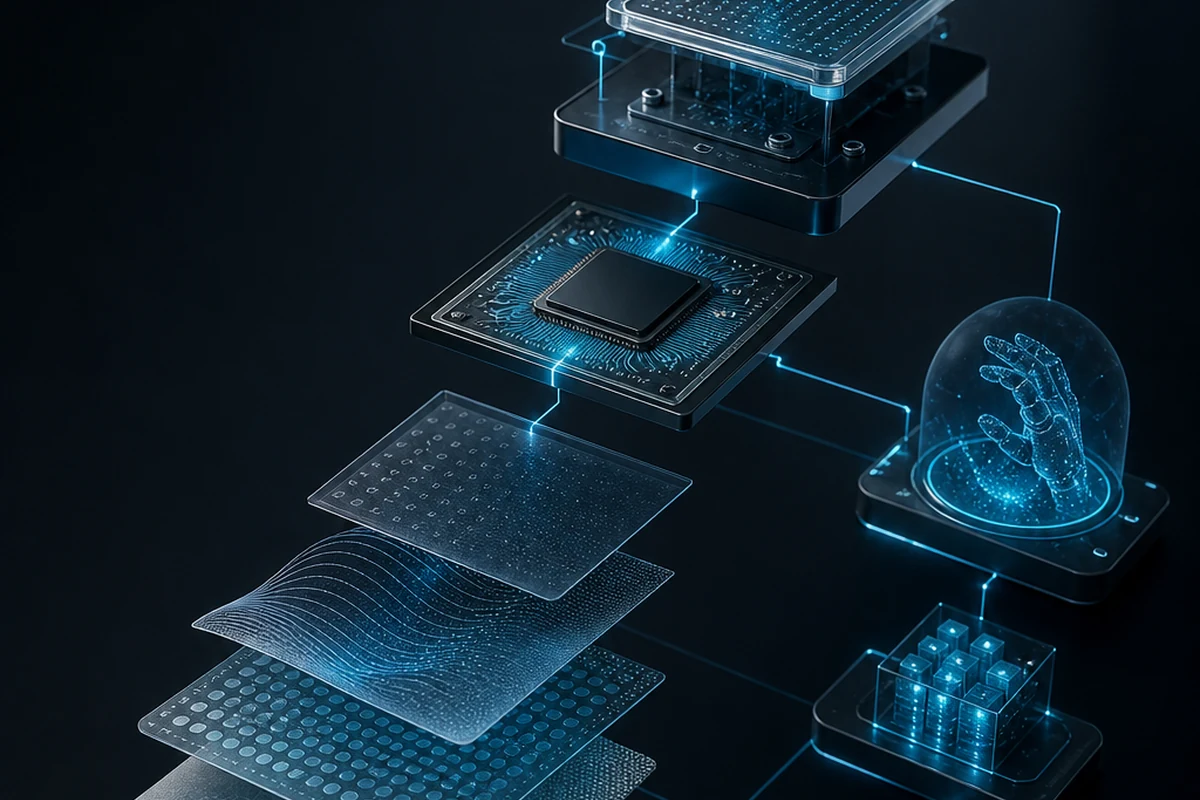
| Temporal tactile VQ-VAE | Encodes changing touch instead of only a static tactile frame | Which short-timescale events remain visible after compression? |
| Variable-rate Mixture-of-Transformers | Lets tactile-reactive processing coexist with slower VLA capabilities | What are the measured sensing-to-action latency and compute cost? |
| Twelve-task evaluation | Tests force-sensitive and deformable-object manipulation | How far does performance transfer beyond the paper's task and hardware distribution? |
The main conceptual contribution is temporal separation. A policy can retain slower semantic or visual reasoning while giving the tactile pathway a rate suited to contact dynamics. That does not mean every taxel should run through a large model at raw sensor rate; the source proposes a learned temporal representation and variable-rate processing strategy.
Artifact availability verified on August 22, 2026
The artifact status changed after the original RoboSkin review. The official T-Rex repository now provides post-training and inference code on its main branch, a separate full-pipeline branch for pretraining and midtraining code, hardware and teleoperation utilities, and dataset inspection tools. The maintainers also publish pretrained and midtrained checkpoints on Hugging Face.
The public T-Rex dataset is labeled MIT and its card currently specifies 5,464 episodes, 5,473,459 frames at 30 FPS (approximately 50 hours), 5,370 language-annotated trajectories, 22 motor primitives, and 207 objects in LeRobot v3.0. Its signals include head and bilateral wrist video, robot state and actions, ten fingertip tactile streams, deformation maps, and estimated 6D wrenches. The repository explicitly distinguishes this release from the complete 100-hour collection, so RoboSkin records both values instead of replacing one with the other.
Use the normalized T-Rex dataset record, T-Rex model record, and verified robot configuration to inspect the release, license, embodiment, and evidence boundaries separately.
Reported evidence
The abstract describes performance as more than 30% higher than the strongest baseline. The paper's original table and official project page resolve the unit: T-Rex averages 65%, while EgoScale averages 35%, yielding a 30-percentage-point absolute difference.
| Reported item | Value | Evidence boundary |
|---|---|---|
| EgoScale | 35% | Strongest listed baseline in the authors' Table 1. |
| T-Rex | 65% | Macro-average reported by the authors across the same 12 tasks. |
| Absolute gap | +30 percentage points | Arithmetic difference between 65% and 35%; the official project page labels it an absolute success-rate gap. |
| Evaluation count | 16 rollouts per task | The paper states that object positions and rotations are randomized across trials. |
All real-world experiments use one fixed-base bimanual Dexmate Vega-1 with two 22-DoF Sharpa Wave dexterous hands. The system observes a ZED head camera, two monocular wrist cameras, per-finger tactile force vectors, and deformation maps. The paper states that all compared methods use the same robot setup, action space, and evaluation protocol. Multi-stage tasks use progress-based rubrics, and results are averaged across trials and then tasks.
The correct interpretation remains narrow: within that author-run setup, the complete T-Rex system achieved a 30-percentage-point higher macro-average than EgoScale. The table does not establish the same gain for other robots, sensors, policies, datasets, or task distributions.
Why this matters for robot hands
Dexterous hands create distributed, changing contact over fingertips, finger links, and sometimes the palm. A static tactile cue may say that contact exists, while a temporal signal can expose whether load is rising, migrating, oscillating, or disappearing. T-Rex therefore sits between the broad robot hands architecture layer, the focused robot hand tactile sensing route, and the learned control layer described in tactile manipulation.
The project is also relevant to robot VLA models. It illustrates a design question for multimodal action models: how should a relatively slow language-conditioned policy interact with a faster contact feedback loop? The tactile AI guide provides the broader sensing-to-action context.
Dataset and benchmark implications
One hundred recorded hours is a collection-duration statement, not a complete measure of data diversity or effective sample size. Adjacent tactile frames are correlated, repeated motor primitives may dominate the distribution, and an hour of data can vary greatly in contact density and task coverage. Reproducibility claims must also distinguish the reported full collection from the approximately 50-hour subset currently available for download.
The tactile robotics dataset directory explains the metadata needed to evaluate reuse: robot, sensor, sampling rate, synchronization, task, object, trajectory count, failures, splits, format, and license. The tactile benchmark hub separates dataset scale from evidence about generalization and closed-loop success.
What this does not prove yet
T-Rex is an arXiv preprint, not an independently replicated result. The reported 100 hours, 12 tasks, 65% T-Rex average, 35% EgoScale average, and 30-percentage-point gap all come from the authors. The evidence is tied to one Dexmate Vega-1 and Sharpa Wave hardware configuration and does not establish universal superiority over every VLA, dexterous policy, or tactile encoder.
The result also does not isolate one causal factor by itself. Dataset collection, temporal encoding, variable-rate architecture, training choices, and evaluation design contribute to the complete system. Deployment decisions still need sensor calibration, synchronization, end-to-end latency, compute, durability, and failure-recovery evidence.
Evaluation checklist
- Report the 65% and 35% averages, the +30-percentage-point gap, and 16 rollouts per task together.
- Report task-level outcomes instead of only one average across 12 tasks.
- Document tactile sampling, timestamping, compression, and policy update rates.
- Split complete trajectories or sessions before extracting temporal training windows.
- Compare static-touch, temporal-touch, vision-only, and matched-compute baselines.
- Test unseen objects, materials, deformable states, contact failures, and new robot hands.
Primary sources
Check the data behind this research
Compare the reported collection with the publicly listed files, dataset license, split documentation and dated access evidence.
Read the directory’s public availability and reproduction analysis.
Continue the topic