Core concept
Tactile AI: touch data for Physical AI
Tactile AI turns robot touch signals into perception, learned representations, and action. Explore models, datasets, benchmarks, robot platforms, and Physical AI research.
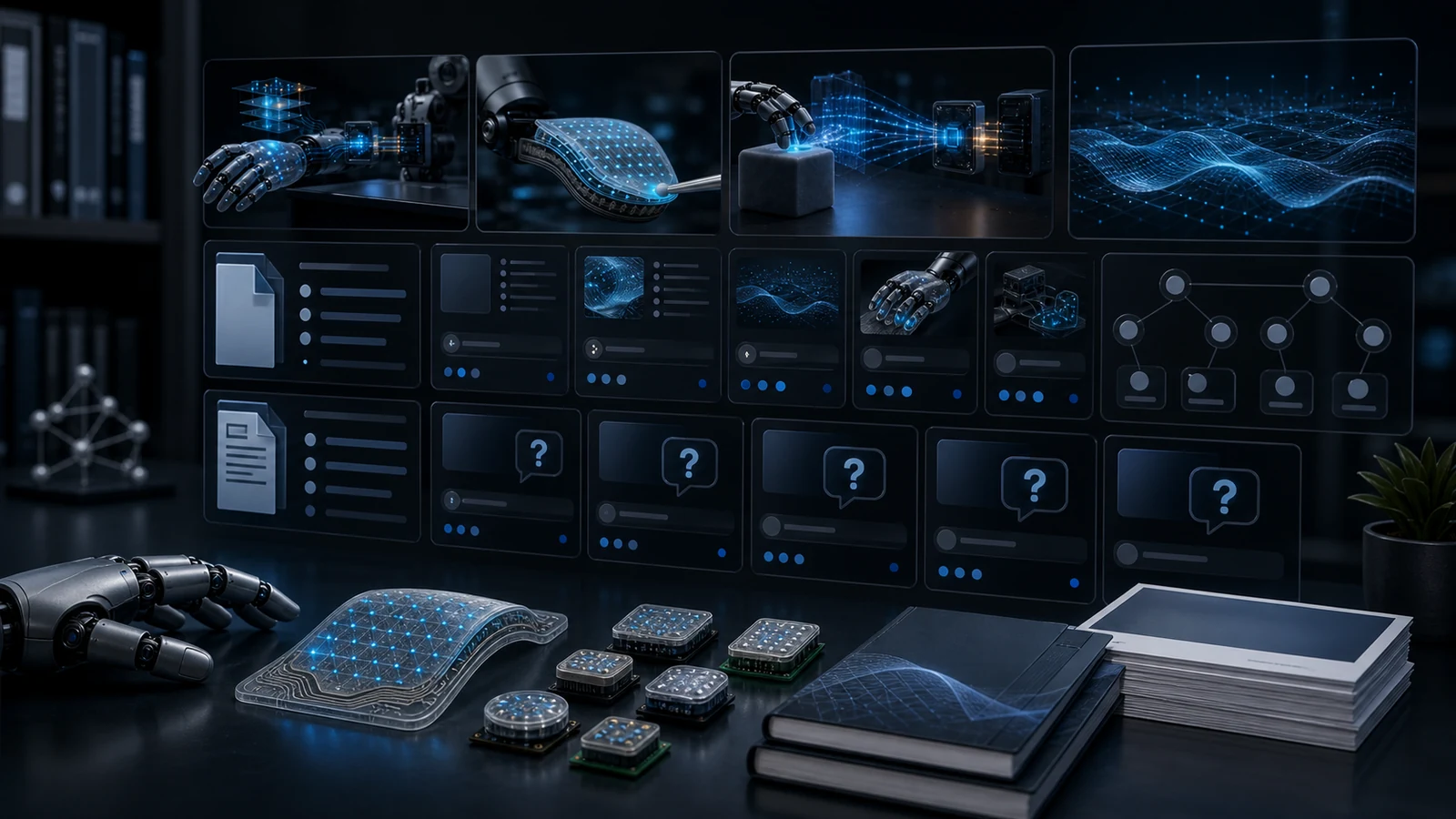
Short answer
What you need to know
- 1
Tactile AI is the sensing, data, and control workflow that turns touch signals into useful robot behavior.
- 2
It can support grasp confidence, slip response, contact-aware motion, safer interaction, and evaluation analytics for Physical AI systems.
- 3
The phrase is broader than a single tactile sensor. It describes the full stack from contact surface to model, controller, benchmark, and feedback loop.
Topic 01
Choose the integration point before comparing models
Three recent studies make different engineering decisions: detect an event for a separate controller, learn joint actions directly from tactile history, or render contact into a visual policy. Choose the decision your robot needs to make before comparing reported accuracy or success. The linked reviews use the original v1 papers and retain the training, timing and hardware limits.
| Decision to improve | Integration route | Evidence needed before deployment |
|---|---|---|
| Detect loss of grip | SlipSense combines pressure and vibration, then triggers regrasp. | Measure the delay distribution, false alarms and recovery failures separately. |
| Continue contact-rich motion | Touch2Trace predicts joint commands from tactile features and joint history. | Match control rate, history duration, pretrained encoder and distance-based success thresholds. |
| Use touch in an image-conditioned policy | Visible Touch projects contact markers onto camera images. | Validate geometry, signal normalization, policy training and complete-task success. |
Topic 02
Start a tactile AI experiment with a measurable question
Choose one output before choosing a model: a contact classification, an estimated physical quantity, a predicted tactile observation, or a robot action. Specify how an independent reference or a repeated task will tell you whether that output is useful. A good first experiment can be small, provided its measurement and success criterion are explicit.
For a hardware experiment, the DIGIT, GelSight Mini, and ReSkin guides document three different acquisition paths. For an experiment with existing data, the tactile dataset directory exposes the sensor, task, access, and split information to check before training. Use the experimental evidence module to see how a result changes meaning when its sample, comparator, or protocol changes.
- Keep raw measurements, calibrated quantities, model predictions, and controller actions distinguishable in the log.
- Record sensor identity, calibration state, timestamps, coordinate frame, robot state, action and task outcome.
- For a transfer claim, hold out the relevant objects, sessions, sensors or embodiments; random neighboring frames may share the same contact event.
- For a tactile-versus-vision comparison, keep the robot, tasks, controller budget and success criterion matched.
- Report the number of independent trials and failures with the metric. Count a subset once, and keep prediction error separate from task success.
| Starting point | Direct observation | First validation task |
|---|---|---|
| DIGIT optical fingertip | RGB frames from the documented Python interface. | Record the actual stream mode and unloaded gel appearance; validate any inferred depth or force against a separate reference. |
| GelSight Mini optical sensor | Camera images; example software adds 3D reconstruction. | Preserve preprocessing, model and scale settings; check reconstruction on reference shapes and recheck after changing the gel. |
| ReSkin magnetic skin | Magnetic channels and temperature readings from the magnetometers. | Keep skin placement and unloaded readings with the data; validate the calibration on the contacts and replacement skins you plan to use. |
| An existing tactile dataset | The released observations and annotations, as described by its source. | Confirm downloadable files and reuse terms, then define a held-out split whose unit matches the transfer claim. |
Topic 03
The tactile AI stack
A tactile AI stack starts with a contact surface and ends with an action or measurement loop. Between those endpoints, the system needs sensing materials, electronics, timestamps, calibration, feature extraction, model inputs, and robot middleware.
If the robot cannot use the signal in a control or evaluation loop, the system is only collecting touch data. Tactile AI begins when that data changes what the robot can decide or verify.
- Skin materials and sensor arrays collect local contact signals
- Signal processing filters, calibrates, timestamps, and compresses data
- Edge AI or analytics can classify slip, contact type, or grasp confidence
- Robot control uses tactile features for grasping, safety, and manipulation
Topic 04
Why tactile AI matters for humanoids
Humanoid robots and dexterous hands operate in contact-rich settings. Vision can guide the robot toward an object, but a hand often blocks the camera once grasping begins.
Touch data can reveal whether an object is seated correctly, sliding, deforming, or being squeezed too hard. That information matters for household tasks, warehouse handling, prosthetics, assistive devices, and research platforms.
Touch is not limited to the hand. Plantar pressure arrays can expose the support realized beneath a humanoid foot after touchdown, giving a locomotion policy spatial evidence about partial, asymmetric, compliant, or shifting contact.
Topic 05
What to validate before claiming tactile AI
Tactile AI claims should be tied to measured tasks. A demo that classifies contact on a benchtop is different from a robot hand that adjusts grip during motion.
Useful validation includes sensor drift, response time, synchronization with joint state, robustness after mounting, and whether the tactile signal improves a real robot behavior.
Topic 06
Tactile sensing and tactile AI are different layers
Tactile sensing is the measurement layer. Tactile AI is the larger perception-and-action system that turns those measurements into a representation, prediction, decision, or controller input. Keeping the boundary clear prevents a sensitive sensor demo from being described as an intelligent robot system without task evidence.
| Layer | Primary job | Typical output | Evidence question |
|---|---|---|---|
| Robot skin or tactile sensor | Measure physical contact at a surface. | Pressure map, force vector, slip event, vibration, temperature, or tactile image. | What is directly measured, at what rate, geometry, calibration, and repeatability? |
| Signal and representation | Condition, synchronize, map, and encode raw touch. | Calibrated frames, events, tokens, contact graphs, or learned embeddings. | Does the representation preserve the contact information required by the task? |
| Tactile model | Infer properties, predict contact futures, or select actions. | Class, latent state, future tactile observation, subgoal, or policy action. | Does it transfer across held-out objects, tasks, sensors, or robot embodiments? |
| Robot control and evaluation | Use touch to change behavior or verify an outcome. | Grip correction, trajectory change, recovery event, task result, or replayable log. | What improves over vision-only or no-touch baselines on the real robot? |
Topic 07
How tactile data becomes robot action
The operational chain is contact → sensing → calibrated and timestamped data → tactile representation → model inference → controller or policy → robot action → measured outcome. Each transition has a contract: units, coordinate frame, sampling rate, latency, uncertainty, and failure behavior.
A robust system keeps measured values separate from inferred values. For example, a pressure array may measure taxel response while a model estimates slip risk; the controller then decides whether to increase grip, regrasp, slow the motion, or stop. Logging all three levels makes the result auditable.
- Synchronize touch with vision, proprioception, commands, and task phase
- Register fingertips, palms, arms, or skin patches to robot coordinates
- Expose uncertainty and latency, not only a clean contact visualization
- Measure whether the tactile pathway changes manipulation or safety behavior
Topic 08
Relationship with VLA models, world models, and Physical AI
A vision-language-action model can provide semantic task context and propose actions, while tactile feedback supplies local physical evidence after contact. A tactile or visuo-tactile world model instead predicts how contact state may evolve under a candidate action. These roles can be combined, but a VLA label does not prove high-frequency touch control and a plausible world-model rollout does not prove safe execution.
Physical AI is the broader embodied system: vision observes the scene, language represents goals and knowledge, proprioception describes the robot body, and touch grounds the interaction at the contact surface. Tactile AI is the part of that system responsible for interpreting and using touch.
Topic 09
Current tactile AI research landscape
The systems below solve different parts of the stack and should not be collapsed into one leaderboard. The source status and hardware contract matter as much as a reported metric.
| Research asset | Tactile AI role | Primary evidence | Boundary |
|---|---|---|---|
| Sparsh-X | Self-supervised multisensory touch representation across image, audio, motion, and pressure. | Approximately 1M Digit 360 interactions plus physical-property and manipulation evaluations. | A 2025 preprint tied to its sensor, data, downstream tasks, and baselines. |
| HT-Bench / HandTouch | Full-hand tactile representation benchmark and vector-quantized visuo-tactile encoder. | 10M RGB frames, 7.8M tactile frames, 226 tasks, and four evaluation tracks. | A 2026 preprint; it does not claim a universal benchmark across every sensor or embodiment. |
| UniVTAC | Simulation-pretrained, 512-dimensional ResNet-18 tactile representation supplied to downstream task policies. | 205,826 encoder-pretraining samples; eight simulated tasks; and a three-task physical study. | A 2026 preprint. The encoder is not a VLA or foundation model, and its pretraining samples, policy trajectories, public episodes, physical demonstrations, and evaluation rollouts are different units. |
| TouchWorld | Predictive tactile subgoals plus fast reactive tactile correction around higher-level planning. | Six source-reported dexterous manipulation tasks in clean and perturbed settings. | A 2026 preprint; reported success remains protocol-specific. |
| ADEPT | Fingertip TacMap representations fused into an embodiment-specific reinforcement-learning policy. | One matched Flexiv-Sharpa insertion condition reports 3/10 vision-only versus 8/10 visuo-tactile final success. | A 2026 preprint with ten trials per modality in this single tactile ablation; KUKA experiments are vision-only. |
| Dream-Tac and FeelWorld | Action-conditioned prediction of future tactile or contact state for planning. | Source-reported contact-rich manipulation and planning experiments. | Prediction quality and task success are not universal hardware-transfer evidence. |
| Tac4Loco | Spatiotemporal plantar pressure representation for post-contact humanoid locomotion feedback. | Unitree G1 simulation and physical comparisons across rigid, inclined, partial, compliant, and granular support. | A 2026 preprint on one robot and bilateral FSR insole layout; the gravel result is qualitative. |
| EmArm | Whole-arm skin, proprioception, perception, and contact-aware control in one sensorimotor loop. | Peer-reviewed whole-arm localization, intent, manipulation, and replanning demonstrations. | One integrated platform does not establish identical performance on all humanoid surfaces. |
Topic 10
Research entities, datasets, benchmarks, and robot platforms
RoboSkin.ai tracks entities through their public research assets instead of presenting a vendor ranking. This keeps company, laboratory, sensor, and robot relationships traceable to primary sources.
| Institution or group | Public asset | Sensor or robot context | Why it belongs in the map |
|---|---|---|---|
| FAIR at Meta, University of Washington, and Carnegie Mellon University | Sparsh-X | Digit 360; insertion and in-hand rotation research | Multisensory representation learning and downstream manipulation. |
| TU Dresden, ScaDS.AI, and LASR Lab | RCT dataset and benchmark | Three DIGIT sensors on a robot collection rig | Contact-sequence and held-out-material evaluation. |
| ShanghaiTech University and InstAdapt | TactiDex | Whole-hand tactile glove; bimanual Franka Inspire deployment | Human-to-robot tactile skill transfer and benchmark structure. |
| OpenDriveLab research consortium | FreeTacMan | Wearable collection hardware; Piper and Franka interfaces | Scalable visuo-tactile demonstrations and policy-learning data. |
| HKUST (Guangzhou), University of Hong Kong, and Nanyang Technological University | Tac4Loco | Unitree G1 with 60-element FSR insole per foot | Post-contact support topology and temporal load transfer for humanoid locomotion. |
| ScaleLab at Shanghai Jiao Tong University and eight source-listed collaborators | UniVTAC | Simulated Franka Panda with GelSight Mini; physical Tianji Marvin with ViTai GF225 | Connects tactile simulation, representation pretraining, benchmark tasks, and protocol-bounded physical transfer. |
Topic 11
From robotic tactile sensing to a usable learning signal
Robotic tactile sensing supplies observations of contact; tactile AI depends on a defined representation, calibration target and data-quality contract. Keep raw image or sensor units separate from derived depth and force, and retain unknown values through preprocessing.
Start with a sensor-specific calibration plan, practice missing-data checks in the synthetic Python exercise, then inspect episode and timestamp conventions before combining observations with robot actions. None of these data exercises establishes physical sensor accuracy.
Topic 12
September research: learning from human and simulated touch
Two September 2026 preprints expose different data choices for tactile AI. DexTouch-WM transfers human glove observations into an action-conditioned robot world model using a shared tactile layout and motion retargeting. Bench2Dex provides a simulation pipeline for bimanual demonstrations, geometric tactile maps, and controlled policy evaluation.
Keep their evidence separate: better predicted contact does not guarantee better policies trained on synthetic observations, and a simulated tactile image is not a physical force measurement. Our September 18 source reviews examine the result definitions, data contracts, and release status before connecting either project to a training workflow.
Paper routes
Start with source-backed RoboSkin briefs
 Tactile AI / 2026-09-19UniVTAC separates tactile simulation, representation learning, and policy evaluationChoose the matching code branch and dataset before using UniVTAC. This guide separates its tactile encoder, simulation benchmark, public downloads and paper-reported physical results.Tactile AI / 2026-08-22Vision-based tactile intelligence connects sensor optics to robot actionA 2026 review maps vision-based tactile sensing as one integrated stack: deformable contact hardware, optical readout, tactile representations, learning, simulation, datasets, and robot action.
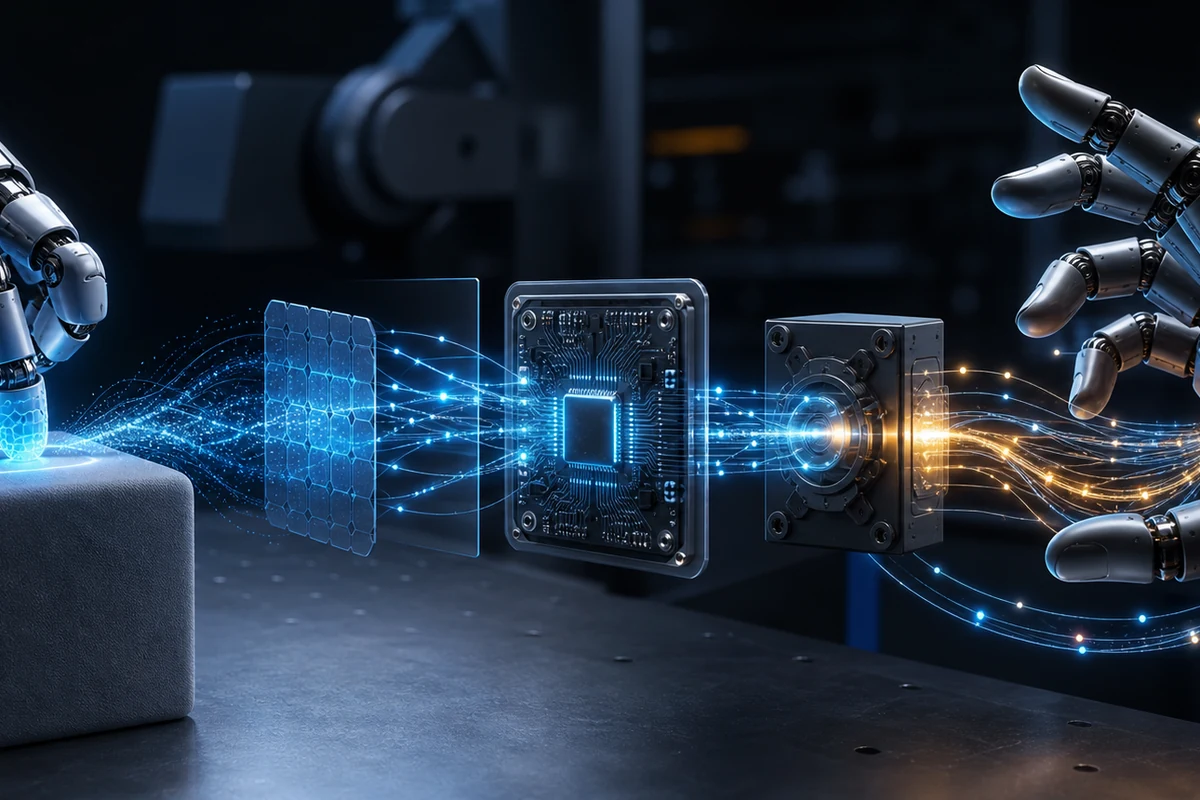 Robot learning / 2026-08-22ADEPT reports a 3/10 to 8/10 tactile ablation on dexterous insertionADEPT reports 3/10 vision-only versus 8/10 visuo-tactile final success in one matched Flexiv-Sharpa insertion condition, with ten physical trials per condition.
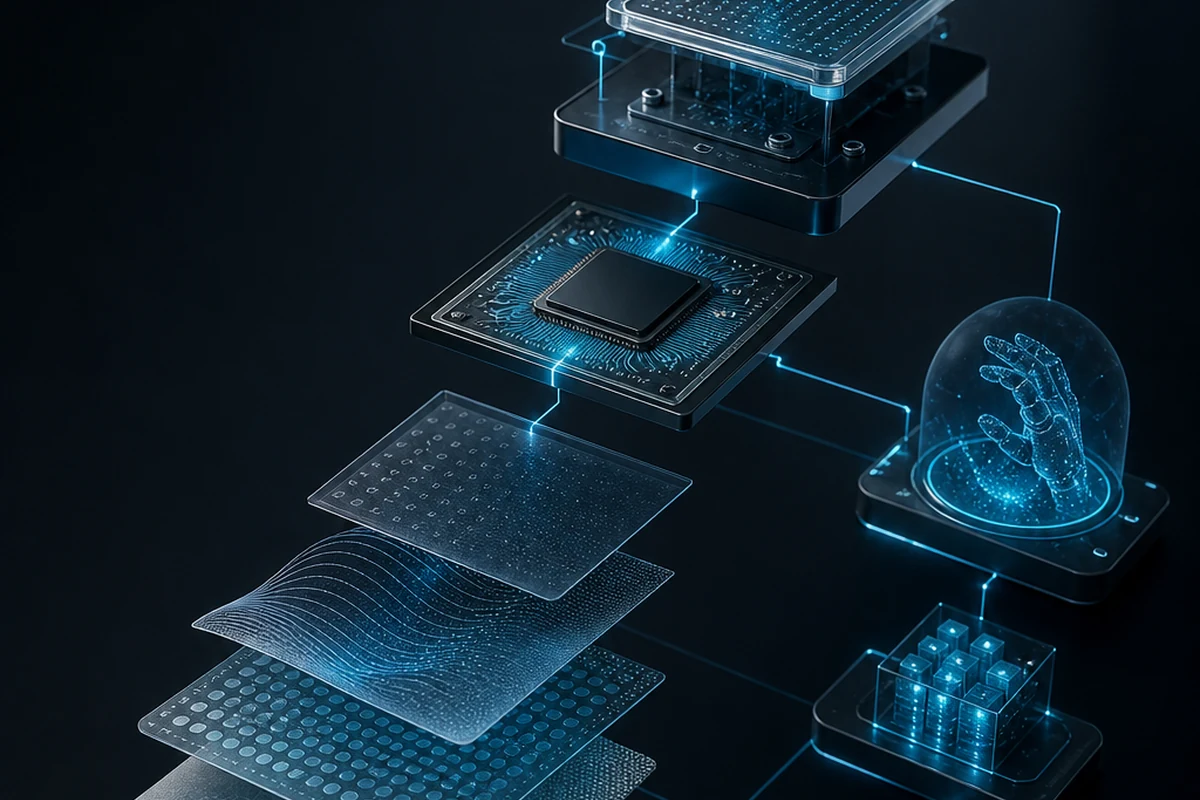 Humanoid tactile sensing / 2026-08-18Tac4Loco uses plantar pressure to adapt humanoid locomotionTac4Loco turns bilateral plantar pressure maps into post-contact feedback for Unitree G1 locomotion on slopes, partial support, foam, and gravel.Tactile AI / 2026-08-15FeelWorld predicts contact, tactile force states, and slip for robot planningFeelWorld adds explicit contact, force-related tactile, and slip prediction to a visual world model for contact-rich robot planning.Tactile AI / 2026-08-22HT-Bench full-hand tactile benchmark for robot manipulationHT-Bench v2 pairs egocentric vision with millions of full-hand tactile frames, corrects the vision-to-tactile metric split, and adds four real-robot evaluations.Tactile AI / 2026-06-18Sparsh-X multisensory touch representations for tactile AISparsh-X fuses image, audio, motion, and pressure from Digit 360, showing how multisensory touch can improve tactile AI for robot manipulation.Tactile AI / 2026-08-15Dream-Tac: A Unified Tactile World Action Model for Contact-Rich Robot ManipulationDream-Tac models action-conditioned tactile futures for contact-rich robot manipulation, showing why robot skin data needs prediction, not only reaction.
Common questions
FAQ for this topic
Is tactile AI only machine learning?
No. Machine learning can be part of tactile AI, but the stack also includes sensor design, signal processing, calibration, middleware, control, logging, and validation.
How is tactile AI different from tactile sensing?
Tactile sensing measures touch. Tactile AI organizes and uses touch data so a robot can classify contact, adjust behavior, or evaluate a manipulation task.
What is the best first page to read after this?
For hardware acquisition, start with the DIGIT, GelSight Mini or ReSkin sensor guide. For model training, use the tactile dataset directory to check access and splits. For evaluation, inspect the experimental evidence module and its sources before comparing scores.