AI and robotics hub
How artificial intelligence works in robots
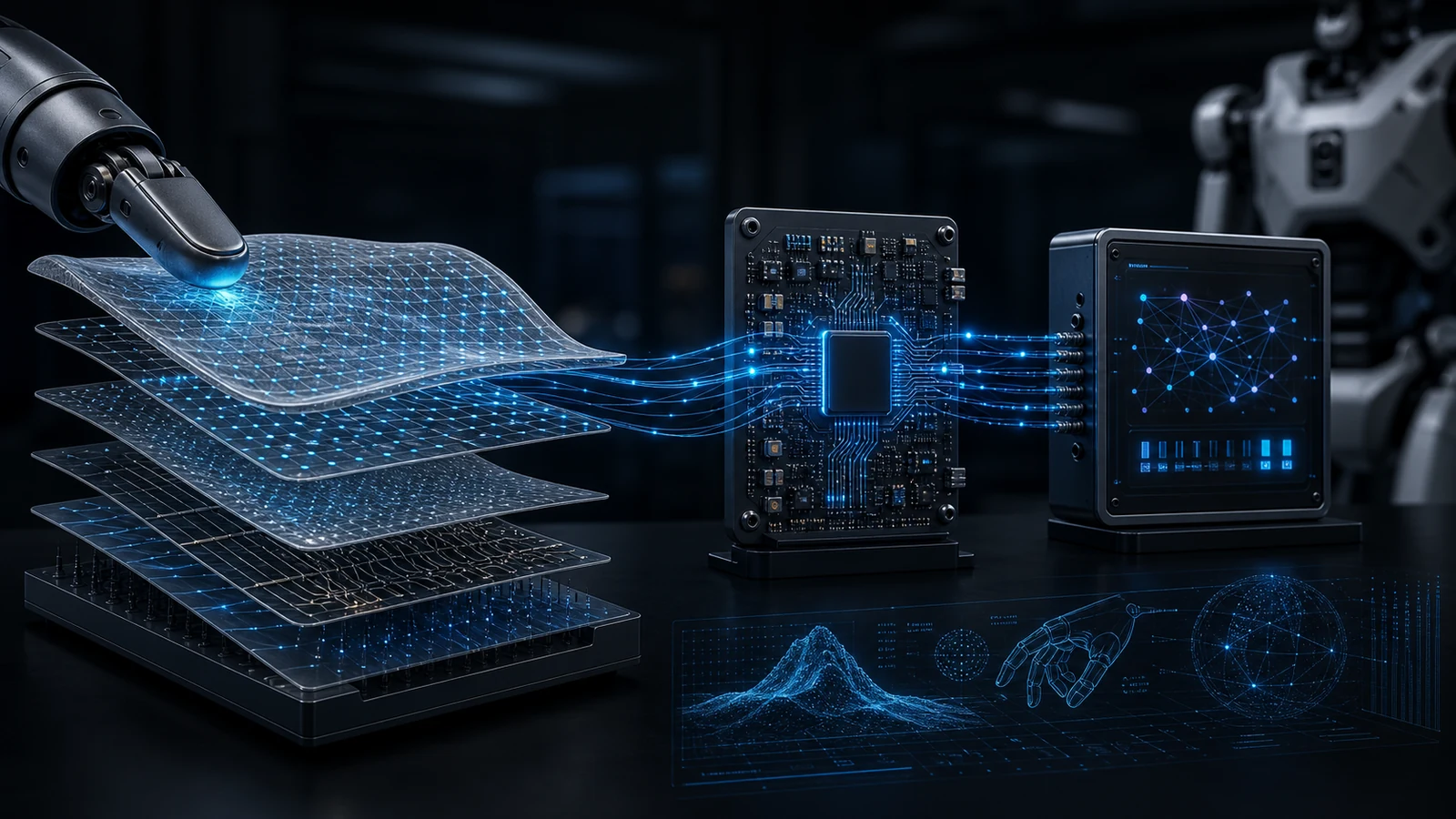
AI provides perception, reasoning, prediction, and learned policies; robotics provides sensors, control, actuators, safety, and a physical body. Map the closed loop from instruction to action and touch feedback.
- 7
- sections
- 5
- questions
- 18
- next routes
Short answer
What you need to know
- 1
Artificial intelligence and robotics are related but different. AI supplies methods for perception, prediction, learning, reasoning, and action selection; robotics supplies sensors, embodiment, actuators, control, integration, and physical safety.
- 2
They form a closed loop when a robot observes its environment, an AI model or engineered policy selects an action, controllers execute it through the robot body, and new sensor feedback reports what actually happened.
- 3
Touch closes the contact-specific part of that loop. Robot skin and tactile sensors measure physical interaction, while tactile AI interprets those signals so a policy or controller can respond.
Topic 01
AI and robotics are not the same thing
AI is a family of computational methods. Robotics is the engineering of machines that sense and act in the physical world. An AI system can operate entirely in software, and a robot can execute fixed, model-based, or manually programmed behavior without a learned AI model.
The useful overlap is an embodied system in which perception and decision methods are connected to a specific robot, action interface, controller, operating environment, and evaluation protocol. Calling a system an AI robot does not by itself identify any of those contracts.
| Question | AI layer | Robotics layer | Evidence boundary |
|---|---|---|---|
| What is observed? | Represents images, language, audio, robot state, or touch. | Sensors capture signals with hardware-specific rates, calibration, geometry, and failure modes. | A supported input modality does not prove that the robot uses it effectively. |
| What should happen next? | A model, planner, or learned policy proposes a state, subgoal, or action. | The robot exposes an action space constrained by its body, tools, workspace, and task. | A plausible plan is not evidence of successful physical execution. |
| How is motion produced? | The policy may output waypoints, poses, action chunks, or lower-level commands. | Controllers, actuators, estimation, and safety functions turn commands into motion. | A model output should not be described as torque-level control unless that interface is actually documented. |
| How is success known? | Models may classify outcomes, estimate value, or update a policy. | Measurements, task criteria, interventions, force, damage, and timing establish the result. | Provider demos and author-reported trials remain bounded to their stated protocol. |
Topic 02
The closed loop from instruction to physical feedback
A robot AI system is best understood as a loop rather than a single model: goal or instruction → multimodal observation → representation and state estimation → reasoning or planning → policy action → robot control → physical motion and contact → new observation.
Different systems combine or omit stages. Some policies map observations directly to actions; others use semantic subgoals, explicit planners, predictive models, or separate fast controllers. RoboSkin.ai records the implemented interfaces rather than treating one architecture as universal.
- Goals can come from language, a task specification, a human operator, or a programmed state machine.
- Observations can include vision, depth, audio, proprioception, force, torque, and tactile sensing.
- Policies select actions; low-level controllers track commands and respond at the robot and actuator level.
- Physical outcomes must return as measured feedback if the system is to detect error, contact, slip, or success.
Topic 03
VLM, embodied reasoning, VLA, world model, policy, and control
These labels describe different jobs and should not be collapsed into one capability claim. Google DeepMind, for example, publicly distinguishes an embodied-reasoning model from a vision-language-action model in its Gemini Robotics architecture; other research systems use different boundaries.
| Component | Primary job | Typical output | What the label does not prove |
|---|---|---|---|
| Vision-language model (VLM) | Connect visual observations with language and semantic knowledge. | Text, labels, answers, scene descriptions, or representations. | That its output is grounded in a robot action space or can control hardware. |
| Embodied reasoning (ER) | Reason about spatial state, affordances, task steps, or plans for an embodied agent. | Plan, subgoal, pose, code, tool call, or structured instruction. | That the proposed result can be executed safely or robustly by a specific robot. |
| Vision-language-action model (VLA) | Map observations and instructions into robot actions or action chunks. | Discrete or continuous commands in a documented action representation. | Cross-robot transfer, high-frequency contact response, or general physical intelligence. |
| World model | Predict future observations, states, contact, rewards, or outcomes under candidate actions. | A rollout, latent future, video, tactile state, or predicted transition. | That prediction alone selects or executes a successful action. |
| Robot policy | Choose an action from the current observation, state, history, or goal. | Joint, pose, gripper, torque, or higher-level command. | That the policy is learned; classical and hybrid policies are also possible. |
| Robot control | Estimate and regulate motion, force, balance, and actuator behavior. | Tracked trajectories, forces, torques, motor commands, or protective responses. | That a high-level AI model replaces control, integration, or safety engineering. |
Topic 04
Where robot learning and data fit
Robot learning uses data or interaction to improve a representation, predictor, reward model, policy, or controller. Demonstrations can come from teleoperation, scripted collection, existing datasets, simulation, autonomous rollouts, or corrections after failure.
A larger dataset does not automatically imply broader capability. Evidence should identify embodiments, sensors, action spaces, tasks, environments, human interventions, splits, access terms, and whether evaluation occurred on a physical robot.
- Use the robotics dataset route for broad demonstration, observation, action, access, and license fields.
- Use the robot teleoperation route to trace how human control becomes synchronized training data.
- Use the robot learning route for imitation, reinforcement, correction, transfer, and deployment evidence.
- Use the benchmark routes to keep dataset scale separate from evaluated robot performance.
Topic 05
How touch closes the physical contact loop
Vision can describe a scene and guide an approach, but cameras may not directly measure local pressure, shear, slip, deformation, or hidden contact after a hand or tool reaches an object. Tactile sensing supplies that local measurement channel.
Robot skin is the physical sensing surface. Tactile AI is the representation, inference, and action workflow that uses touch data. Depending on the system, touch can enter a multimodal policy, a predictive world model, a task evaluator, or a faster reactive correction loop. None of those roles should be inferred unless the source documents it.
| Touch layer | Role in robot AI | Minimum evidence |
|---|---|---|
| Robot skin or tactile sensor | Measures contact at a fingertip, palm, gripper, foot, arm, or body surface. | Sensor, modality, geometry, calibration, sampling, mounting, and repeatability. |
| Tactile representation | Converts raw taxels, force, vibration, pressure, or tactile images into model-ready features. | Training data, held-out protocol, sensor dependence, and task-relevant information. |
| Tactile policy or world model | Uses touch to select an action or predict contact evolution. | Action interface, comparison baseline, real-robot protocol, latency, and failure cases. |
| Contact-aware control | Changes grip, motion, force, recovery, or stop behavior from measured contact. | End-to-end response time and a measured behavioral difference under the same conditions. |
Topic 06
Physical AI and embodied AI in this map
Physical AI is used here as a broad industry term for AI systems that perceive, reason, and act through physical machines. Embodied AI is a broader research framing that can include physical robots as well as simulated or virtual embodied agents. Robotics remains the engineering discipline that supplies the machine and its physical interfaces.
These terms overlap, but there is no single model architecture implied by either label. The Physical AI page covers the broad system boundary; Physical AI and touch is the child route for tactile sensing and contact feedback.
Topic 07
How to evaluate an AI robot claim
Start with the robot and task rather than the model name. Record what the system observed, what the model produced, what controller executed, what human help remained, and how outcomes were measured. Then test the scope of any generalization claim.
- Identify the robot embodiment, end effector, sensors, compute path, and action representation.
- Separate training environments and objects from held-out evaluation conditions.
- Report trials, resets, interventions, failures, recovery, task time, force, and damage where relevant.
- Distinguish a project demonstration, provider-reported evaluation, preprint result, peer-reviewed result, and independent reproduction.
- Do not treat a VLM benchmark, simulated rollout, or generated video as real-robot task success.
Common questions
FAQ for this topic
What is the difference between AI and robotics?
AI provides computational methods for perception, learning, prediction, reasoning, and action selection. Robotics engineers physical machines with sensors, actuators, controllers, integration, and safety. They overlap when AI methods are connected to a robot observation-and-action loop.
Do all robots use artificial intelligence?
No. Robots can use fixed logic, state machines, classical planning, feedback control, teleoperation, learned models, or hybrids. The presence of sensors and automation does not by itself prove that a robot uses AI.
Is a VLM the same as a robot VLA model?
No. A VLM connects vision and language, while a VLA model adds an action output tied to a documented robot action representation. A VLM can support reasoning or planning without directly controlling a robot.
Why does robot AI need tactile feedback?
Touch can measure local physical interaction that vision and language do not directly observe, including contact, pressure, shear, slip, and deformation. Its value depends on whether the signal is calibrated, synchronized, and used by evaluation, a model, a policy, or a controller.
Does a world model control a robot?
Not necessarily. A world model predicts possible future states or observations. A planner or policy may use that prediction to choose an action, while a controller executes commands on the robot.