Dream-Tac: A Unified Tactile World Action Model for Contact-Rich Robot Manipulation
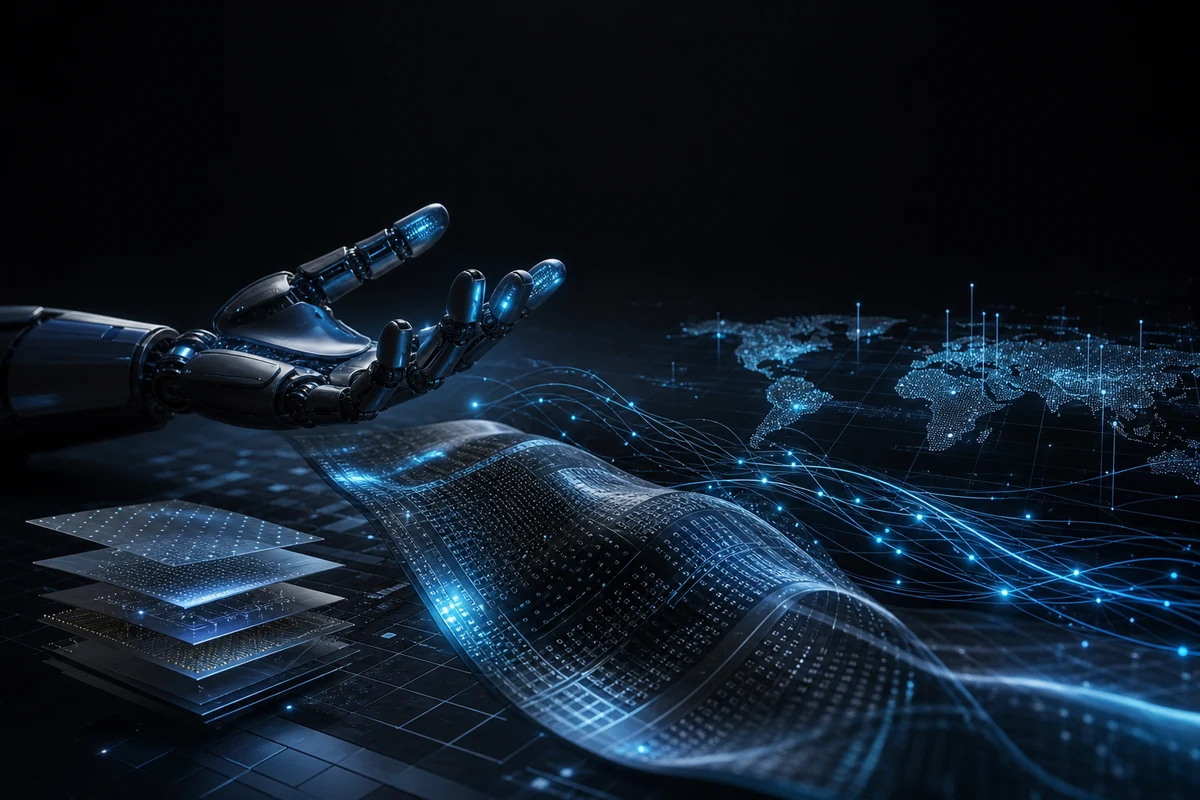
Dream-Tac models action-conditioned tactile futures for contact-rich robot manipulation, showing why robot skin data needs prediction, not only reaction.
Updated technical brief - June 2026
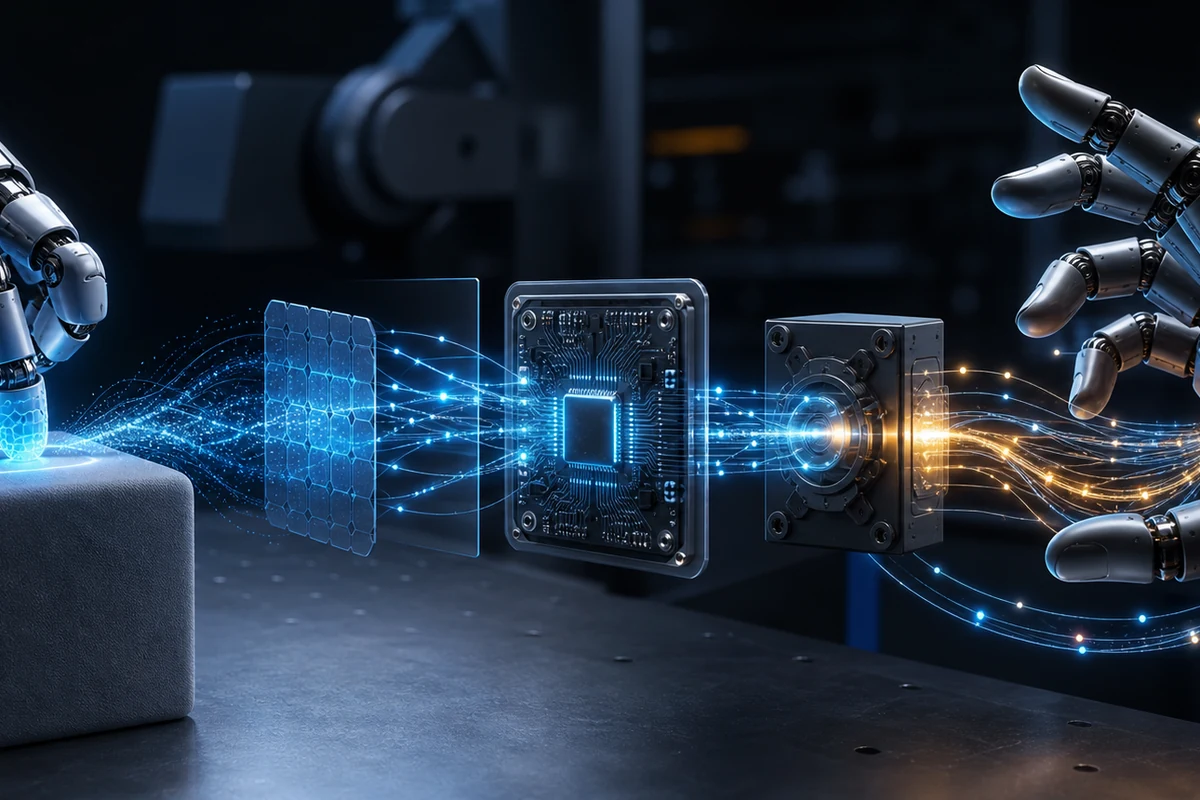
Dream-Tac is a unified tactile world action model for contact-rich robot manipulation. It predicts future visual and tactile observations conditioned on robot actions, addressing the gap between sensing current contact and anticipating what happens next. For robot skin and tactile AI, that matters because predictive contact data can inform regrasping, insertion, slip response, and failure analysis.
Source findings
Many tactile policies react to what the sensor reports now. Contact-rich manipulation often needs more than reaction. The robot needs to predict how contact will evolve after an action: whether the object will slip, rotate, jam, release, or settle into a stable grasp.
The Dream-Tac preprint is useful because it integrates tactile sensing into a world-action model. The source explicitly models future visual and tactile observations conditioned on robot actions. For RoboSkin.ai, this points toward a stronger tactile AI standard: robot skin should support prediction, not only detection.
The paper adds contact-gated visuo-tactile fusion and contact-aware attention. Its abstract reports up to 2.9x faster training, 1.8x faster inference, and a 31.7% average action-accuracy improvement across six contact-rich manipulation tasks. These are source-reported preprint results tied to the authors' model, tasks, acceleration design, and baselines.
RoboSkin analysis
A tactile world model links action, visual state, tactile state, and future contact dynamics. Instead of treating tactile feedback as an isolated signal, it becomes part of a model that estimates what will happen next. That is important for insertion, regrasping, manipulation under occlusion, and tasks where contact changes faster than vision can resolve.
| Model input | Why it matters | Evaluation question |
|---|---|---|
| Visual state | Object pose and scene context | Does vision lose contact after grasping? |
| Tactile observation | Local force, contact, or deformation | Does it predict hidden state? |
| Robot action | What the policy intends to do | Does the model predict action effects? |
| Future tactile state | Expected contact evolution | Can it warn about slip or jam? |
Engineering implications
This source matters because it moves robot skin content away from sensor specs alone. A sensor can be sensitive and still weak if the policy cannot use it predictively. A tactile world model asks whether robot skin data can support action-conditioned reasoning.
The practical challenge is data. World models require consistent trajectories, synchronized streams, and enough diverse contact examples to avoid learning only a narrow lab distribution. That ties Dream-Tac back to data collection systems and tactile datasets.
What this means for robot skin
For robot skin, Dream-Tac changes the question from "can the surface detect contact?" to "can the robot predict what contact will do next?" A useful tactile skin does not only publish pressure, deformation, or slip hints. It should produce data that can be aligned with actions, replayed after failure, and used by models that estimate future contact outcomes.
This makes Dream-Tac a bridge between sensor pages and software pages. Readers should compare it with the visuo-tactile world model guide for the broader 2026 model landscape and the ROS 2 tactile sensor pipeline for replayable data handling.
What this does not prove yet
Dream-Tac does not prove that one tactile world model will generalize across every robot hand, gripper, sensor material, and manipulation task. It also does not remove the need for careful sensor calibration, synchronized data, and real-world failure analysis. The model can only learn useful contact dynamics when the training data covers the contacts that matter.
Where this fits next
The next route is a stack question: tactile sensing captures contact, a ROS 2-style pipeline records and replays it, calibration-transfer work keeps force labels usable across sensors, and world-action models try to predict what will happen after the next robot action. That stack is the practical path from robot skin data to Physical AI behavior.
Practical questions
- Is Dream-Tac a robot skin sensor? No. It is a tactile world-action model; the robot skin relevance is how tactile observations can support action-conditioned prediction.
- Why does this matter for Physical AI? Physical AI systems need to act under contact uncertainty, and tactile world models give them a way to reason beyond the current reading.
- What should readers open next? Start with ROS 2 tactile sensor pipeline for data replay and GenForce transferable force sensing for calibration transfer.
Evaluation checklist
- Check whether the model predicts future tactile observations, future actions, or both.
- Ask what tactile sensor type and sampling rate were used.
- Review whether tasks include hidden contact dynamics such as slip, insertion, or jamming.
- Separate simulation performance from real robot transfer.
- Ask whether prediction errors are interpretable during failure.
- Compare against reactive tactile policies and vision-only policies.
What not to infer
This source does not mean tactile world models are ready for arbitrary robot hands. It also does not mean more tactile data automatically produces better prediction. World models can fail when the sensor changes, the task distribution shifts, or contacts become too different from training data.
Tactile AI benefits from prediction and replay. Robot skin data becomes more valuable when it helps a robot anticipate contact outcomes before failure.
Source
arXiv: Dream-Tac: A Unified Tactile World Action Model for Contact-Rich Robot Manipulation
Continue the topic