Runnable project · Python verified
Inspect the dataset format ->LeRobot episodes, timestamps and validation
Understand v3 storage and run a bounded numeric checker on valid and broken synthetic Parquet fixtures.
Choose what you need to do, then follow a guide, sensor record, dataset, or paper review. The complete directory below is grouped by subject so you can move from a question to the relevant evidence.
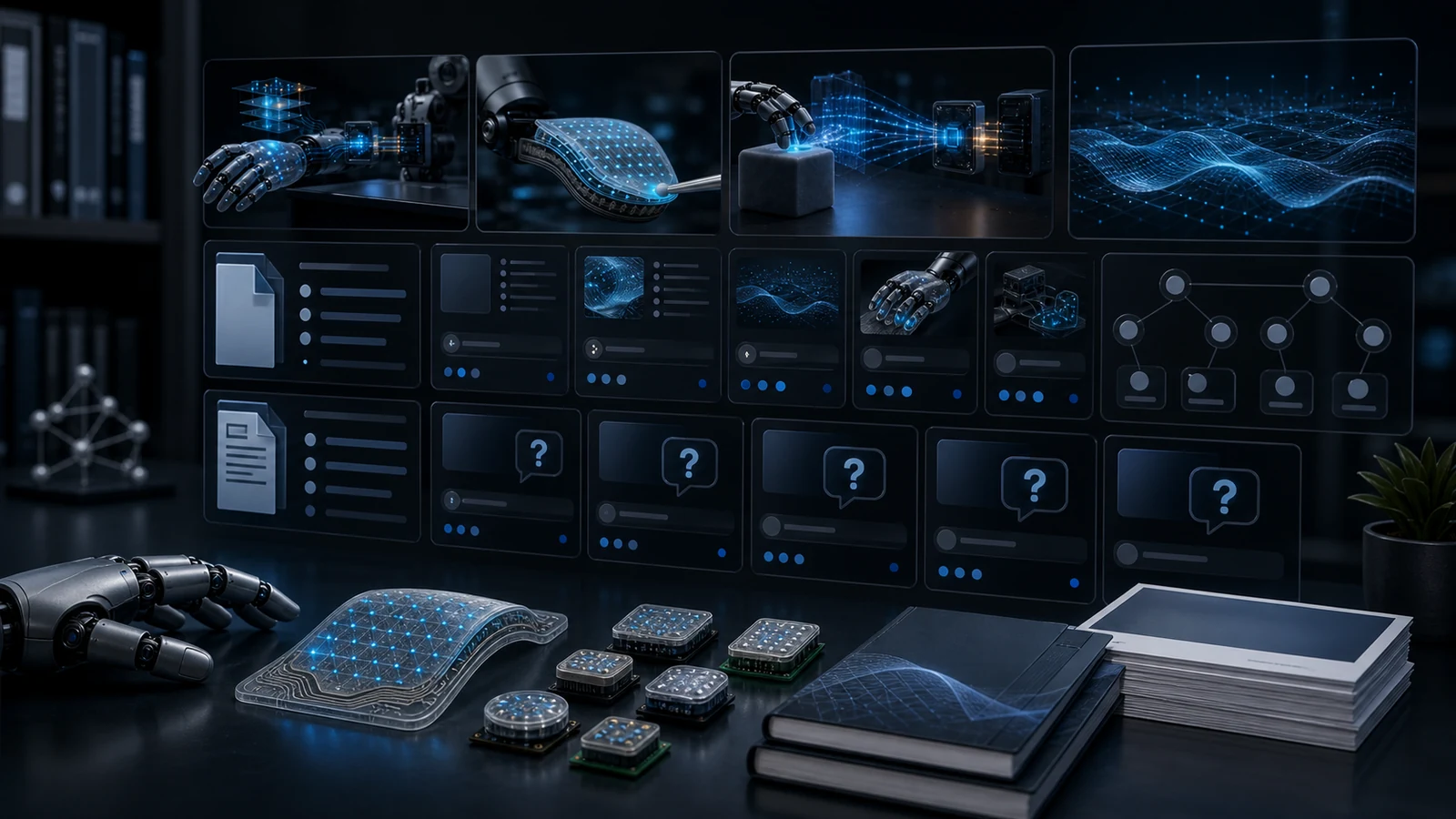
Three learning paths from terminology to hardware and usable robot data.
Start with slip, missing body contact, calibration drift, or data access.
Find sensor principles, documented outputs, software, and source evidence.
Check modalities, file availability, licenses, tasks, and evaluation splits.
Runnable project · Python verified
Inspect the dataset format ->Understand v3 storage and run a bounded numeric checker on valid and broken synthetic Parquet fixtures.
Source-based workflow · no hardware experiment
Prepare a calibration workflow ->Separate image, depth and force targets and download a blank calibration record with units, repeats and references.
Learning path
Explore the programming path ->Choose Python and ROS 2 tools, learn without hardware, and connect sensor data to robot learning.
Runnable project · Python verified
Run the Python exercise ->Download a complete synthetic CSV exercise with quality checks, generated plots and contact-event exports.
Source-checked walkthrough · runtime pending
Read the ROS 2 walkthrough ->Build the starter kit, inspect its message contract and follow the recording workflow. Local ROS runtime checks remain pending.
Public guide
Explore ->Read a plain-language route into robot skin, tactile AI, e-skin, and tactile sensing terminology.
Public guide
Explore ->Understand how the site supports robotics education, research notes, and source-backed category pages.
Public reference
Read ->Review definitions for robot skin, tactile AI, e-skin, slip detection, and multimodal tactile sensing.
Public explainer
Read ->Understand Physical AI as a full physical perception, reasoning, policy, control, embodiment, safety, and feedback system.
Public reference
Read ->Read guidance about how to interpret public robot skin and tactile AI source boundaries.
Contact path
Send note ->Use the contact route for corrections, partnership, or content collaboration around RoboSkin.ai.
Contact path
Send note ->Suggest sources, corrections, or additions that improve robot skin and tactile AI category coverage.
Complete guide directory
Definitions and system concepts before choosing a component or model.
AI provides perception, reasoning, prediction, and learned policies; robotics provides sensors, control, actuators, safety, and a physical body. Map the closed loop from instruction to action and touch feedback.
Core conceptRobot skin is a tactile sensing surface for robots. Learn how robot skin relates to tactile AI, e-skin, humanoid hands, grippers, and contact-aware robotics.
Core conceptTactile AI turns robot touch signals into perception, learned representations, and action. Explore models, datasets, benchmarks, robot platforms, and Physical AI research.
Core conceptE-skin, or electronic skin, is a flexible sensor surface. Learn how e-skin connects to robot skin, soft robotic skin, tactile sensors, and humanoid robots.
Technology guideTouch grounds Physical AI in real contact. Learn how tactile sensing combines with vision, language, proprioception, world models, robot learning, and control.
Evaluation guideCompare binary contact switches, force measurements, and tactile arrays. Choose the signal your robot needs and plan a first contact-sensing test.
Comparison guideCompare robot skin and e-skin. Learn where the terms overlap, where they differ, and how tactile AI connects electronic skin to robot behavior.
Comparison guideCompare robot skin and tactile sensor terms. Learn when a robot needs a tactile sensor, when it needs robot skin, and how tactile AI connects the system.
Tactile feedback · evidence reviewDoes better touch sensing improve robot manipulation? Compare detection, control and task evidence from six studies, with trial counts, training limits and verified resource access.
Sensor hardware, measurement tradeoffs, and evidence for a shortlist.
Evaluate the original DIGIT tactile sensor: paper specifications, Python stream settings, design files, calibration needs, repository status, and reuse terms.
Sensor evidence / Commercial optical touchReview GelSight Mini specifications, RGB and 3D workflows, calibration limits, replaceable gel, Python examples, and evidence for robotics use.
Sensor evidence / Magnetic tactile skinUnderstand ReSkin magnetic tactile sensing: replaceable elastomer, five-magnetometer design, 400 Hz research setup, Python data collection, and calibration evidence.
Technology guideFlexible tactile sensor arrays measure contact across curved robot surfaces. Learn how arrays relate to robot skin, e-skin, calibration, and tactile AI.
Evaluation guideA tactile sensor for robots measures pressure, force, slip, strain, or contact maps. Compare sensors for robot hands, grippers, and robot skin.
Sensor comparison guideCompare visual, acoustic, magnetic, and resistive tactile sensors by manipulation task, signal, integration constraint, and evidence boundary.
Source-reviewed sensor directoryCompare tactile sensors for robot hands, grippers, and skins by sensing principle, signal, form factor, rate, integration, access, and evidence boundary.
Hands, grippers, soft bodies, manipulation, and contact evaluation.
Humanoid robot skin brings tactile sensing to hands, arms, and body surfaces. Map the whole-body tactile stack, safety boundaries, sensors, datasets, and research.
Application guideRobot hand tactile sensors help dexterous hands detect contact, slip, force patterns, and grasp stability. Learn where fingertip, palm, and full-hand sensing differ.
Application guideSoft robotic skin uses flexible sensing surfaces for curved robots, grippers, prosthetics, and soft machines. Learn how it differs from generic e-skin.
Evaluation guideRobot gripper tactile sensors help detect contact, pressure patterns, slip, and grasp stability. Learn what to evaluate before choosing tactile sensing for grippers.
Evaluation guideSlip detection helps robot hands and grippers react before an object drops. Learn the tactile signals, validation questions, and robot-control constraints.
Tactile AI pillarLearn how tactile manipulation turns contact, pressure, shear, and slip into closed-loop robot actions for grasping, insertion, dexterity, and Physical AI.
High-interest robotics pillarUnderstand humanoid robots through perception, robot learning, whole-body control, dexterous hands, safety, tactile sensing, and Physical AI evidence.
High-interest robotics task pillarExplore robot manipulation across grasping, dexterous hands, insertion, robot learning, VLA policies, force control, tactile feedback, and evaluation.
Robotics hardware pillarCompare robot hands and grippers by actuation, sensing, control, task fit, and evidence. Learn how tactile robot hands support dexterous manipulation.
Robotics assurance pillarUnderstand industrial and humanoid robot safety, ISO 10218 scope, risk reduction, collision and contact sensing, validation, and robot-skin evidence boundaries.
Training inputs, model roles, artifact access, and evaluation protocols.
Compare OpenVLA, Octo, RT-2 and other robot AI models by training data, robot compatibility, code and weight access, tactile input, and evaluation evidence.
Source-linked dataset directoryFind tactile and visuo-tactile datasets for robot learning. Filter by sensor, robot and task; compare primary download links, license status and split design.
Tactile AI model guideCompare tactile foundation models and related robot-learning systems by representation, prediction, policy role, evidence, and transfer limits.
2026 world-model guideCompare VT-WM, Dream-Tac, TouchWorld, ViTacWorld and FeelWorld: what each predicts, how it guides robot actions, reported results and limits, with primary sources.
Structured benchmark directoryCompare tactile robotics benchmarks by task, sensor, robot, modality, metric, split protocol, access, and evidence boundary.
Multimodal tactile AI pillarUnderstand visuo-tactile robotics: how robots align vision and touch for contact perception, representation learning, world models, and manipulation.
Vision-language-action guideWhat is VLA in robotics? Learn how vision-language-action models work, compare 11 models, and find OpenVLA, UniTacVLA and VLA-Touch code and access details.
High-interest robotics pillarLearn how robots learn from demonstrations, reinforcement, datasets, simulation, and touch, with source-backed guidance for real-world evaluation.
Robot data pillarCompare robotics datasets by robot, task, modality, action space, timing, access, and license. Find robot learning, manipulation, teleoperation, VLA, and humanoid data.
Robot learning model pillarLearn how robot world models predict future states for planning and control, how they differ from VLA and foundation models, and where tactile prediction fits.
Robot data collection pillarLearn how robot teleoperation captures demonstrations for robot learning and VLA training, including interfaces, synchronization, quality control, limits, and evaluation.
Python, ROS 2, calibration, and dataset-format workflows.
Start robotics programming with Python, ROS 2 and sensor feedback. Follow a hardware-free tactile data exercise, then explore messages, replay and robot learning.
ROS 2 tutorialBuild the RoboSkin ROS 2 starter kit, inspect normalized tactile arrays and use rosbag2 to record and replay. Includes verified source references and explicit runtime limits.
Python tutorialRun a hardware-free Python exercise with synthetic tactile CSV data. Validate missing values and timestamps, plot a heatmap, detect teaching contact events and export results.
Robot data tutorialUnderstand LeRobot dataset v3 metadata, Parquet, video and episode timing. Run a small Python checker on synthetic numeric data and inspect its limits.
Tactile engineering guidePlan DIGIT and GelSight Mini calibration: separate image baselines, depth reconstruction and force estimation, then record references, repeats and uncertainty.
Paper discovery and the sources behind named research projects.
Browse source-backed robot skin papers and research routes for tactile sensing, e-skin, soft robotic skin, robot hands, and tactile AI.
Historical research projectA source-backed record of the EU FP7 ROBOSKIN project, its robot-skin research scope, funding, partners, 2013 Springer paper, and relationship to RoboSkin.ai.
Trusted external references
RoboSkin.ai keeps external links narrow and useful. These resources help readers align terminology and avoid unsupported product claims.
For robotics and embedded-system hardware development, Vigor Components provides access to electronic components, connectors, power devices, and sourcing resources that can support BOM planning and prototype-to-production workflows.
For motor-drive and industrial power electronics component information, see SHYSEMI power semiconductors (IPM, IGBT and SiC).
Start with source-backed research, terminology, or a research inquiry depending on what you need to understand.