Technology guide
Physical AI and touch
Touch grounds Physical AI in real contact. Learn how tactile sensing combines with vision, language, proprioception, world models, robot learning, and control.
Updated 2026-08-22 by RoboSkin.ai Editorial Team
- 7
- sections
- 3
- questions
- 11
- next routes
Short answer
What you need to know
- 1
Physical AI touch data is contact information collected from robot surfaces during real interaction with objects, people, tools, or environments.
- 2
It complements vision because the robot often needs feedback at the exact surface where contact happens, especially when the hand blocks the camera.
- 3
Useful touch data is timestamped, calibrated, mapped to robot geometry, and connected to control, evaluation, or learning workflows.
Topic 01
Why vision is not enough
Vision can help a robot identify an object and plan an approach. Once the robot touches the object, the hand, gripper, or tool may occlude the most important part of the scene.
Touch data gives Physical AI a local signal after contact. It can reveal slip, seating, deformation, force patterns, contact timing, and unexpected interaction events.
- Grasp stability when cameras are blocked
- Safety contact during human-robot interaction
- Task evaluation through replayable tactile logs
- Feedback loops for manipulation and robot learning
Topic 02
What makes touch data useful
Raw tactile signals are not automatically useful. They need consistent timing, calibration, coordinate mapping, metadata, and interfaces that robot software can consume.
A useful Physical AI touch-data workflow covers the full lifecycle: capture, condition, align, store, interpret, act, and evaluate.
Topic 03
Where robot skin fits
Robot skin is one way to collect touch data at the surface. A tactile sensor array, soft skin, fingertip pad, or full-hand skin can all produce contact signals for a Physical AI stack.
The practical connection is the data path from contact event and calibration through timestamps, robot state, control, and task-level evaluation.
Topic 04
Touch data pipeline for embodied AI
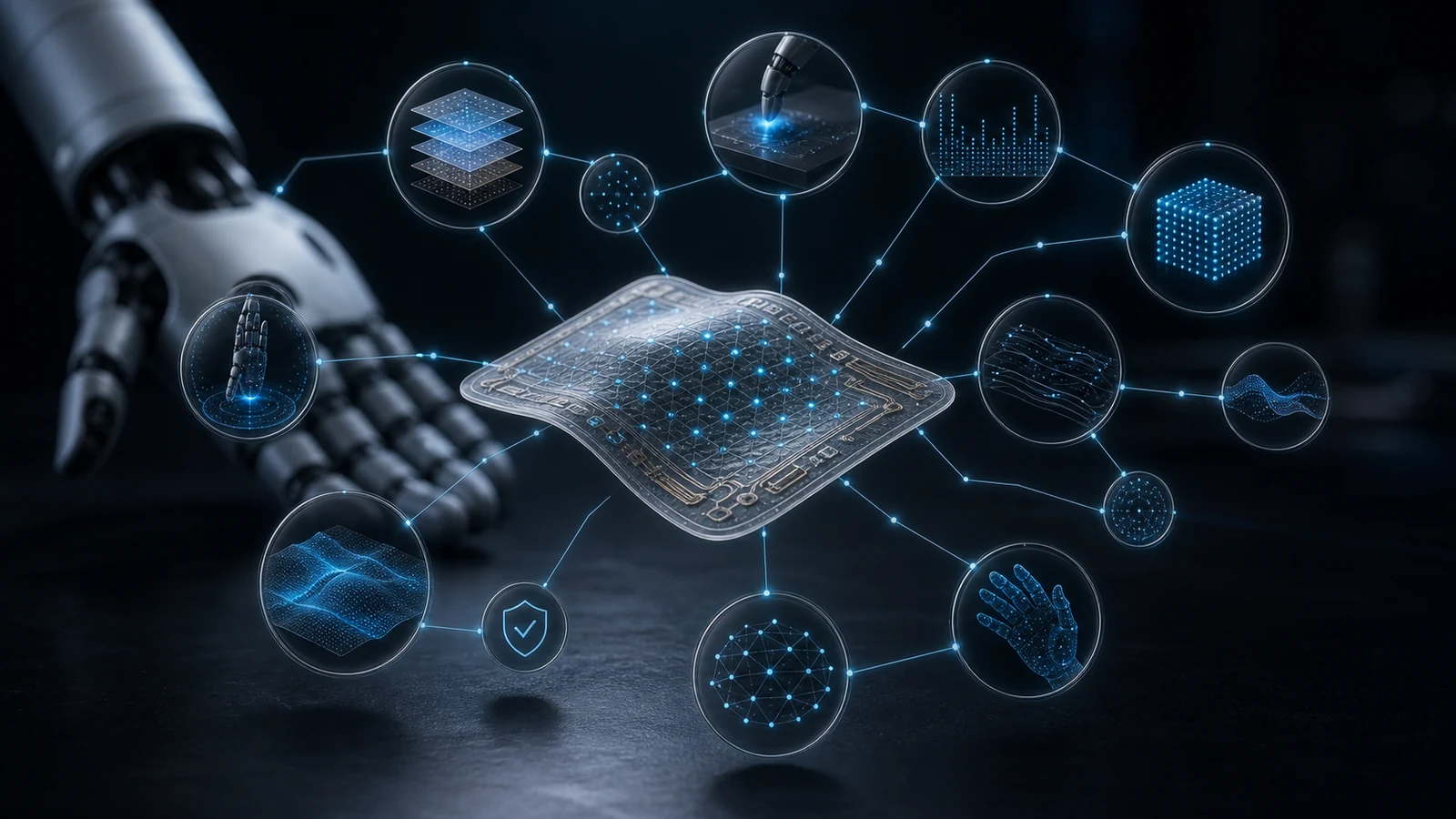
A touch data pipeline for embodied AI should preserve each contact event, timestamp, body frame, calibrated value, and robot action so the signal can be replayed, compared, and used outside the original demo. Without that path, a tactile sensor produces measurements but not durable Physical AI evidence.
The pipeline begins at the contact surface, moves through electronics and calibration, aligns with robot state, stores metadata, and then feeds control, evaluation, or learning. Each stage should be visible enough that another team can understand what was measured and what was inferred.
- Capture: contact event, timestamp, body frame, calibrated value, and robot action
- Align: synchronize tactile data with joint state, vision, commands, and task phase
- Store: retain calibration metadata, sensor location, units, sampling rate, and failure notes
- Use: expose features for grasp control, safety checks, replay diagnostics, or learning systems
Topic 05
The multimodal perception stack for Physical AI
Physical AI combines complementary channels rather than treating one sensor as sufficient. Vision describes visible geometry and motion, language encodes goals and semantic context, proprioception reports the robot body, and touch measures the contact that results when an action meets the world.
| Channel | Best evidence | Typical blind spot | Role after fusion |
|---|---|---|---|
| Vision | Scene, object, pose, motion, and free-space geometry. | Occlusion and hidden contact state. | Approach planning, object context, and visible outcome. |
| Language | Task goals, instructions, concepts, and prior knowledge. | It does not directly measure the current physical interaction. | Semantic planning, task decomposition, and explanation. |
| Proprioception | Joint state, robot pose, velocity, and internal body configuration. | It may not localize or characterize surface contact. | Embodiment state, control, and coordinate alignment. |
| Touch | Local pressure, force, shear, slip, vibration, temperature, deformation, or contact geometry. | It is local, hardware-specific, and calibration-dependent. | Contact grounding, correction, recovery, and task verification. |
Topic 06
Touch in VLA models and world models
A VLA policy can connect visual observations and language goals to robot actions, but touch may require a faster feedback pathway than semantic planning. TouchWorld, for example, separates higher-level planning and tactile subgoal prediction from high-frequency tactile residual correction. That architecture is one research result, not a universal prescription.
Visuo-tactile world models predict possible visual and contact futures under candidate actions. Their value must be tested twice: whether the predicted tactile state is physically informative, and whether using that prediction improves planning or control on the real robot. Offline image similarity alone is not a Physical AI benchmark.
Topic 07
Minimum evidence for embodied tactile intelligence
A credible Physical AI touch claim should identify the measured signals, robot and sensor, data alignment, model role, control rate, baseline, task outcome, and transfer boundary. The most useful ablation compares vision-only, touch-only where meaningful, fused input, and no-feedback or reactive baselines under the same task protocol.
- Held-out objects, surfaces, tasks, sensors, or embodiments matched to the transfer claim
- Latency from contact to controller-usable feature and robot response
- Failures under occlusion, slip, misalignment, force mismatch, and external disturbance
- Replayable logs that preserve observation, action, prediction, measured touch, and outcome
Common questions
FAQ for this topic
Is Physical AI touch data only for training models?
No. It can be used for real-time control, safety events, grasp evaluation, debugging, benchmarking, and model training.
How does touch data relate to tactile AI?
Touch data is the input. Tactile AI is the workflow that processes and uses that input for robot decisions, evaluation, or learning.
Why treat Physical AI touch data separately from robot skin?
Robot skin describes the sensing surface. Physical AI touch data also includes timing, calibration, alignment, storage, interpretation, and how the signal changes a robot action or evaluation.