Tactile AI model guide
Tactile foundation models for robotics compared
Compare tactile representations by preprocessing, adaptation, task heads and transfer tests; distinguish learned force fields from measurements.
Published | Updated by RoboSkin.ai Editorial Team
November 18, 2026: clarified the TaF-Foundation project page's conditional dataset release plan and placeholder artifact links. Preserved the November 17 adaptation and comparison review; no model execution.
- 11
- sections
- 5
- questions
- 13
- next routes
Short answer
What you need to know
- 1
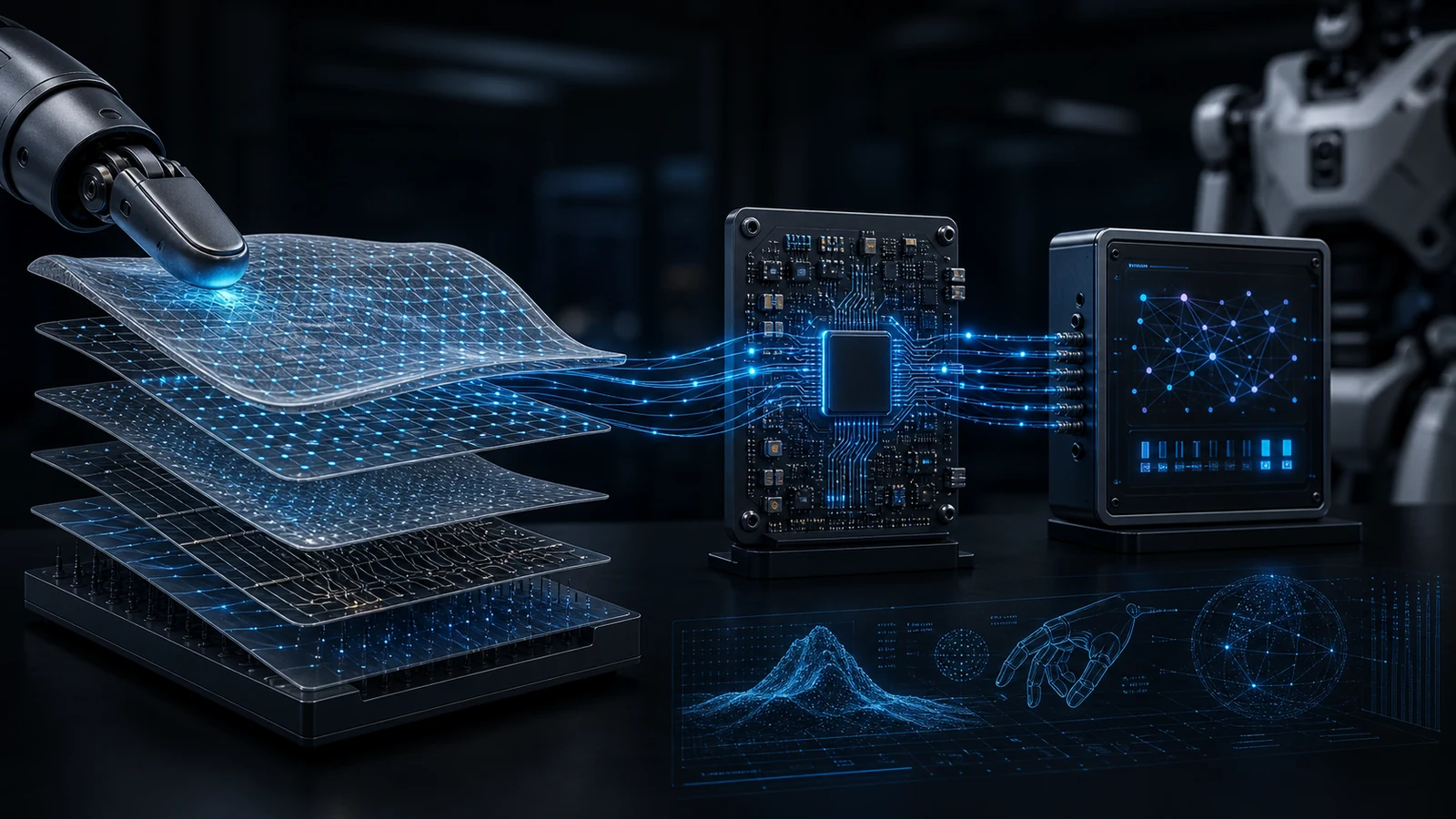
Tactile foundation model is not one fixed architecture. Current systems may learn reusable touch representations, predict future tactile observations, combine vision-language planning with tactile control, or adapt heterogeneous sensor streams for imitation learning.
- 2
Sparsh-X, Dream-Tac, TouchWorld, and MiTaS address different layers of the tactile AI stack. Their metrics are not a direct leaderboard because the sensors, tasks, training data, baselines, and outputs differ.
- 3
Evaluate a model by the role touch plays, the transfer claim it tests, the robot task it changes, and the latency and hardware assumptions required at deployment.
Topic 01
TaF-Foundation: what does cross-sensor transfer require?
TaF-Foundation is a November 16, 2026 preprint that uses measured six-axis force and torque as common supervision for heterogeneous tactile sensors. Its shared encoder still needs sensor-specific input adaptation; a common physical target is not a plug-and-play hardware interface.
For an unseen sensor, the authors require labelled tactile–wrench pairs and train an input module. In the magnetic-sensor Board Clean experiment, they use all available adaptation data, freeze the backbone during adaptation, then freeze the adapted encoder during policy training. This is adapted transfer, not zero-shot deployment.
Table 5 reports four real-world tasks with 20 trials per task per method: TaF-Policy averages 46.25%, versus 23.75% for AnyTouch2. UniVTAC omits the magnetic-sensor task, so its three-task average is not comparable with those four-task averages. These are author-reported results, not RoboSkin tests.
Before choosing this approach, budget for reference-force collection and adapter training, match the evaluation task subset, and inspect failure modes rather than relying on the average. The authors identify alignment and grasp-stability failures. As checked on November 18, 2026, the official project page says the dataset is planned for release after paper acceptance; this does not establish acceptance or current dataset availability. Its GitHub and ModelScope buttons both point back to the page top rather than to artifact repositories, so code and checkpoint downloads remain unverified.
Topic 02
What was frozen, what was trained, and what actually transferred?
A reusable encoder is only part of a downstream system. Sparsh's official examples pair representations with task-specific decoding, probing or a manipulation policy. UniTouch separately documents an encoder-only path and the full Touch-LLM workflow. An embedding alone does not produce a force estimate, a language answer or an executable action without the corresponding downstream components.
For an evaluation plan, keep a component ledger rather than writing only "pretrained model used." Record the sensor and preprocessing, pretrained checkpoint, frozen parameters, newly trained head, adaptation data and final output. Then describe the changed condition: new objects, a new sensor, a new task or a new robot. Success on one of those axes does not establish the others.
| Adaptation choice | Question it can test | Additional evidence needed |
|---|---|---|
| Frozen encoder, trained probe | Is target information accessible in the representation under this protocol? | Independent split, labels, probe budget and matching baseline |
| Encoder or adapter fine-tuning | Can the representation be adapted with the provided target data? | Which parameters changed, target-data amount and held-out conditions |
| Representation inside a policy | Does the complete policy use the features effectively on its task? | Action interface, physical attempts, intervention rules and matched ablation |
| Changed sensor or mounting | Does the pipeline survive a specified observation shift? | New calibration/preprocessing and exact permitted adaptation |
Example: estimated force is still a model output
NeoForce's force-space pipeline first estimates dense three-axis fields from tactile images through a learned conversion. The paper describes paired calibration data and simulation augmentation for that conversion. Its reconstruction target therefore has its own measurement and modeling chain; a force-labelled tensor is not proof of an independently measured force at every pixel.
Before reusing such a field, inspect the calibration reference, spatial convention, normalization, loading conditions and error on the target sensor. Keep a field reconstruction error separate from a robot task score. This is a proposed evidence check, not a new calibration or reproduction by RoboSkin.ai.
Topic 03
What Is N0-Foundation? NeoData, NeoForce and N0-VTLA
N0-Foundation, pronounced Neo-Foundation, is a tactile-centred research framework from the NeoteAI and Fudan TEAI teams, combining hardware, data, representations and evaluation. The September 20, 2026 report describes NeoData as more than 30,000 hours of synchronized visual-tactile demonstrations from robot teleoperation and the handheld N0-TacUMI interface. It reports OpenNeoData as a 5,000-hour open subset; the full corpus and the open subset are different resources.
NeoForce learns visuo-tactile representations using estimated dense three-axis force fields as a shared supervision space: two shear components and one normal component. The intended benefit is a physical contact representation less tied to sensor-specific images. NeoReal evaluates physical manipulation and NeoSim supplies simulated tasks. These author-reported evaluations do not establish unrestricted transfer to every tactile sensor.
N0-VTLA is the related vision-tactile-language-action policy described in a separate official project. It uses NeoData pretraining and predicts latent tactile tokens to condition action generation. Keep this policy distinct from the Foundation infrastructure and NeoForce representation. Dataset size alone does not establish the exact training mixture of every checkpoint, and RoboSkin has not independently reproduced the models.
Compare access and collection units in the tactile dataset directory.
For the action-producing component, use the robot VLA model guide.
Topic 04
Four different jobs for tactile learning
A reusable representation compresses raw tactile signals into features for later tasks. A world model predicts how touch may change after an action. A policy converts observations and goals into robot actions. A residual tactile controller can make local corrections around a separate plan; its actual update rate and response delay depend on the implemented system.
These roles can be combined, but they should not be confused. A model that improves material classification has not automatically demonstrated dexterous control. A policy with high task success has not automatically shown broad transfer across tactile sensors.
Start with the tactile sensing definition to distinguish a physical measurement from the features a model learns.
Topic 05
Sparsh vs UniTouch: what do you want to transfer?
Original Sparsh learns reusable representations from vision-based tactile images; UniTouch aligns touch with a multimodal embedding space. Begin with the downstream output you need rather than treating them as interchangeable robot controllers. The comparison below summarizes their official project and repository documentation reviewed on October 7, 2026; RoboSkin has not run the models.
Sparsh-X is a separate multisensory extension associated with Digit 360. Its inputs and results should not be copied onto original Sparsh. Likewise, a standalone UniTouch embedding and the full Touch-LLM question-answering setup are different integration paths.
| Decision | Original Sparsh | UniTouch |
|---|---|---|
| Representation objective | Self-supervised learning of visual tactile features for downstream touch tasks. | Bind touch to an ImageBind-based multimodal space for alignment with other modalities. |
| Example use | Investigate downstream contact-property estimation and manipulation tasks using TacBench evaluation. | Investigate cross-modal retrieval, classification and the separately configured Touch-LLM question-answering workflow. |
| Integration contract | Match sensor images, preprocessing, encoder checkpoint and the downstream task head or policy. | The standalone touch encoder returns an embedding; retrieval or language output requires the corresponding comparison or language components. |
| Choice criterion | A starting point when the target is reusable tactile features for a measured contact task. | A starting point when the target is touch-to-language or cross-modal semantic alignment. |
| Evidence boundary | A downstream demonstration does not establish transfer to every sensor or robot. | Embedding or question-answering quality does not establish closed-loop robot control success. |
Topic 06
Model and system comparison
The table compares architectural role and evidence boundary. It does not rank unlike systems by one score. MiTaS and UniVTAC Encoder are included as related tactile learning systems, not labeled here as general-purpose foundation models.
| System | Primary level | Role of tactile data | Reported evaluation focus | Evidence boundary |
|---|---|---|---|---|
| Sparsh-X | Self-supervised multisensory representation | Fuses Digit 360 image, audio, motion, and pressure into reusable touch features. | Physical-property inference and contact-rich manipulation tasks. | 2025 preprint; sensor stack and cross-hardware transfer assumptions must be checked. |
| Dream-Tac | Tactile world-action model | Predicts future visual and tactile observations conditioned on robot actions. | Contact-rich manipulation where anticipating tactile futures can support action selection. | 2026 preprint; reported tasks and hardware do not establish universal world-model transfer. |
| TouchWorld | Hierarchical planning and tactile control system | Combines vision-language planning, tactile world-model prediction, goal-conditioned action, and high-frequency tactile residual correction. | Six dexterous manipulation tasks in clean and perturbed conditions. | 2026 preprint; reported success rates are specific to its tasks, sensors, data, and baselines. |
| MiTaS | Multi-resolution tactile imitation learning | Aligns vision-based and event-based tactile streams with different spatial and temporal properties. | Robot-hand imitation learning with heterogeneous tactile inputs. | 2026 preprint and related learning system; it does not by itself establish a general tactile foundation model. |
| UniVTAC Encoder | Pretrained tactile representation encoder | Maps tactile images to a 512-dimensional ResNet-18 feature using simulated shape, contact, and pose supervision. | Eight simulated benchmark tasks plus three physical tasks on a separate GF225-equipped robot. | 2026 preprint and related representation model; it is not a VLA or a demonstrated sensor-independent foundation model. |
Topic 07
How to compare tactile models fairly
First match the output. Representation quality should be tested on held-out downstream tasks and conditions. World-model quality needs prediction metrics plus evidence that prediction improves action. Policy quality needs real-robot task outcomes, disturbances, baselines, and trial counts.
Then expose the hardware contract. Note every tactile modality, sensor model, placement, sampling rate, calibration path, preprocessing step, and synchronization assumption. A model that accepts tactile images from one fingertip does not automatically accept whole-hand force arrays or acoustic touch streams.
Before transferring an encoder, compare the sensing surfaces in the GelSight versus DIGIT guide and record which hardware assumptions carry into training.
- Transfer across objects, tasks, sensors, placements, robots, and environments
- Ablation showing what tactile input adds beyond vision and proprioception
- Pretraining data composition and train-test independence
- Online latency, update rate, compute, and controller interface
- Recovery under slip, occlusion, contact uncertainty, and external disturbance
- Availability and license for model weights, code, data, and evaluation tasks
Topic 08
Where TouchWorld fits
TouchWorld reports a hierarchical system with slower semantic planning and faster tactile correction. The preprint reports 65.0% success in clean conditions and 53.7% under perturbations across six tasks, with improvements of 15.7 and 18.5 percentage points over its strongest reported baseline.
Those numbers are useful within the paper protocol, not as a general score for all tactile foundation models. The architectural lesson is more portable: semantic task reasoning and high-frequency contact correction operate on different time scales and may need separate pathways.
Its tactile world-model component is first pretrained on EgoTouch and then adapted to robot demonstrations. RoboSkin keeps that training resource separate from the authors’ six-task evaluation protocol so a dataset, model, and benchmark are not collapsed into one claim.
Check the training-resource side in the tactile dataset directory; a training corpus and a robot evaluation protocol answer different questions.
Topic 09
What foundation does not guarantee
The word foundation does not guarantee sensor independence, zero-shot robot transfer, safe contact, low latency, public weights, or production readiness. Each of those needs separate evidence. A large pretraining corpus can still contain split leakage or narrow sensor coverage.
For deployment, treat the model as one layer in a tactile system. The surface, calibration, synchronization, robot state, control loop, failure logging, and task benchmark still determine whether learned touch changes behavior reliably.
For the observation interface, use the ROS 2 tactile publishing and replay tutorial to inspect timestamps, units and validity before connecting a learned model. The tutorial uses synthetic signals.
Topic 10
Tactile foundation model vs haptic foundation model
A tactile foundation model usually refers to reusable representations or dynamics learned from touch. Wang, Dong and El Saddik’s The Potential of Haptic Foundation Models proposes a broader haptic foundation model (HFM) framework spanning optical tactile images, force/torque, vibration, thermal feedback, contact sound and interaction trajectories, potentially aligned with vision and language.
In that proposal, action-coupled sensing and action-conditioned prediction extend the discussion beyond encoding a tactile frame. This is a useful distinction in scope, not a standardized boundary between two disjoint model classes: the paper also describes existing tactile encoders as haptic foundation models.
The authors explicitly frame the HFM architecture as prospective design objectives. Their benchmark uses frozen encoders and linear readouts for force, slip and relative-pose tasks; it does not establish the full proposed active-perception or predictive framework. HFM here names a research direction, not a newly released universal checkpoint.
Use the HFM glossary entry for the short definition, and read active sensing in context before treating a representation as an action policy.
For policy integration, compare VLA, diffusion action policies, world models and HFM by their inputs, prediction targets and roles in the robot control loop.
Topic 11
Challenges & Limitations
Sensor heterogeneity: the HFM paper identifies incompatible sensing modalities, rates and representations as a challenge. A result for an optical tactile encoder does not demonstrate the same transfer for force arrays, contact audio or a different mounting geometry.
Benchmark scope: the HFM study freezes pretrained encoders and tests linear readouts on selected TacBench tasks. Those results concern that evaluation setup; they do not validate the proposed complete HFM architecture or unrestricted robot transfer.
Action and deployment evidence: the same paper treats action-coupled exploration and future haptic-state prediction as design objectives. Neither an embedding score nor the foundation-model label establishes a reliable closed-loop controller, safe contact or real-time execution on a new robot.
Record these boundaries using the research methodology so model comparisons keep proposed capabilities separate from demonstrated results.
Paper routes
Start with source-backed RoboSkin briefs
 Tactile AI / 2026-11-04UniVTAC separates tactile simulation, representation learning, and policy evaluationChoose the matching code branch and dataset before using UniVTAC. This guide separates its tactile encoder, simulation benchmark, public downloads and paper-reported physical results.Tactile AI / 2026-11-03Sparsh-X multisensory touch representations for tactile AISparsh-X fuses image, audio, motion, and pressure from Digit 360, showing how multisensory touch can improve tactile AI for robot manipulation.
 Tactile AI / 2026-11-03Dream-Tac: A Unified Tactile World Action Model for Contact-Rich Robot ManipulationDream-Tac models action-conditioned tactile futures for contact-rich robot manipulation, showing why robot skin data needs prediction, not only reaction.
 Tactile AI / 2026-11-03MiTaS multi-resolution tactile imitation learning for robot handsA technical note on MiTaS, heterogeneous tactile sensors, GelSight and event-based touch fusion, and why tactile frequency matters for robot hand learning.
Common questions
FAQ for this topic
What is a tactile foundation model?
It generally refers to a model trained on broad tactile data so its representations or learned dynamics can support multiple downstream touch tasks. The term is used inconsistently, so always inspect the exact transfer experiments.
Is a tactile world model the same as a tactile foundation model?
No. A tactile world model predicts future tactile observations or contact dynamics. It may be pretrained broadly, but world modeling describes its predictive role, not the breadth of its transfer evidence.
Can one tactile model work with every sensor?
Not without evidence. Tactile sensors expose different images, forces, events, audio, pressure arrays, rates, and calibration assumptions. Cross-sensor transfer must be designed and tested explicitly.
Should model comparisons use task success or offline metrics?
Use both when possible. Offline metrics diagnose representation or prediction quality; real-robot task success shows whether the tactile pathway changes manipulation under execution noise.
How is a haptic foundation model different from a tactile foundation model?
The 2026 HFM paper proposes a broader contact-and-action framework covering heterogeneous haptic signals, active sensing and prediction. The terms overlap in the literature. Its proposed framework goes beyond the frozen-encoder tasks actually benchmarked, so the paper does not establish a new universal HFM checkpoint.