Robot data collection pillar
Robot teleoperation: from human demonstration to robot data
Learn how robot teleoperation captures demonstrations for robot learning and VLA training, including interfaces, synchronization, quality control, limits, and evaluation.
Published | Updated by RoboSkin.ai Editorial Team
- 10
- sections
- 7
- questions
- 10
- next routes
Short answer
What you need to know
- 1
Robot teleoperation is remote or mediated human control of a robot through interfaces such as joysticks, teach pendants, motion capture, wearable devices, cameras, handheld end effectors, or bilateral systems. Teleoperated behavior is not autonomous behavior.
- 2
For robot learning, teleoperation can generate aligned observations and actions, but useful data also requires calibration, timing, task definitions, resets, failures, operator context, quality control, schema, access, and license.
- 3
Demonstrations do not become a capable policy automatically. Training must account for action representation, embodiment, coverage, compounding errors, evaluation splits, interventions, and repeated real-robot testing.
Topic 01
Passive observation vs teleoperation data for robot learning
Passive observation data can show what a human did and how a scene changed. Teleoperation can additionally record the commands sent to a particular robot alongside its measured state. That observation-action pairing is the key distinction for policy training: ordinary video does not directly tell you which robot command produced each transition.
These are complementary data sources. R3M pretrains visual representations on Ego4D human video and uses the representation for downstream robot policy learning. It does not make the original videos a dataset of measured robot actions. The R3M paper is an example of representation pretraining followed by task learning, not proof that every imitation-learning recipe can train from unlabelled video.
UMI is a third case: an instrumented handheld demonstration interface. Its gripper-mounted camera and trajectory-processing pipeline provide more structure than passive video, while collection can happen away from a robot. GELLO instead controls a robot through a joint-based interface. The table summarizes the original projects and R3M sources checked on September 19, 2026; RoboSkin has not run these hardware systems.
| Data source | Observations and action information | Collection hardware | Contact-information boundary |
|---|---|---|---|
| Passive human video | Images and temporal changes; optional text or annotations. Robot action targets are absent unless separately inferred or supplied. | An existing video corpus can be studied without a robot; acquiring footage needs a camera and appropriate permissions. | Visible contact is not a measurement of force, slip or an occluded contact patch. |
| Original UMI | Visual observations, reconstructed relative end-effector trajectories and gripper width; later robot deployment requires a compatible policy interface. | Handheld parallel-jaw gripper and mounted camera; no robot at every demonstration site. | Original UMI does not provide a default calibrated force or tactile stream. |
| Original GELLO | Controller joint measurements mapped to robot commands, plus the observations actually recorded by the robot setup. | Joint-encoder controller matched to the robot and a robot for physical demonstrations; cameras are separate. | Joint commands do not establish contact force. Record additional calibrated sensing if the task needs it. |
| Teleoperation with added tactile sensing | Aligned commands, measured state and recorded touch; haptic feedback to the operator is an independent design choice. | A suitable robot, interface and tactile sensor with a documented capture pipeline. | Preserve raw units, calibration, validity and clocks. A recorded tactile channel does not prove a trained policy uses it. |
Topic 02
Choose data by the training task
For visual representation learning, video may be useful before robot action labels are available. For supervised action imitation, first establish the action representation and its alignment with observations. For contact-sensitive insertion or grasp adjustment, decide whether touch supplies an observation, a training label, operator feedback or an evaluation signal; each role requires different records.
Consider inserting a plug. A passive clip shows motion and visible outcome. A teleoperation log can also preserve the commanded motion and measured robot state. Tactile sensing can add a local contact observation when the camera cannot see the mating surfaces. To compare these sources, hold out objects or scenes, report autonomous success separately from intervention, and state which streams the deployed policy actually receives. This is an experimental design example, not a RoboSkin hardware result.
- Before collecting: specify the task, embodiment, observation streams and whether actions are measured, commanded or reconstructed.
- Before merging: check camera calibration, coordinate frames, capture and receive times, missing streams, action dimensions and units.
- Before training: preserve failed and interrupted episodes with reasons; document exclusions and split by the intended generalization claim.
- Before reporting: separate data-format validity, useful demonstrations and independently evaluated policy performance.
Topic 03
What robot teleoperation controls
Teleoperation can command a mobile base, arm pose, joint motion, gripper, dexterous hand, whole humanoid body, or a high-level subtask. The operator may watch direct video, stereo or depth views, a digital twin, or the physical robot. Some systems provide haptic or force feedback; others are one-way.
The interface changes the data. A low-dimensional joystick, handheld gripper, motion-capture rig, exoskeleton, and bilateral master device encode different human intent and produce different action distributions. Dataset records should preserve that acquisition contract.
| Interface family | Typical command | Strength | Data limitation to record |
|---|---|---|---|
| Joystick or gamepad | Base, end-effector, gripper, or mode commands | Portable and familiar | Low-dimensional mapping and operator-specific mode switches |
| Teach pendant or kinesthetic teaching | Waypoints, joint motion, or physically guided pose | Direct connection to industrial workflows or robot geometry | May be slow, robot-specific, or unsuitable for free whole-body motion |
| Motion capture or wearable interface | Human pose, hand pose, or joint targets retargeted to the robot | Can capture natural coordinated motion | Human-robot morphology, occlusion, calibration, and retargeting errors |
| Bilateral or haptic master | Position or force-related commands with feedback | Can expose contact to the operator | Cost, stability, latency, scaling, and master-slave mismatch |
| Handheld data-collection device | End-effector pose and gripper state without the full robot | Can lower collection friction and move data capture away from a robot cell | Requires reliable calibration and later embodiment mapping |
Topic 04
The demonstration-to-policy pipeline
A teleoperation recording is a source trajectory, not a finished learning asset. The complete pipeline aligns sensors and commands, segments tasks, records outcomes and failure context, validates the episode, converts it to a stable schema, splits it without leakage, trains a model, and tests the model in closed loop.
- Specify task, object, environment, operator instruction, success criteria, and reset policy
- Calibrate and synchronize cameras, depth, proprioception, hand state, force or touch, commands, and timestamps
- Record latency, packet loss, control modes, interventions, discarded episodes, failures, and operator identity or experience when relevant
- Normalize episodes and action spaces while preserving raw data, units, coordinate frames, and provenance
- Train and evaluate with splits that isolate the claimed objects, scenes, tasks, operators, or embodiments
Topic 05
Teleoperation data is not autonomous capability
A teleoperated demonstration proves that a person and interface could make the robot perform the task under those conditions. It does not prove that a learned policy can perceive the same state, recover from error, or act safely without the operator.
A policy trained by imitation can encounter states absent from expert demonstrations because small prediction errors compound during execution. Corrective demonstrations, interactive data collection, recovery examples, and policy rollouts can target this gap, but they still require an explicit intervention policy and fair evaluation.
Topic 06
Current open data-collection signals
The official Hugging Face Grabette article describes a handheld gripper-and-camera device that records data in the standard LeRobot dataset format. It is an example of collecting manipulation demonstrations without keeping a full robot in the loop during every recording. The transfer value still depends on calibration, task coverage, observation and action mapping, and later robot evaluation.
The LeRobot v0.6 release describes rollout tools and DAgger-style human corrections. FreeTacMan investigates wearable, robot-free visuo-tactile data collection. DROID and Open X-Embodiment represent broader real-robot and multi-embodiment data strategies. These resources solve different parts of the pipeline and should not be treated as identical teleoperation systems.
Topic 07
Touch and force feedback in teleoperation
Touch can be recorded as robot-side training data, returned to the operator as haptic feedback, or both. Robot-side tactile data can label contact onset, slip, pressure distribution, or grasp state. Haptic feedback can help a person adjust motion, but the master device, scaling, delay, and feedback modality shape what the operator feels.
For imitation learning, synchronize tactile observations with the action that preceded the contact and the corrective action that followed it. A contact stream without robot state, timestamps, or action context is much harder to use for closed-loop policy learning.
The Missing Touch study maps GelSight Mini contact images to a 32-DoF cutaneous display and reports more natural and consistent trajectories in two 2-DoF tasks. It did not train an autonomous policy, so its learning relevance is a demonstration-quality implication rather than a measured policy-success gain. PRISM provides a separate collection perspective by combining exoskeleton, tracker, and VR interfaces across industrial tasks, while limiting tactile sensing to an unspecified subset of episodes.
Topic 08
Quality and evaluation checklist
Data quality is a measured property, not a consequence of collection volume. Before training, inspect timing, calibration, missing streams, task labels, duplicated episodes, operator shortcuts, failures, and inconsistent resets. Before a capability claim, test the learned policy on the physical robot under a protocol that distinguishes autonomous success from human correction.
| Stage | What to verify | Failure if omitted |
|---|---|---|
| Capture | Calibration, clocks, latency, commands, observations, raw units, and failure flags | The trajectory can look complete while actions and observations are misaligned |
| Curation | Episode boundaries, outcomes, duplicates, exclusions, class balance, and operator distribution | The model learns shortcuts or the dataset overstates coverage |
| Training | Action representation, normalization, history, embodiment mapping, and intervention handling | The learned interface differs from the deployed robot |
| Evaluation | Autonomy, objects, scenes, trials, resets, interventions, recovery, force, damage, and time | A staged or corrected run is reported as autonomous capability |
| Release | Schema, version, documentation, access, license, checksums, and known limitations | Other teams cannot audit or legally reuse the data |
Topic 09
Robot Data Collection: from a demonstration to an export
Define an episode before recording: task instruction, start/reset condition, expected outcome and failure categories. Record observations and operator commands separately so an action target cannot be mistaken for a measured robot state. Preserve raw streams and a capture manifest alongside any training export.
Time synchronization belongs in acquisition. Save sensor capture time, host receive time and clock domains; estimate offsets using a documented synchronization method and inspect residual alignment. A resampled episode timestamp is a training index, not a measurement of end-to-end latency.
Before exporting, inspect dropped frames, duplicate or reversed timestamps, changed array dimensions, stale observations, saturation and invalid tactile samples. Label failed trajectories, interventions and recovery segments with reasons. Retain their provenance whether the training recipe includes or excludes them; do not silently call every recorded episode a success.
For training export, record state/action names, units, coordinate frames, episode boundaries, task text and outcome labels. Split by the intended generalization claim before computing training statistics. The linked LeRobot exercise checks a numeric subset with synthetic data; it does not validate videos, policy compatibility or the quality of a physical demonstration.
Topic 10
UMI vs GELLO: two routes to robot demonstration data
Original UMI and GELLO are complementary collection approaches. UMI moves demonstration capture into a handheld gripper; GELLO maps a human-operated joint controller to a robot arm. The comparison below is scoped to the original project and paper, checked on September 16, 2026. It does not generalize later tactile variants to the originals.
| Aspect | Original UMI | Original GELLO |
|---|---|---|
| Collection method | Human directly manipulates handheld grippers; the robot is not required at every collection site. | Operator moves a smaller controller with a kinematic structure matched to the target robot; joint measurements drive teleoperation. |
| Hardware requirements | Handheld parallel-jaw gripper and mounted GoPro; the processing pipeline reconstructs trajectories. Deployment later needs a suitable robot and mapping. | 3D-printed controller with encoder-equipped servos, a communication interface and a supported robot for physical demonstrations; cameras are separate observation hardware. |
| Data produced | Visual observations, reconstructed end-effector trajectories and gripper width used by the collection/policy pipeline. This is not automatically a LeRobot export. | Controller joint targets and recorded robot observations; camera streams depend on the capture setup. Define action/state mappings before conversion. |
| Force / tactile information | The original UMI system is not a default tactile-sensor system. Video and gripper width do not supply calibrated contact force. | Encoder position and mechanical resistance at the controller are not a calibrated tactile stream. Additional sensing and alignment are required for force/touch labels. |
| Main quality question | Is pose reconstruction reliable, is timing aligned and is the trajectory feasible for the deployment embodiment? | Are joint mapping, offsets, robot observations and camera/command timing correct for the matched embodiment? |
Paper routes
Start with source-backed RoboSkin briefs
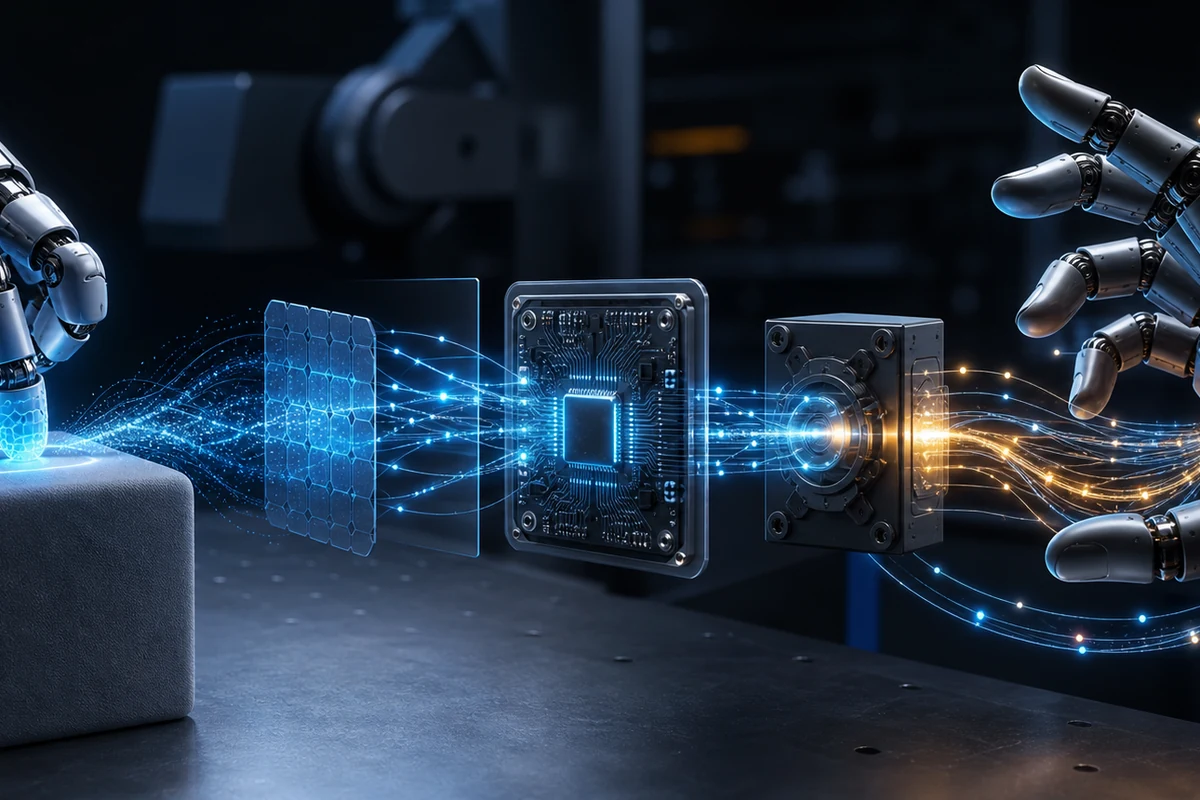 Robot teleoperation / 2026-08-22The Missing Touch tests spatial tactile feedback in robot teleoperationA GelSight Mini and 32-DoF fingertip display made two teleoperation tasks more natural and consistent, but no autonomous robot policy was trained or evaluated.
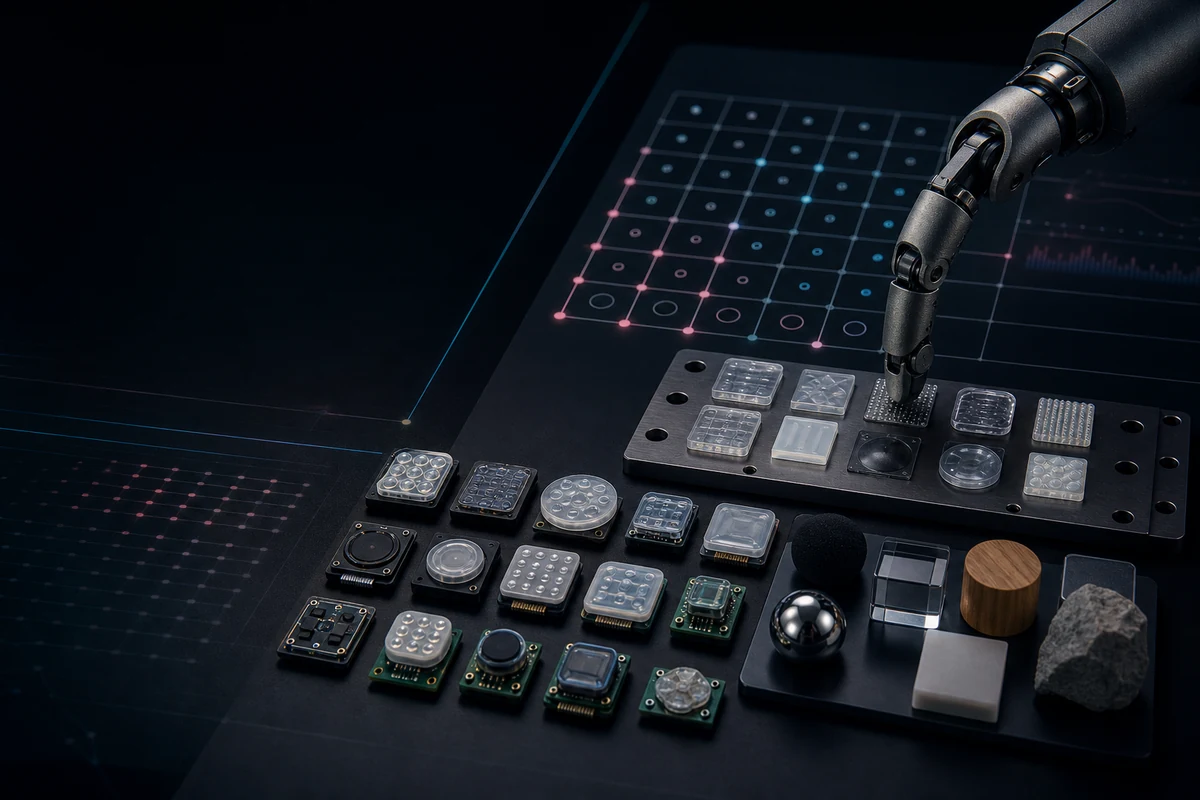 Tactile datasets / 2026-08-22PRISM maps 5,000+ contact-rich industrial robot trajectoriesPRISM reports 5,000+ robot trajectories across 25+ industrial tasks, but tactile observations cover only a subset and the announced dataset download is not yet available.
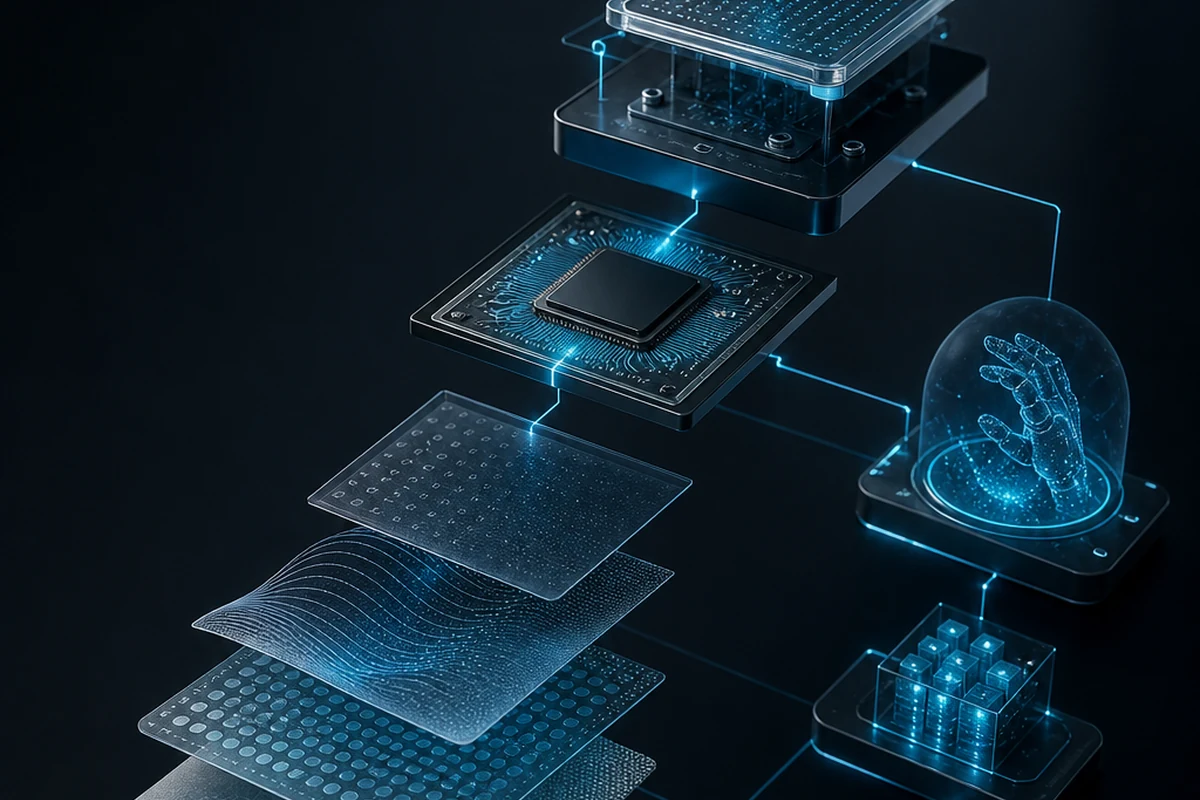 Tactile datasets / 2026-08-22RoboTacDex maps 6,000+ humanoid visual-tactile trajectoriesRoboTacDex reports 6,000+ Unitree G1 trajectories across 19 tasks, an author-reported 23 skills, and 22 objects, but public dataset access remains pending.
 Tactile Data / 2026-08-22FreeTacMan robot-free visuo-tactile data collection for tactile AIA research note on FreeTacMan, robot-free visuo-tactile datasets, tactile AI data collection, and why robot skin models need contact diversity.Tactile Data / 2026-08-22GIST humanoid visual-tactile-action dataset maps 101.9K soft-object samplesThe GIST preprint reports 101.9K visual-tactile-action samples for towel and sponge manipulation, with dense hand touch, two camera views, and explicit access limits.
Common questions
FAQ for this topic
Can passive video replace teleoperation data?
Passive video can support representation learning, but it does not directly supply synchronized robot action targets. Using it for policy learning requires a suitable learning objective, inferred or additional action information, and evaluation on the target robot.
Is UMI the same as passive video collection?
No. Original UMI uses an instrumented handheld gripper and a trajectory-processing pipeline to provide a structured demonstration and policy interface. It can collect away from a robot, but its original design does not include a default calibrated tactile or force stream.
What is robot teleoperation?
Robot teleoperation is remote or mediated human control of a robot through an interface such as a joystick, teach pendant, motion-capture system, wearable device, handheld end effector, or bilateral master.
Is a teleoperated robot autonomous?
No. Teleoperation shows human-controlled behavior. Autonomous capability requires the robot policy to perceive and act without the operator under a defined evaluation protocol.
How does teleoperation create robot-learning data?
It records synchronized observations, robot state, human commands, actions, task context, and outcomes. Those episodes are calibrated, quality-checked, normalized, split, and used to train and evaluate a policy.
What limits learning from teleoperation?
Limits include interface bias, latency, morphology mismatch, narrow task coverage, inconsistent operators, missing failures, action retargeting, compounding policy errors, and evaluation leakage.
Why record tactile data during teleoperation?
Touch can expose contact onset, pressure, shear, slip, seating, and corrective behavior that cameras may miss, but it must be synchronized with robot state and actions to support learning.