A blind grasp reflex lets a dexterous hand feel through proprioception
MIT, Seoul National University and Yonsei researchers train a hand-local policy that reacts to contact through joint encoders, without fingertip tactile sensors. The strongest evidence is simulated; the hardware study is qualitative.
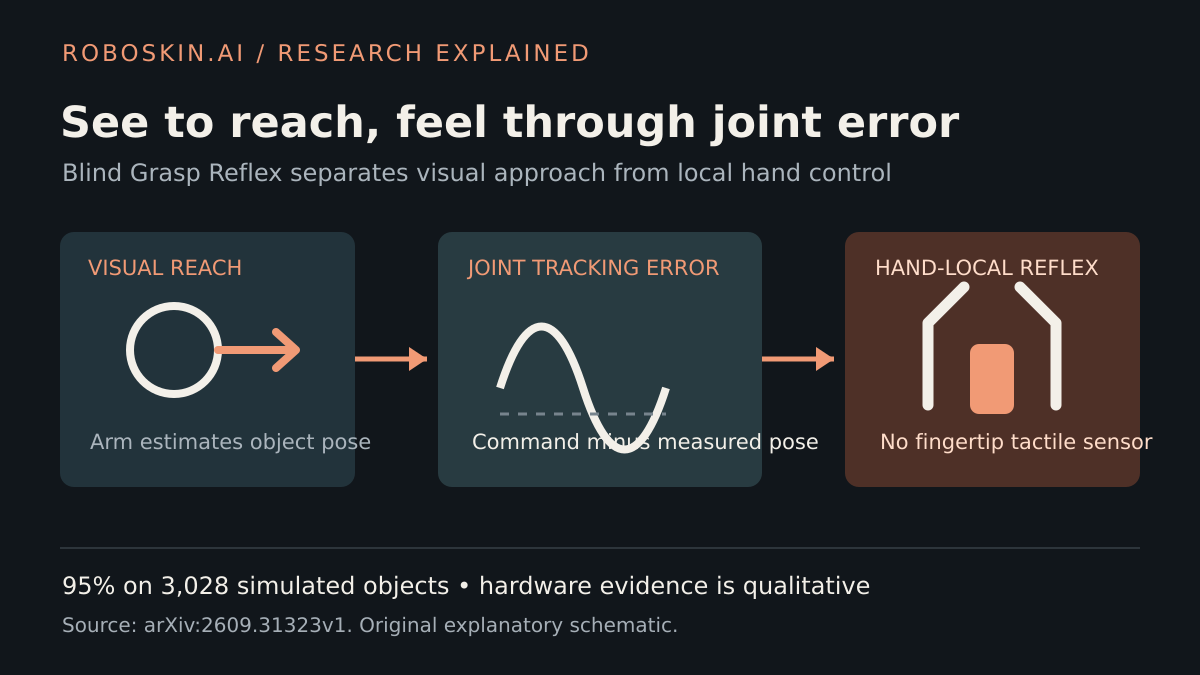
Researchers from the Massachusetts Institute of Technology, Seoul National University and Yonsei University released Blind Grasp Reflex on September 25, 2026. The system separates visually guided reaching from a hand-local grasp controller that uses only joint positions and motor-command errors. It treats tracking error as an implicit sign of contact, so the hand can react without cameras or fingertip tactile sensors during closure. Paper and version record.
Key takeaways
- On 3,028 simulated GraspXL objects, the modular policy reports 95% grasp success, compared with 97% for an end-to-end reinforcement-learning policy under the same simulation study.
- When an object is moved during closure, Blind Grasp Reflex reaches 92% in the reported dynamic test while the end-to-end baseline reaches 8%.
- The hardware section shows successful grasps on 29 objects, but it does not provide repeated trial counts or a physical success rate. Those demonstrations should not be compared directly with the simulation percentages.
What changed
The method gives the arm and hand different jobs. A perception-driven arm controller moves the palm toward an estimated object pose. Once the hand is in range, a reflex policy closes its 20-degree-of-freedom Robotis HX5-D20-MRT hand. The hand observes a five-frame history of joint position and the difference between commanded and measured position. A stalled finger therefore becomes a crude contact signal.
Training uses a privileged teacher with simulated object state, then distills the behavior into a student that sees only proprioception. The policy runs at 11.9 Hz, above a 1 kHz low-level joint loop, and the authors report roughly four GPU-hours on one NVIDIA L40S. Method details.
This is not tactile sensing in the usual robot-skin sense. It does not measure pressure distribution, shear, slip or contact location directly. It infers contact from how the mechanism fails to follow a command. That distinction matters for readers comparing the work with tactile manipulation systems.
Results under the reported conditions
On 78 YCB objects, Blind Grasp Reflex reaches 96% simulated success and the end-to-end reinforcement-learning baseline reaches 98%. On the larger 3,028-object GraspXL set, the corresponding figures are 95% and 97%. The small two-point gap suggests that modularity does not cost much in these static simulation tests.
The separation matters more under intervention. In the paper's dynamic-object evaluation, an external motion changes the object during closure. The reflex policy succeeds in 92% of cases, while the end-to-end baseline succeeds in 8%. In a separate object-pose generalization test, the figures are 90% and 15%. These are results from the authors' simulator, not an independent benchmark or a physical disturbance study. Evaluation tables.
The authors also test whether a learned grasp score tracks the analytic Ferrari-Canny metric. Across 15,097 simulated grasps, the mean Spearman correlation is 0.77; the reported subsets are 0.78 for 14,346 successful grasps and 0.61 for 751 failures. Correlation supports the training signal, but it does not prove equivalent force closure on hardware.
What this means for robotics
RoboSkin analysis: the architecture resembles a biological division of labor. Vision gets the limb near the target; fast local feedback handles uncertain contact. A frozen hand policy can therefore be paired with several unseen arm controllers without retraining the full perception-to-action stack. That modularity could make robot hands easier to integrate.
The practical trade-off is observability. Encoder error is inexpensive and available on many hands, but it combines contact, friction, backlash, saturation and controller dynamics. A grasp reflex may be robust enough to close around an object while remaining unable to estimate why a finger stopped. Tasks that depend on incipient slip, contact geometry or force regulation still need richer sensing.
Limitations and availability
Blind Grasp Reflex is an arXiv v1 preprint, and RoboSkin.ai has not reproduced it. The strongest quantitative evidence is in simulation. The project page shows hardware examples on 29 objects but gives no per-object trial count, failure count or physical success percentage. The arm still relies on perception to reach the target; “blind” describes the hand policy during grasping, not the entire robot.
At publication time, the official project page labels code as “Coming Soon.” No public training environment, weights, dataset or software license was verified. The manuscript is available under CC BY 4.0, which licenses the paper rather than unreleased implementation assets.
Sources and related resources
Continue the topic