Whole-hand force regulation tracks contact without tactile sensors
MIT, Seoul National University and Yonsei University researchers regulate contacts across finger sides, backs and palm from an object model and joint state. The approach is fast, but depends on pose tracking and quasi-static assumptions.
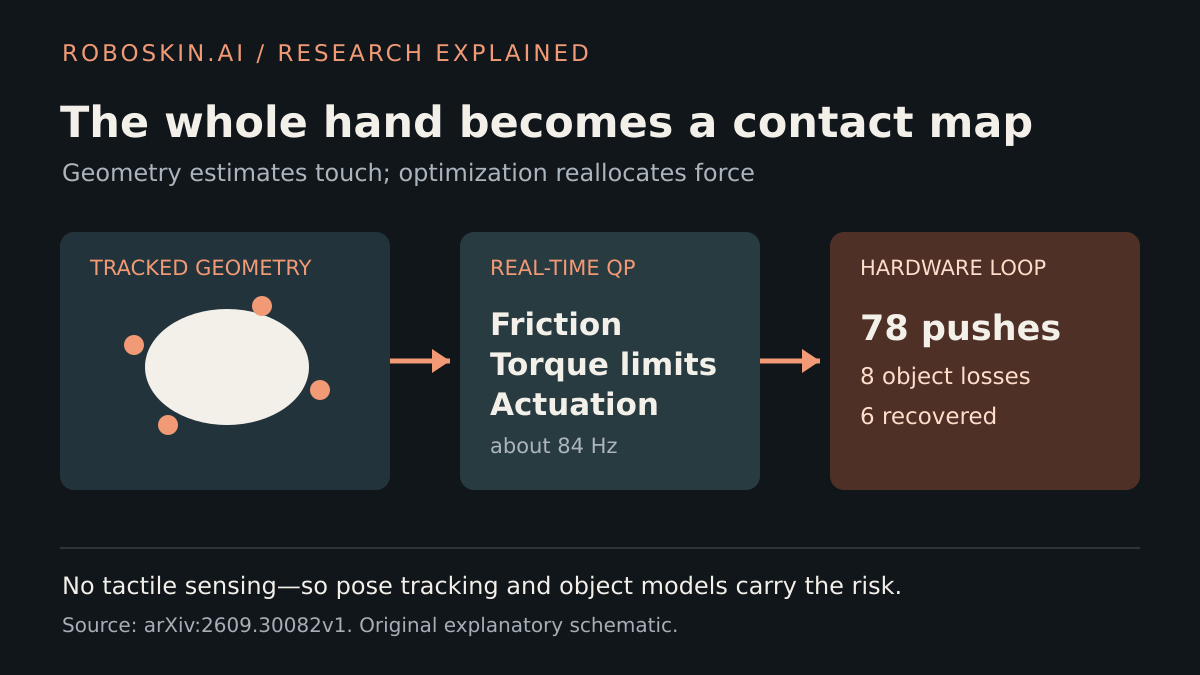
Researchers at Seoul National University, Massachusetts Institute of Technology and Yonsei University released a real-time whole-hand force controller on September 24, 2026. It estimates contact across fingertips, finger sides, dorsal surfaces and the palm from a tracked object model and joint angles, then reallocates desired forces as those contacts change. The method explicitly does not use tactile sensing at the contacts. Paper and version record.
Key takeaways
- About 3,000 sampled hand-surface points are queried against the object's signed distance field every cycle. That geometric contact search takes under 1 ms on the reported GPU.
- In gravity-free simulation, whole-hand regulation reaches 88.6% success after a 90-degree perturbation versus 72.4% when contact candidates are restricted to fingertips.
- Hardware evidence consists of three uncut runs totaling about 200 seconds, 78 human-applied perturbations and eight object losses; the system autonomously recovers six losses. Official hardware summary.
What changed
Grasp planners usually choose contacts once, then execute forces or impedance targets tied to that initial geometry. That becomes brittle when an object rolls, slides or gains new contacts against another part of the hand.
This controller treats contact as a live geometry query. The object mesh is converted to a signed distance field, and the measured hand configuration places sampled points from every link into that field. Points within a threshold become contact candidates. For each current set, a quadratic program allocates force under friction pyramids, minimum normal force, joint-torque limits and an actuation-consistency constraint.
The last constraint is important. An optimizer can request forces that satisfy object-level equations but cannot be generated by controlled finger torques. The method suppresses force components in the null space of the actuated contact Jacobian. It remains a conservative allocation rule, not proof that compliant physical contacts realize every desired vector.
Reactive reaching handles acquisition. It follows a tracked object until the thumb and two fingers make contact, hands control to force regulation, and returns to reaching after a detected loss. This creates an approach-hold-regrasp loop rather than evaluating a stored grasp alone.
Simulation and hardware evidence
Simulation uses MuJoCo with gravity disabled, 79 YCB objects and ten power grasps per object. A six-direction load equal to 10% of object weight tests each initial grasp. For dynamic perturbations, five representative objects and 50 grasps per method are rotated up to 90 degrees; non-adaptive baselines allocate force only at initialization. Whole-hand online regulation beats fixed feedforward torque, fixed impedance and fingertip-only execution at every angle. Simulation protocol.
Under constant synthetic pose errors up to 30 degrees and 5 mm, the feedforward baseline falls from 79% to 54%, while adaptive regulation stays between 87% and 93%. That test does not include time-varying noise, latency or complete tracking loss.
There is a measurable speed-coverage trade-off. Allowing one candidate per link gives a 227 Hz force solve and 90.9% success; five candidates peaks at 93.2%; seven slows to 66 Hz and falls to 91.9%. The selected five-contact setting runs the full quadratic program at about 84 Hz.
Hardware uses a 7-DoF Flexiv Rizon 4 arm, a 20-DoF Robotis 5F hand, one RealSense D455, an Intel i9-13900K and an RTX 4090. The hand's fingertip tactile sensors are present but unused. A Pringles can and two boxes are pushed or taken during the three runs. Six of eight losses are recovered; the other two leave the arm workspace. These demonstrations show autonomous transitions, but three runs are not a comparative hardware benchmark.
What this means for robot skin
RoboSkin analysis: this work is a useful counterexample to the claim that every contact-control problem requires dense skin. If the object model, pose tracker and hand kinematics are reliable, geometry can infer likely contacts over surfaces that have no taxels at all.
That does not eliminate the case for [robot skin](/). It relocates it. A tactile layer can directly observe unexpected objects, normal uncertainty, local slip and contacts that the tracker cannot see. Geometry offers broad coverage; touch offers physical confirmation. A hybrid system could use this controller as a contact prior and tactile residuals to correct model error.
Limitations and availability
The method requires an object model from CAD or a short RGB-D scan and a maintained six-degree-of-freedom pose. Heavy occlusion breaks contact estimation. Thin objects are especially sensitive because millimeter-scale pose error can flip a sampled point to the far side and reverse the estimated normal.
Force allocation is quasi-static. It does not explicitly compensate gravity, inertia or external wrenches, even though friction is expected to resist unmodeled loads. Simulation disables gravity, and hardware disturbances are manual rather than standardized.
The project supplies the paper, videos and detailed results. Its code link is labeled “Soon”; no repository, data package or software license was available on September 26. The project-page content is CC BY-SA 4.0, which licenses that page, not unreleased controller code. RoboSkin.ai has not reproduced the system.
Sources and related resources
Continue the topic
Related tactile robotics news
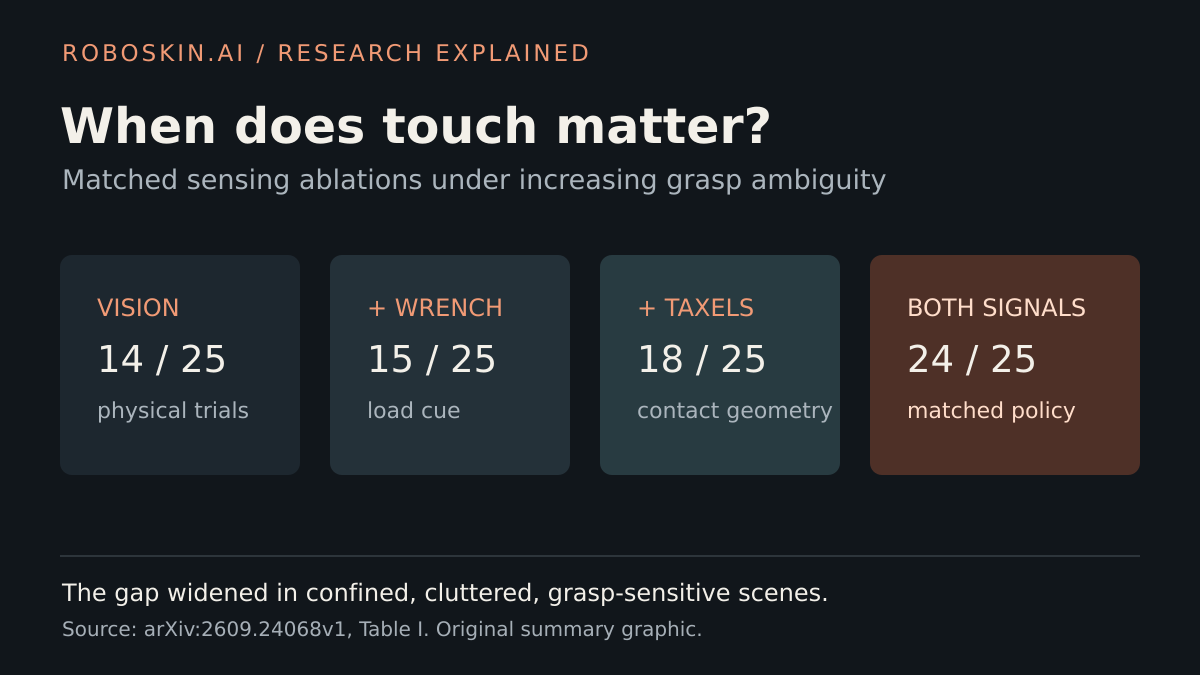 Dexterous manipulation benchmarksWhen Does Touch Matter tests tactile and wrench feedback in clutter
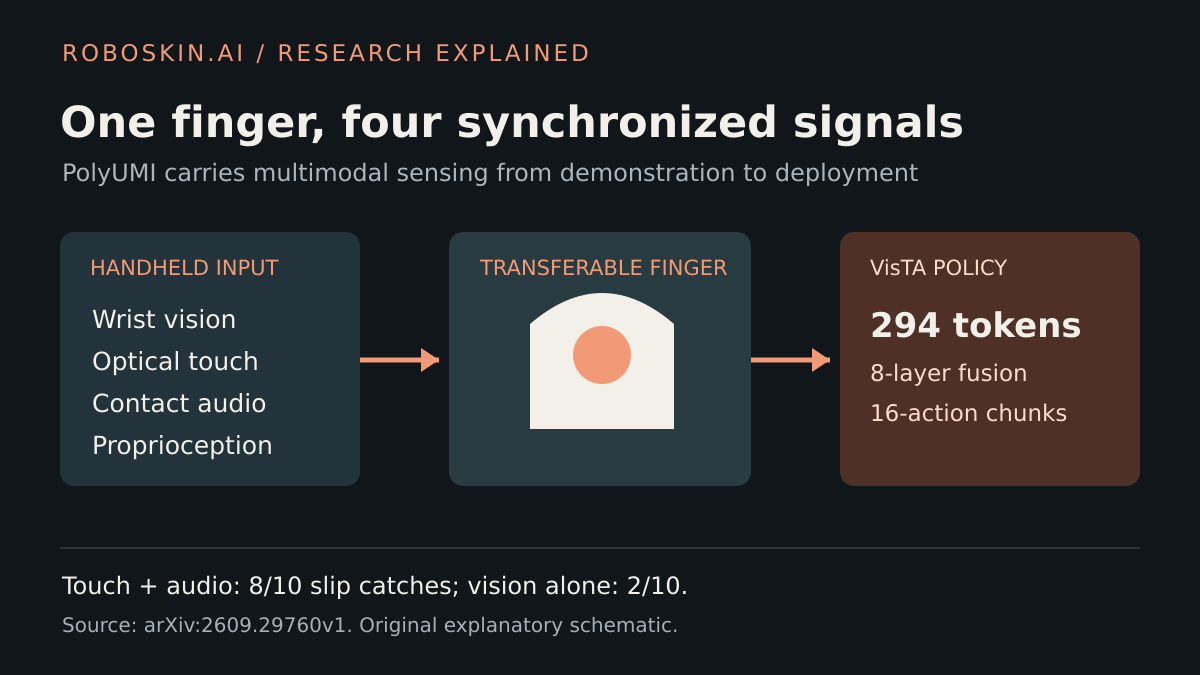 Multimodal tactile learningPolyUMI records vision, touch and contact audio in one wireless interface
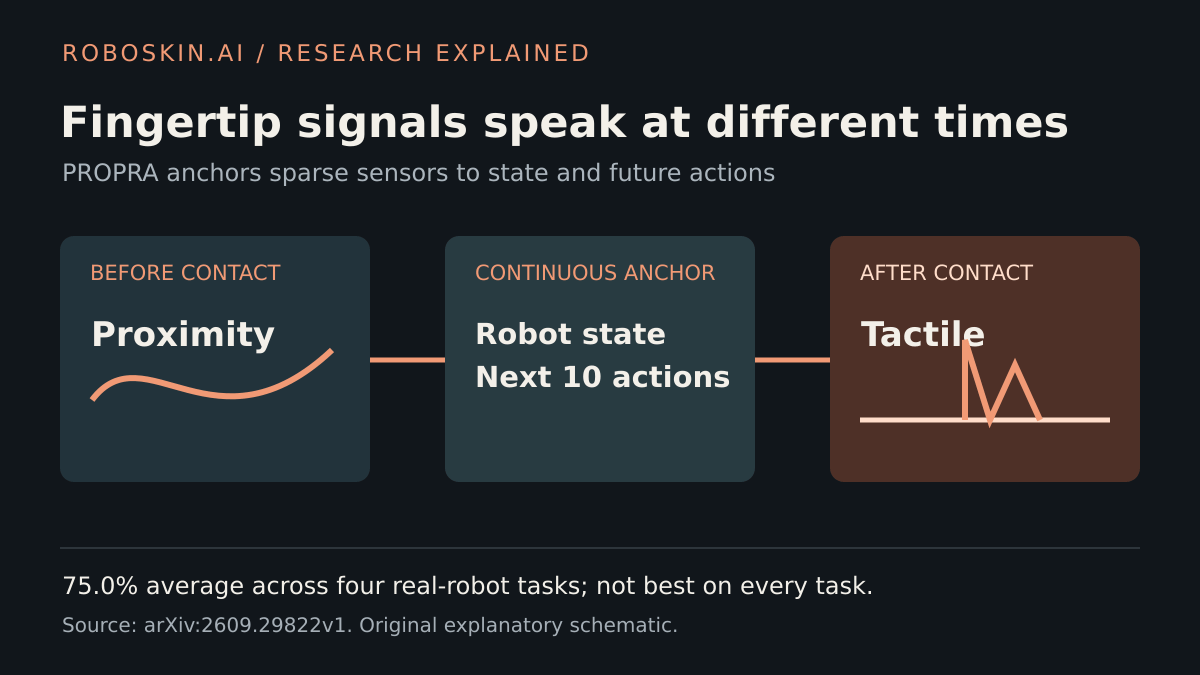 Tactile representation learningPROPRA anchors pre-touch and tactile signals to robot state and future actions