When Does Touch Matter tests tactile and wrench feedback in clutter
A USC and University of New Mexico study holds demonstrations and control fixed while varying policy-visible sensing. The advantage grows in confined, cluttered scenes.
University of Southern California and University of New Mexico researchers released “When Does Touch Matter?” on September 21, 2026. The study asks a narrow but important question: when does policy-visible interaction sensing improve on RGB-D geometry for target-oriented dexterous grasping in clutter? It holds demonstrations, action space and compliant control fixed while varying whether the learned policy sees estimated wrenches, fingertip taxels or both. Paper and version record.
Key takeaways
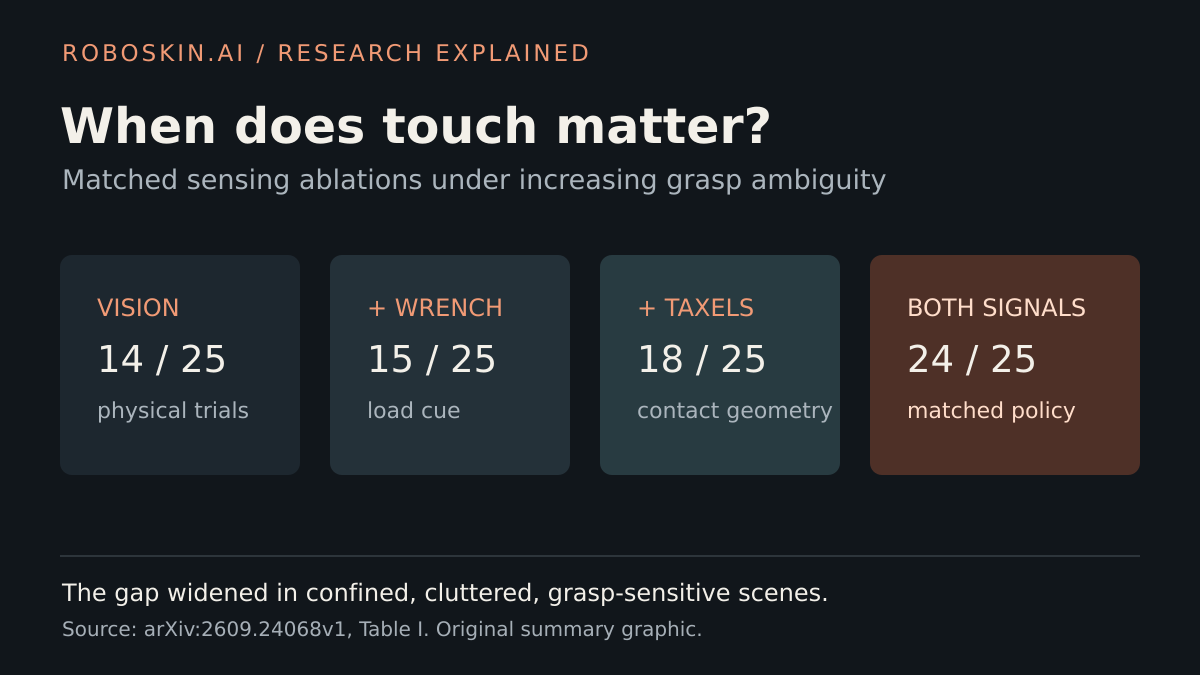
- The combined vision, wrench and taxel policy succeeds in 24/25 trials, versus 14/25 for vision-only, across five physical scene conditions.
- On the three nested confined conditions, the combined policy scores 15/15 while vision-only scores 6/15. On easier or less ambiguous conditions, the gap is small or absent.
- Every controlled policy still uses the same wrench-based compliant controller. The ablation changes what the learned policy observes, not whether the robot physically responds compliantly to contact. Design and Table I.
What changed
The xArm7 carries a 16-DoF LEAP Hand with four PaXini fingertip pads, providing 508 three-axis taxels. Motor currents and hand Jacobians estimate four fingertip wrenches and one aggregated wrist wrench. Two Intel RealSense cameras provide RGB-D views. Grounding DINO and SAM 2 produce target masks, which are converted into a 1,024-point target-context cloud.
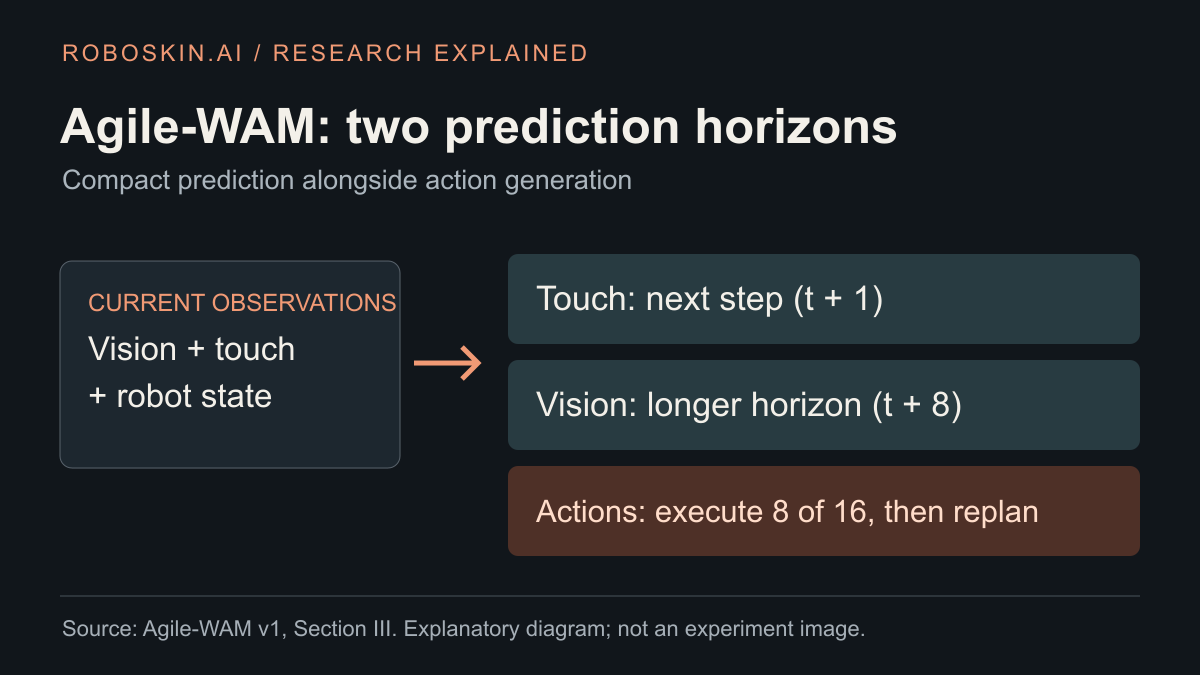
A diffusion policy runs at 10 Hz and predicts 16 steps of end-effector pose and hand-joint references, executing eight before replanning. Taxels are encoded with a two-layer attention model; wrench and proprioception are supplied directly. All variants use the same 320 demonstrations, 90/10 split, 300 training epochs and compliance controller. System details.
Where the interaction gap appears
| Policy-visible input | Overall physical success |
|---|---|
| Vision only | 14/25 (56%) |
| Vision plus wrench | 15/25 (60%) |
| Vision plus taxels | 18/25 (72%) |
| Vision plus wrench plus taxels | 24/25 (96%) |
The combined result is not simply the sum of two sensors. Estimated wrench exposes weak or obstructed loading and can trigger an early regrasp. The taxel field describes how support is distributed across fingers. In the three progressively harder conditions, the combined policy stays at 5/5 while the stronger single-interaction result reaches only 3/5, 4/5 and 3/5.
The study covers 200 physical trials across eight policy variants, five conditions and five trials per cell. That total sounds large, but the headline 24/25 comparison still has only five trials per scene. Manual resets introduce small placement variation, and confidence intervals are not reported for the success table.
An external vision-only ClutterDexGrasp reproduction is not included in the matched physical table. The authors report that its zero-shot hardware deployment produced unsafe rapid motion and downward pushing that required an emergency stop. Because it did not share the compliant controller, it should be treated as an implementation warning rather than a clean performance baseline.
What this means for robot hands
RoboSkin analysis: the main contribution is a demand-conditioned comparison, not a claim that every grasp needs touch. Vision-only ties the combined policy at 4/5 in the open small-object scene. Interaction sensing becomes decisive when confinement, occlusion and grasp sensitivity accumulate. That distinction helps teams decide where robot-hand tactile sensing is worth integration effort.
The ablation also warns against treating “force” and “tactile” as interchangeable. Wrench estimates provide compact load cues; distributed taxels provide contact geometry. The strongest policy uses both, which aligns with the design questions in the tactile manipulation guide and robot gripper sensor guide.
Limitations and availability
The experiment uses one LEAP Hand embodiment, one PaXini sensor class and five engineered tabletop conditions. The thick fingertips limit access to narrow gaps. Complete target occlusion can defeat relocalization, and the policy can stall locally without explicit progress monitoring. Execution-time statistics condition on successful episodes and therefore have survivorship bias.
This is a preprint, and RoboSkin.ai has not reproduced the trials. As checked September 22, the official project page provides method explanations and evaluation videos, but no public code, trained policy or dataset download was identified. The paper says all trial videos will be released; readers should verify that the complete set is present before using it as an audit trail.
Sources
Continue the topic