Robotics hardware pillar
Robot hands: dexterity, sensing and evidence
Compare robot hands and grippers by actuation, sensing, control, task fit, and evidence. Learn how tactile robot hands support dexterous manipulation.
- 6
- sections
- 4
- questions
- 9
- next routes
Short answer
What you need to know
- 1
A robot hand is an end effector with fingers or multiple articulated contacts designed to grasp, reorient, manipulate, or use objects. The term covers simple adaptive hands as well as highly actuated anthropomorphic systems.
- 2
A multi-finger hand can create more contact configurations than a two-finger gripper, but it also increases mechanical, sensing, calibration, control, data, and maintenance complexity. More joints do not guarantee better task performance.
- 3
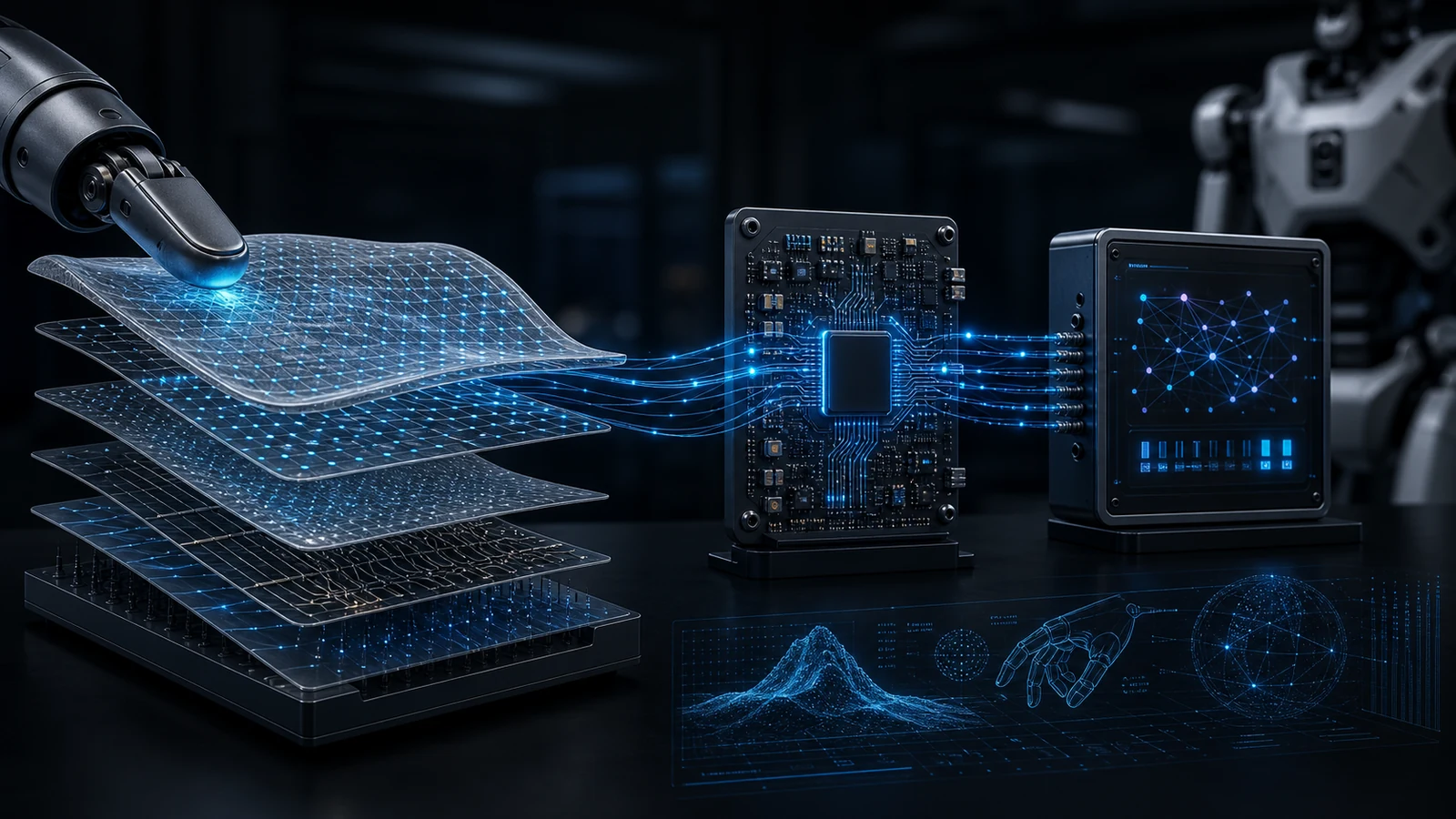
Tactile sensors on fingertips, fingers, and palms can expose contact location, pressure, shear, slip, and grasp state after vision becomes occluded. Their value should be tested through closed-loop task outcomes, not sensitivity claims alone.
Topic 01
Robot hand, adaptive hand, or gripper?
End-effectors should be selected for the work they must perform. A parallel gripper can be reliable for repetitive pick-and-place, while a multi-finger hand can support more grasp shapes, in-hand motion, and tools designed for people. Adaptive or underactuated hands sit between these categories by allowing several joints to conform with fewer independently controlled actuators.
The words hand, gripper, dexterous, and anthropomorphic do not establish capability by themselves. A defensible comparison names the joints and actuators, sensing, payload and object range, control interface, cycle time, durability, task protocol, and failure behavior actually tested.
| End-effector class | Typical advantage | Typical engineering cost | Where touch can help |
|---|---|---|---|
| Parallel or two-finger gripper | Simple action space and repeatable opposing contact for suitable objects | Limited grasp geometry and in-hand reconfiguration | Detect first contact, seating, slip, and grip imbalance |
| Adaptive or underactuated hand | Passive or coupled conformance around varied shapes | Internal joint state and contact distribution may be harder to infer | Reveal which fingers contacted and how load is distributed |
| Fully or highly actuated multi-finger hand | More controllable contacts for reorientation and human-tool compatibility | Larger action space, calibration burden, data demand, and maintenance surface | Support contact-rich policies, slip response, and grasp-state estimation |
| Soft hand or soft gripper | Compliance can reduce geometric precision requirements and peak contact | Material behavior, wear, hysteresis, and precise state estimation can be difficult | Measure distributed deformation and contact across compliant surfaces |
Topic 02
The robot-hand technology stack
A robot hand is a coupled mechatronic and software system. Mechanical design sets reachable contact configurations; actuation and transmission determine controllability; sensors expose joint and contact state; the controller turns those signals into coordinated motion; and the policy or planner selects actions for a task.
- Mechanics: finger count, joint layout, thumb opposition, compliance, workspace, and replaceable contact surfaces
- Actuation: electric, tendon-driven, pneumatic, hydraulic, direct-drive, geared, or underactuated mechanisms
- State sensing: encoders, current, force or torque, fingertip touch, finger and palm arrays, and external vision
- Control: position, impedance, force, synergy, trajectory, policy, or layered high- and low-frequency control
- Integration: wrist interface, power, communication, calibration, robot middleware, logging, and safety behavior
Topic 03
How to compare robot hands without a misleading leaderboard
Degrees of freedom and actuator count describe architecture, not universal dexterity. Payload, fingertip force, speed, repeatability, tactile coverage, compliance, environmental tolerance, power, mass, maintenance, software access, and task evidence all matter. Values from different test methods should not be placed in one ranked table without aligning definitions and conditions.
For procurement or research selection, record whether each specification is a manufacturer statement, a calibrated measurement, a peer-reviewed result, an independent benchmark, or an observation from a demonstration. Unknown fields should stay unknown rather than being inferred from a product image or marketing name.
| Comparison field | What to record | Evidence check |
|---|---|---|
| Kinematics and actuation | Controllable joints, coupled joints, actuators, workspace, and control modes | Use current manuals, interface documentation, or a named experimental setup |
| Physical operating range | Mass, dimensions, payload, force, speed, environmental and duty constraints | Keep units and test conditions; do not mix peak and continuous values |
| Sensing | Joint state, force or torque, tactile modality, coverage, rate, calibration, and replaceability | Separate built-in sensing from optional or research-added sensors |
| Software and data | API, middleware, command interface, logs, simulator, examples, and license | Verify the exact hardware and software version |
| Task evidence | Objects, trials, success criteria, speed, interventions, failures, and baseline | Treat official demos, preprints, peer review, and independent tests as different evidence levels |
Topic 04
Tactile sensing across fingertips, fingers, and palms
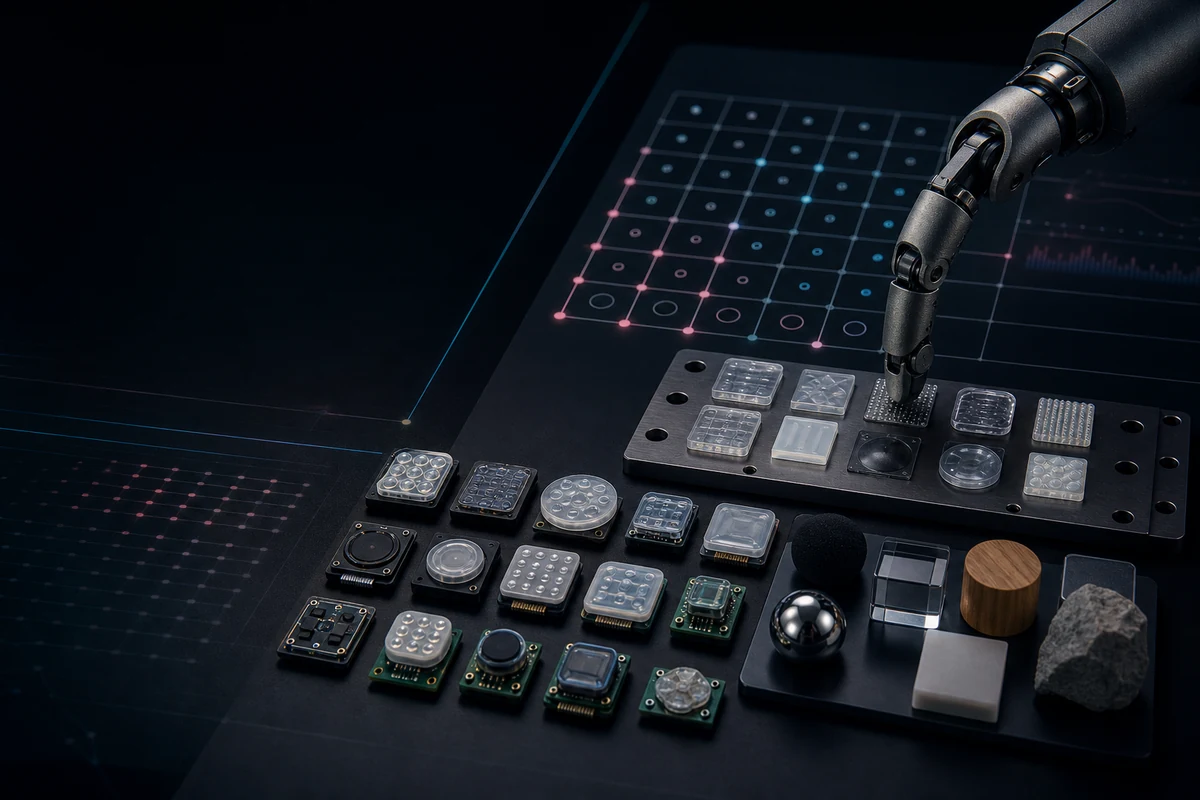
A fingertip sensor can resolve local contact for insertion, slip response, or texture-related tasks. Finger and palm sensing can expose load paths and contacts that a fingertip-only layout misses. Whole-hand systems increase coverage but create routing, calibration, durability, bandwidth, and representation challenges.
The Nature Machine Intelligence full-hand tactile sensing work and the HT-Bench/HandTouch preprint are useful research examples, but they answer different questions. The first demonstrates an integrated full-hand sensing approach; the second proposes data and evaluation tracks for learned full-hand representations. Neither source proves that one sensor or representation is best for every hand and task.
Topic 05
Robot hands in humanoid and dexterous manipulation research
Google DeepMind’s Gemini Robotics 2 announcement reports experiments across whole-body Apollo hardware, a multi-finger Sharpa hand, and a Franka Duo gripper setup. Those are official developer-reported evaluations, not an independent cross-hand benchmark. They show why embodiment and end-effector must remain attached to every task result.
TactiDex, HRDexDB, and related preprints investigate tactile skill transfer or reusable hand data. Their datasets, robots, sensors, object sets, and protocols differ, so reported results should remain source-bounded rather than being converted into a universal hand ranking.
ADEPT compares two different arm-hand workbenches but does not train one cross-hand checkpoint. Its KUKA-Allegro student is vision-only; the five-fingertip tactile pathway and 3/10-versus-8/10 matched result belong only to the Flexiv-Sharpa square-and-round insertion condition.
| Research asset | Hand or sensing role | What it can support | Boundary |
|---|---|---|---|
| HT-Bench / HandTouch | Full-hand tactile data and learned representation evaluation | Cross-task tactile representation research | 2026 preprint with named sensors, tasks, splits, and evaluation tracks |
| TactiDex | Aligned human tactile and kinematic state for tactile-guided dexterous transfer | Single- and bimanual skill-transfer research | 2026 preprint; results belong to its capture and robot deployment setup |
| HRDexDB | Human and multiple robot-hand grasp records with tactile, visual, and kinematic data | Cross-hand grasp and contact research | 2026 preprint; scale and coverage do not by themselves prove policy transfer |
| Gemini Robotics 2 | Official manipulation evaluation across different end effectors and embodiments | VLA and whole-body system research context | Developer-reported task results, not a neutral robot-hand benchmark |
| ADEPT | Embodiment-specific RL on KUKA-Allegro and Flexiv-Sharpa workbenches | Matched vision-only and visuo-tactile evidence on one Flexiv-Sharpa insertion condition | Ten trials per modality; not a cross-hand checkpoint, foundation model, or hand leaderboard |
Topic 06
Evidence checklist for a tactile robot hand
A useful tactile-hand evaluation starts with a task that genuinely depends on contact: occluded grasping, slip, insertion, reorientation, deformable objects, handover, or disturbance recovery. It then aligns the hand, objects, sensors, controller, trial count, success definition, and no-touch baseline.
- Report tactile placement, modality, rate, calibration, latency, wear, and missing-contact regions
- Synchronize touch with joint state, camera frames, action commands, and task events
- Compare matched touch and no-touch conditions when claiming a tactile benefit
- Record drops, excessive force, damage, retries, human intervention, and recovery as well as task success
Paper routes
Start with source-backed RoboSkin briefs
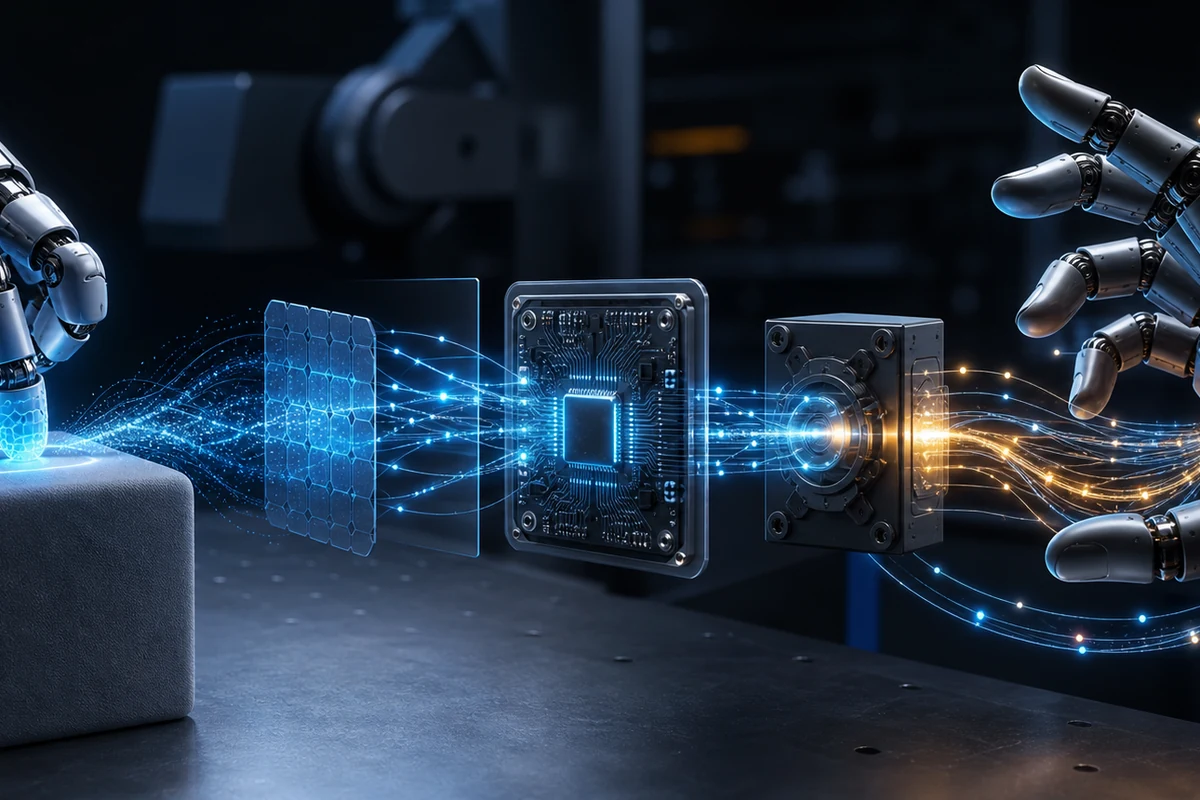 Robot learning / 2026-08-22ADEPT reports a 3/10 to 8/10 tactile ablation on dexterous insertionADEPT reports 3/10 vision-only versus 8/10 visuo-tactile final success in one matched Flexiv-Sharpa insertion condition, with ten physical trials per condition.
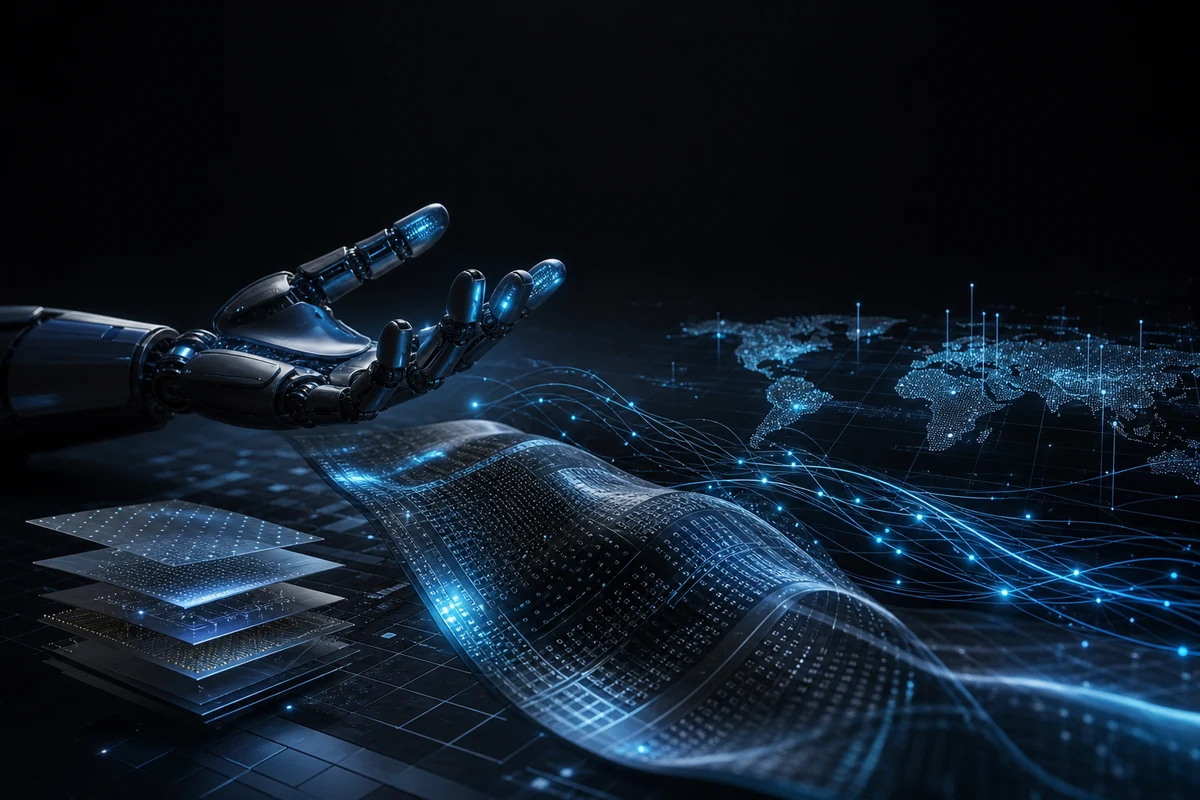 Tactile AI / 2026-08-22HT-Bench full-hand tactile benchmark for robot manipulationHT-Bench v2 pairs egocentric vision with millions of full-hand tactile frames, corrects the vision-to-tactile metric split, and adds four real-robot evaluations.
 Dexterous Manipulation / 2026-05-14Full-hand tactile sensing for adaptive dexterous graspingA research-oriented explanation of why full-hand tactile coverage matters for adaptive grasping, occluded manipulation, and contact-aware robot hands.
 Tactile manipulation / 2026-08-22T-Rex adds high-rate tactile reaction to dexterous robot policiesT-Rex reports a 100-hour collection and a 30-point gap over EgoScale; its official release now provides code, checkpoints, and an approximately 50-hour public subset.Tactile benchmarks / 2026-08-21TactiDex benchmarks contact-level human-to-robot dexterityTactiDex aligns whole-hand tactile signals with kinematic and object states to evaluate physically grounded human-to-robot dexterous transfer.
Common questions
FAQ for this topic
What is a robot hand?
A robot hand is an end effector with fingers or multiple articulated contacts used to grasp, reorient, manipulate, or operate objects. Designs range from adaptive hands to highly actuated anthropomorphic systems.
Is a robot hand better than a robot gripper?
Not universally. A gripper may be simpler and more repeatable for constrained tasks. A multi-finger hand can offer more contact configurations and tool compatibility but increases control, sensing, data, and maintenance complexity.
Why do robot hands need tactile sensors?
Tactile sensors can expose local contact, pressure distribution, shear, slip, and seating after the fingers occlude the object or external cameras cannot see the contact state.
How should robot hands be compared?
Align kinematics, actuation, physical limits, sensing, software, task, objects, trials, success criteria, interventions, failures, and evidence level. Do not rank hands by degrees of freedom alone.