Source-reviewed sensor directory
Tactile sensor comparison for robot manipulation
Compare GelSight Mini, DIGIT and TacTip, then shortlist tactile sensors for grasping, slip detection and insertion with source-specific limits.
Published | Updated by RoboSkin.ai Editorial Team
Short answer
What you need to know
- 1
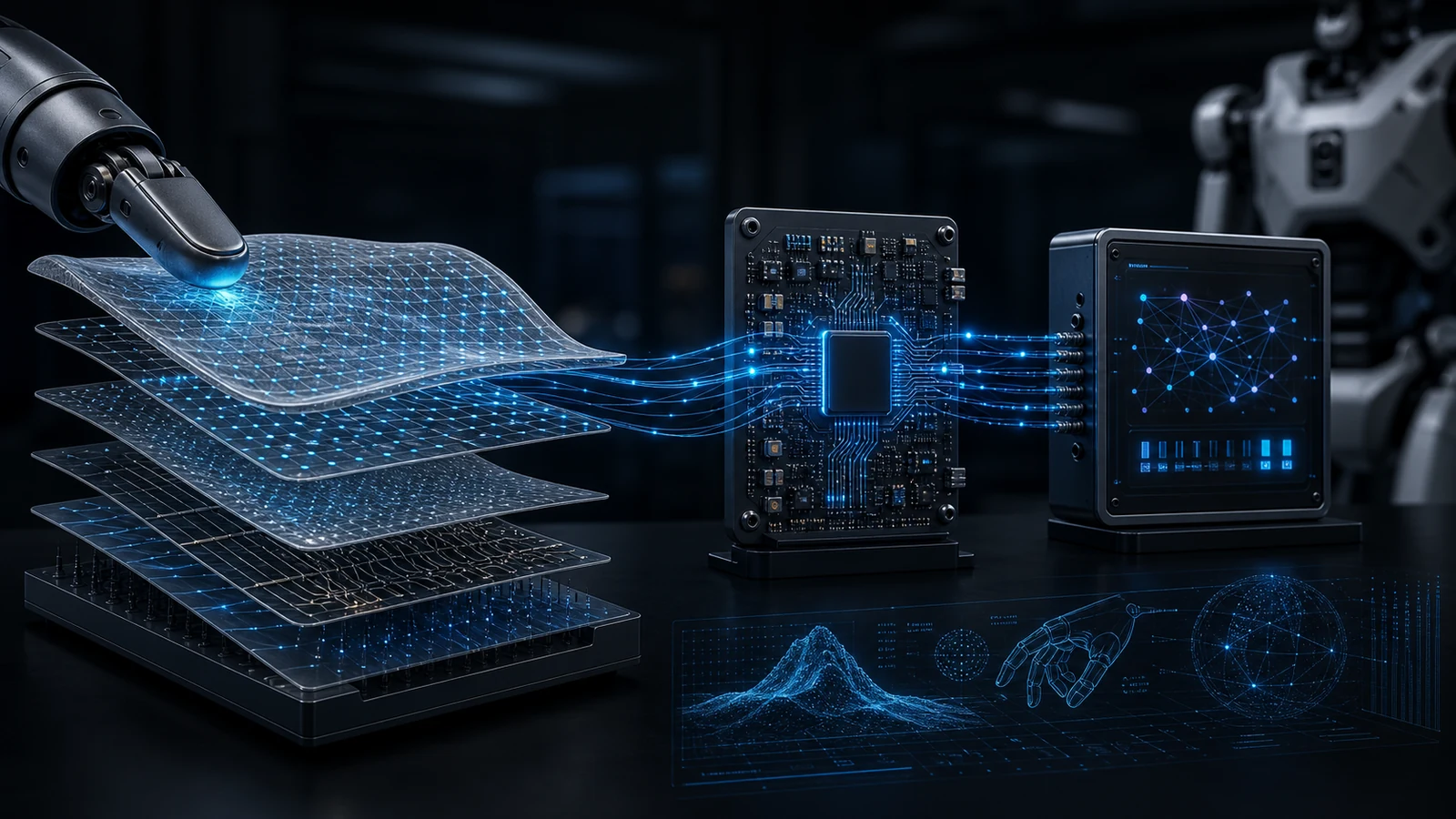
A robot tactile sensor converts physical contact into measurable signals such as images, pressure, normal and shear force, vibration, temperature, or magnetic-field change. The best sensor is the one whose signal, geometry, rate, durability, and interface match the task.
- 2
Vision-based sensors provide dense contact images but need a camera, lighting, compliant surface, and inference pipeline. Magnetic skins can be thin and fast but still require magnetometers, calibration strategy, and protection from mounting and field variation.
- 3
Do not select a sensor from spatial resolution alone. Compare contact coverage, shear sensitivity, latency, force range, drift, replaceability, wear, wiring, middleware, and closed-loop task evidence.
Topic 01
GelSight vs DIGIT vs TacTip: what should you compare?
GelSight is both a sensing technology name and a manufacturer name. This comparison uses GelSight Mini and the original DIGIT; Digit 360 is a separate device. TacTip is a family of designs, so choose a particular variant before comparing specifications.
This is a source-based selection guide, not a head-to-head hardware test. A camera frame rate is not an end-to-end control rate, and an image is not a calibrated force measurement.
| System | Contact observation | Integration decision | Limit to preserve |
|---|---|---|---|
| GelSight Mini | Tactile RGB images, surface topography cues and marker motion | Check the camera workflow, mounting and reconstruction software for your robot | The manufacturer documents this model; force and slip accuracy require a defined model and protocol. |
| Original DIGIT | Tactile RGB images and contact geometry cues | Check fingertip mounting and the archived design / Python interface repositories | Raw images do not automatically provide force or slip; keep original DIGIT separate from Digit 360. |
| TacTip | Internal marker displacement in a soft optical fingertip | Choose a geometry, camera, skin and inference pipeline before integration | No single specification describes the whole sensor family. |
Topic 02
Tactile sensor comparison by manipulation task
Use these task requirements to build a shortlist, then test that shortlist under matching objects, loads, mounts and controller settings. These are evaluation criteria, not measured rankings or claims that a sensor family is always best.
| Task | Signal to investigate | What to measure | Common selection mistake |
|---|---|---|---|
| Grasping fragile objects | Contact distribution and calibrated normal-force cues | Object damage, grasp success and force overshoot at matched loads | Choosing the highest image resolution without checking force calibration. |
| Slip detection and recovery | Time-varying shear, marker motion or vibration cues | Detection delay, false alarms and recovery success across materials | Treating a raw tactile image or advertised frame rate as validated slip detection. |
| Insertion and alignment | Local contact geometry and directional contact cues | Insertion success, peak contact force and recovery under pose errors | Comparing results obtained with different tolerances, parts or controllers. |
| Dexterous hands and full-hand coverage | Fingertip detail plus contact coverage across fingers and palm | Missed contacts, wiring constraints, latency and repeatability after replacement | Assuming one fingertip sensor measures contacts across the whole hand. |
Topic 03
Robot tactile sensor taxonomy
Tactile sensors should first be grouped by physical transduction principle and deployment geometry. A fingertip image sensor, magnetic skin patch, distributed palm array, and whole-body safety surface solve different contact problems even if all are called tactile sensors.
| Sensor family | Raw observation | Typical strength | Integration cost | Evidence to request |
|---|---|---|---|---|
| Vision-based tactile | Camera image of a deforming gel or internal markers | Dense local contact geometry and reusable computer-vision tooling | Camera volume, lighting, gel wear, image bandwidth, learned calibration | Raw frame rate, contact area, replacement repeatability, force or slip validation |
| Magnetic skin | Magnetometer response to a magnetized elastomer or embedded magnets | Thin, fast, replaceable contact surfaces and three-axis cues | Magnetic layout, sensor-to-skin spacing, field interference, calibration | Cross-instance transfer, drift, overload behavior, mounting sensitivity |
| Resistive / capacitive array | Taxel-level resistance or capacitance change | Distributed pressure coverage and compact electronics | Routing, crosstalk, hysteresis, curvature, protective layers | Taxel pitch, force range, sampling architecture, bend and temperature effects |
| Fluid-filled biomimetic | Electrode impedance, fluid pressure, vibration, and temperature | Multimodal fingertip sensing with compliant contact | Mechanical maintenance, nonlinear calibration, platform adapters | Per-modality bandwidth, force reconstruction, skin replacement, task results |
Topic 04
Selection starts from the contact event
Choose the signal from the failure the robot must prevent or recover from. Fine insertion may need local contact geometry and shear. Fragile grasping may prioritize stable normal-force cues and low-latency slip detection. Whole-body safety may prefer broad coverage and robust event detection over fingertip-scale images.
- Task: contact detection, force control, slip recovery, texture, pose, insertion, or collision safety
- Geometry: fingertip, finger link, palm, gripper pad, arm, torso, curved shell, or flexible surface
- Signal path: analog front end, camera stream, embedded processor, timestamp, bus, ROS 2 message, and controller
- Maintenance: gel or skin replacement, calibration, cleaning, wear, overload, temperature, and cable strain
Topic 05
Specifications are not task performance
A manufacturer or paper may report frame rate, taxel pitch, force error, or durability under a controlled setup. Those figures describe that configuration. Mounting, protective layers, contact material, robot vibration, preprocessing, inference, and controller timing can change the useful result.
For procurement or experiment design, preserve the source URL and exact model. Where a reviewed primary source does not state a rate or specification, this directory says so instead of inferring a family-wide value.
Topic 06
Minimum validation before robot deployment
Validate the complete sensor-to-action loop on the target robot. First measure no-contact drift, contact repeatability, saturation, and timing. Then run the real task with touch enabled and disabled, including sensor replacement and disturbed contacts.
- Timestamp stability and end-to-end latency under full robot load
- Repeatability across sensor instances, skins, gels, mounts, and days
- Normal, shear, slip, or contact-state accuracy under the intended materials
- Closed-loop task improvement plus false-positive and failure-recovery behavior
Topic 07
From sensor selection to calibrated data
Tactile sensing in robotics requires more than choosing a sensing principle. Establish whether the output is an image, arbitrary-unit signal, reconstructed geometry or calibrated force; record settings, reference measurements and validity semantics before comparing results.
For original DIGIT and GelSight Mini, the calibration guide separates baselines, depth reconstruction and force estimation. The Python exercise lets you practice quality checks without purchasing either device.
Structured sensor explorer
Compare tactile sensors for robots
This directory separates the physical transduction principle, raw signal, form factor, integration path, and evidence boundary. Family-level specifications are not copied onto every model.
Latest source review: 2026-09-12 / 14 records
Showing 14 of 14 sensors
| Sensor | Principle / form factor | Reported signals | Rate / integration | Access | Evidence boundary | Primary links |
|---|---|---|---|---|---|---|
| ViTai VT-GF225ViTai RoboticsReviewed 2026-08-22 | Marker-based vision tactile sensing with a compliant gel interface Form: 25 × 25 mm sensing area in a 32 × 32 × 60 mm housing | Marker-based tactile image; Normal-force estimate; Tangential-force estimate; Slip-related tactile information | Rate: 30 Hz for the standard version according to the reviewed manufacturer page Integration: USB 2.0 sensor documented for robot grippers and dexterous-manipulation systems; UniVTAC uses two GF225 sensors on its physical Tianji Marvin setup. | Commercial hardware with public product and SDK documentation. No repository-wide license was verified for the ViTai SDK, so it is not described as open-source software. | Manufacturer-reported standard specifications include 240 × 240 tactile information points, approximately 100 μm spatial resolution, 30 N maximum normal and tangential force, 0.01 N minimum identifiable force, IP54, and a −25 °C to 80 °C operating range. The UniVTAC paper documents marker-based RGB use at 30 Hz and does not establish that every advertised SDK output or product specification was used or independently validated. | |
| DIGITRead sensor guideMeta AI Research / GelSightReviewed 2026-09-12 | Vision-based tactile sensing Form: Compact robotic fingertip | High-resolution tactile RGB image; Contact geometry cues | Rate: The 2020 paper reports 60 FPS at 640 × 480; the official Python interface defaults to 640 × 480 at 30 FPS. Verify the stream supported by the actual unit. Integration: Designed for in-hand manipulation; public manufacturing designs and a Python interface are available. The reviewed design and interface repositories are archived. | Design and interface files carry CC BY-NC 4.0 terms; commercial units have been offered through GelSight. | Raw images do not automatically provide calibrated force, slip, or task success; those outputs depend on models and calibration. | |
| Digit 360Meta AI Research / GelSightReviewed 2026-08-19 | Multimodal vision-based tactile sensing Form: Hemispherical compliant fingertip | Tactile image; Audio; Motion / IMU; Pressure; Other on-device sensing features | Rate: Not publicly stated on the reviewed repository overview Integration: ROS 2 resources and a modular five-PCB sensor design are provided by the official repository. | Research design/software repository and call-for-proposals access path; verify current hardware availability. | The source reports approximately 8.3 million image-derived taxels and more than 18 sensing features; deployment performance still depends on task-specific processing. | |
| GelSight MiniRead sensor guideGelSightReviewed 2026-09-12 | Vision-based tactile sensing Form: Compact flat tactile sensor | Tactile RGB image; Surface topography cues; Marker motion for shear estimation | Rate: 25 FPS in the reviewed official datasheet Integration: USB camera workflow with Linux, Windows, macOS, ROS, and ROS 2 support documented by GelSight. | Commercial hardware with a user-replaceable gel cartridge; the reviewed gsrobotics example repository carries a GPL-3.0 license. | The official datasheet reports an 18.6 × 14.3 mm field of view; task-level force or slip accuracy requires a defined model and protocol. | |
| ReSkinRead sensor guideMeta AI Research / Carnegie Mellon UniversityReviewed 2026-09-12 | Magnetic tactile skin Form: Thin replaceable skin patch | Three-axis magnetic tactile signal; Contact location; Force-related deformation | Rate: Up to 400 Hz reported by Meta Integration: Passive magnetized elastomer is separated from nearby magnetometer electronics for replaceable skin interfaces. | Public project and hardware/software documentation; the author-maintained reskin_sensor library carries an MIT license. Check external data and model licenses separately. | Meta reports 2–3 mm thickness, more than 50,000 interactions, and 1 mm spatial resolution at 90% accuracy under its evaluation; do not generalize those figures to every geometry. | |
| AnySkinNew York University / Carnegie Mellon University / Columbia University / MetaReviewed 2026-08-19 | Magnetic tactile skin Form: Replaceable skin interface for robot end effectors | Magnetic-field distortion; Contact; Slip-related signal | Rate: Not publicly stated on the reviewed project page Integration: Adhesive-free mechanical designs target fast replacement across grippers and robot hands. | Project page links paper, code, CAD files, design tool, and sample / purchase paths. | The paper evaluates cross-instance policy reuse on its tasks; it does not establish calibration-free equivalence across all robot geometries. | |
| GelSlim 4.0University of Michigan MMint LabReviewed 2026-08-19 | Vision-based tactile sensing Form: Compact tactile finger for parallel grippers | Tactile image; Contact shape; Marker displacement cues | Rate: Not publicly stated in the reviewed abstract Integration: Open-source design emphasizes reproducibility, a modifiable finger structure, and manufacturable lenses. | Project documentation, code, and data are linked by the paper. | It is a research sensor design; calibrated force, slip, and manipulation results depend on the associated processing and task setup. | |
| TacTipBristol Robotics Laboratory / University of BristolReviewed 2026-08-19 | Biomimetic optical tactile sensing Form: Soft 3D-printed fingertip and related morphologies | Internal marker displacement; Contact shape; Shear and slip cues | Rate: Depends on the camera and TacTip variant; no single rate is stated for the full family Integration: Open 3D-printed sensor family used in tactile perception, servoing, manipulation, and simulation research. | Research designs and publications are openly documented; verify the current variant and files. | TacTip is a sensor family, not one fixed specification. Geometry, camera, skin, markers, and inference pipeline vary by version. | |
| BioTacSynTouchReviewed 2026-08-22 | Fluid-filled biomimetic multimodal sensing Form: Human-fingertip-shaped sensor | Force-related electrode impedance; Fluid pressure; Vibration; Temperature / heat flow | Rate: No single cross-modality rate is used in this directory; BioTac signal channels and hardware revisions must be checked separately. Integration: The reviewed peer-reviewed source describes the biomimetic multimodal sensor; current hand integrations, software support, and connectors require separate verification. | Historically commercial hardware; current sales, support, and availability were not verified in this review. | The curved compliant device provides multiple raw modalities, while explicit force vectors require calibration or learned interpretation. BioTac and BioTac SP revisions must not be conflated, and the former product domain is not treated as current evidence. | |
| uSkinXELA RoboticsReviewed 2026-08-19 | Distributed magnetic three-axis force sensing Form: Soft modular arrays for fingers, palms, grippers, and custom surfaces | Normal force per taxel; Two-axis shear force per taxel | Rate: Up to 500 Hz for the uSPa 11 model in the reviewed catalog Integration: Digital-output modules can contain up to 64 sensing points and connect to XELA processing software. | Commercial hardware in multiple shapes and robot-hand integrations. | Range, resolution, rate, thickness, and taxel count differ by model; compare the exact datasheet rather than applying one model’s specification to the family. | |
| DenseTact 2.0Stanford University ARM LabReviewed 2026-08-19 | Vision-based optical tactile sensing Form: Highly curved soft robotic fingertip | Deformed-surface image; Calibrated shape reconstruction; Six-axis wrench estimate | Rate: Not publicly stated in the reviewed abstract Integration: Designed for compact dexterous manipulation and calibrated through learned shape and wrench models. | Research paper and associated laboratory resources. | Reported shape and wrench errors come from the paper calibration setup; transfer to a new finger still requires calibration data and validation. | |
| 9DTactShanghai Qi Zhi Institute / Tsinghua University / HUST / Shanghai AI LaboratoryReviewed 2026-08-19 | Vision-based tactile sensing with translucent gel Form: Compact tactile fingertip | Tactile image; 3D shape reconstruction; Six-axis force estimate | Rate: Not publicly stated on the reviewed project page Integration: Open hardware, software, dataset, pretrained models, and fabrication tutorial are provided. | Fully open-source research design according to the official project page. | The reported generalizable force model uses approximately 100,000 image-force pairs from 175 objects; unseen hardware and tasks require separate validation. | |
| InsightMax Planck Institute for Intelligent SystemsReviewed 2026-08-19 | Vision-based haptic sensing Form: Soft thumb-sized conical sensor | Directional three-axis force-distribution map; Contact location; Contact shape cues | Rate: Not publicly stated on the reviewed project page Integration: The design maps camera observations to distributed force vectors across a three-dimensional surface. | Research publication and project documentation. | The published force-map performance belongs to the paper hardware, data, and learned calibration, not every derived sensor shape. | |
| AllSightBen-Gurion University research teamReviewed 2026-08-19 | Vision-based optical tactile sensing Form: Round thumb-sized tactile sensor | Contact position; Force; Torsion; Tactile image | Rate: Not publicly stated in the reviewed abstract Integration: Mostly 3D-printed modular design targets in-hand manipulation and broad curved-surface contact. | Open-source research design linked by the paper. | The paper’s zero-shot claim concerns state-estimation transfer across fabricated instances under its protocol, not zero-shot transfer to every task or robot. |
Paper routes
Start with source-backed RoboSkin briefs
 Tactile AI / 2026-08-22Vision-based tactile intelligence connects sensor optics to robot actionA 2026 review maps vision-based tactile sensing as one integrated stack: deformable contact hardware, optical readout, tactile representations, learning, simulation, datasets, and robot action.
 Magnetic Tactile Sensing / 2026-06-18Open-source magnetic tactile calibration for gripper-agnostic touchA practical research note on open-source magnetic tactile calibration, three-axis force sensing, in-situ calibration, and why low-cost sensors still need repeatable setup.
 Dexterous Manipulation / 2026-05-14Full-hand tactile sensing for adaptive dexterous graspingA research-oriented explanation of why full-hand tactile coverage matters for adaptive grasping, occluded manipulation, and contact-aware robot hands.
Common questions
FAQ for this topic
What tactile sensors are used in robot hands?
Common choices include vision-based tactile fingertips, magnetic skins, distributed force arrays, and multimodal biomimetic fingertips. The right choice depends on hand geometry, contact task, control rate, and maintenance constraints.
Are vision-based tactile sensors force sensors?
They produce images of a deforming interface. Force can be estimated after calibration or learned mapping, but a raw tactile image is not automatically a calibrated force measurement.
What is a taxel?
A taxel is a tactile sensing element in an array, analogous to a pixel only at the level of spatial indexing. Taxels can measure different physical quantities and may not have independent responses.
Which tactile sensor has the best resolution?
There is no task-independent winner. Spatial resolution must be considered with field of view, force or shear sensitivity, latency, bandwidth, durability, calibration, and closed-loop evidence.