FunCo-Grasp transfers grasp structure across different robot hands
FunCo-Grasp maps unlike robot hands into shared functional parts and canonical frames before generating an executable dexterous grasp.
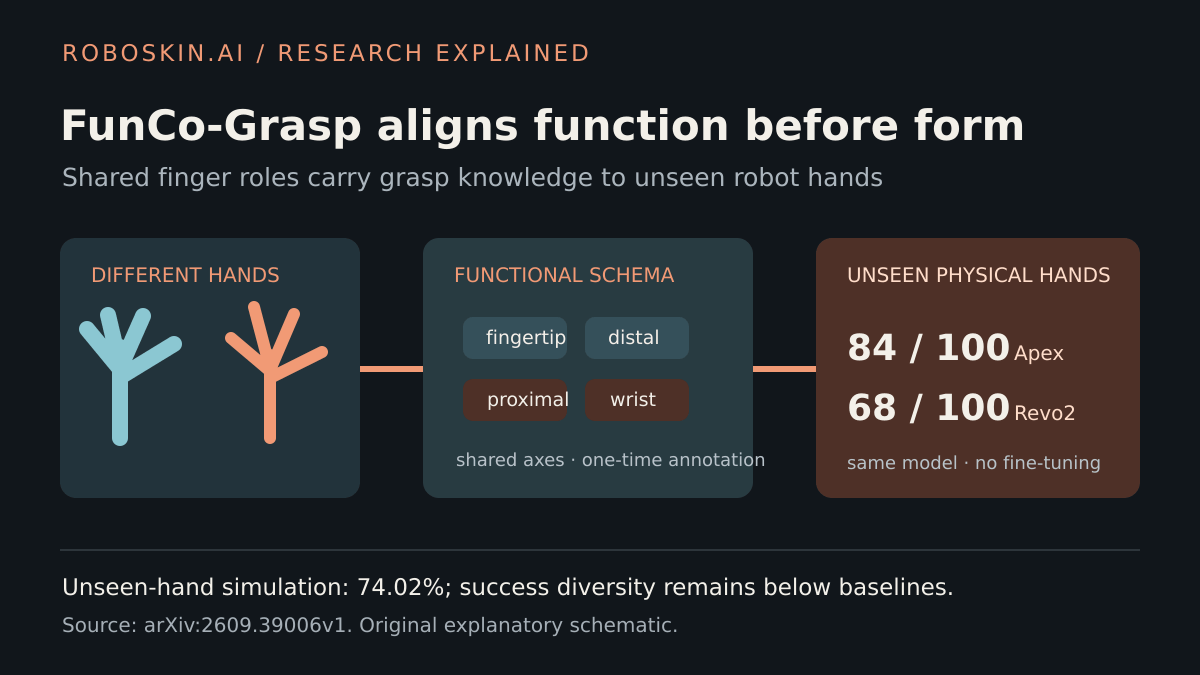
Researchers from Southern University of Science and Technology, KTH Royal Institute of Technology, Shanghai Jiao Tong University and Rysen Robotics released FunCo-Grasp on September 30, 2026. The method assigns physically different links to shared functional roles, then expresses those roles in canonical local frames before generating a grasp. One model reaches 84/100 successes on ApexHand and 68/100 on Revo2, two hand designs not used for training. Paper and version record.
Key takeaways
- The model trains on 14,011 grasps from ShadowHand, Allegro and Barrett, then evaluates four unseen simulation hands without target-hand grasp data or fine-tuning.
- Average simulated success is 92.40% on the three seen hands and 74.02% on ApexHand, XHand, LeapHand and Robotiq-3F.
- The physical total is 152/200 trials across ApexHand and Revo2. The official repository existed at verification time but contained only a 13-byte “Comming soon” README and no license.
What changed
Cross-embodiment grasp models face a representation mismatch. A thumb tip and an opposing finger may play similar roles on two hands even when their link names, topology and axes differ. FunCo-Grasp introduces Functional Part Alignment to map links into fingertip, distal, middle, proximal, metacarpal and wrist roles. Canonical Frame Alignment then gives those roles shared forward, closing and lateral directions.
A graph encoder combines the aligned hand's geometry, roles and kinematics. A frozen object encoder supplies local shape features. A diffusion model generates the spatial arrangement of the functional parts, and inverse kinematics converts those target positions into wrist and joint configurations. Adapting a new hand requires its geometry, kinematics and a one-time role annotation, but not new grasp demonstrations. Method and evaluation.
The filtered CMapDataset split contains 48 training objects and ten held-out objects. Training grasps comprise 3,754 ShadowHand, 6,242 Barrett and 4,015 Allegro examples. Each hand-object simulation pair is evaluated in three runs of 100 newly generated grasps. A grasp succeeds if it survives six directional disturbances and finishes with less than two centimeters of object displacement.
Results and baseline boundaries
On seen hands, FunCo-Grasp averages 92.40%. That is below UniMorphGrasp's paper-reported 94.00% but above locally evaluated T(R,O) Grasp at 91.07%. UniMorphGrasp had no published results for the four unseen hands. On those unseen embodiments, FunCo-Grasp averages 74.02%, compared with 66.50% for CEDex, the strongest available all-four baseline in the table.
The alignment ablation is especially revealing. Removing Functional Part Alignment reduces unseen-hand success from 74.02% to 33.90%; removing canonical frames lowers it to 19.40%; removing both reaches 0.95%. Seen-hand performance moves by less than 2.3 points in the same ablations. Functional correspondence therefore matters most when morphology changes, rather than simply increasing capacity on familiar hands.
The authors also report a weakness: successful grasp diversity is 0.293 radians, lower than 0.401 for T(R,O), 0.450 for D(R,O) and 0.512 for CEDex under the cited protocols. The model is fast at 0.16 seconds per grasp on the reported workstation, but it produces a narrower set of configurations.
Physical tests on unseen hand designs
Both physical platforms mount an unseen hand on a UR5 arm and use a RealSense D435i. Each trial captures fresh RGB-D data, segments the object with SAM2 and generates a grasp. Ten objects receive ten random placements per hand. ApexHand succeeds 84/100 times and Revo2 succeeds 68/100, yielding 152/200, or 76.00%, overall. Per-object counts range from 5/10 to 10/10 on ApexHand and 4/10 to 9/10 on Revo2.
RoboSkin analysis: this is a grasp-generation result, not a full manipulation policy. It shows that an explicit functional schema can bridge robot hand geometries, but the downstream test is lift-and-hold rather than in-hand reorientation, tool use or tactile recovery. A future system could combine this morphology transfer with contact-aware manipulation after the grasp closes.
Limitations and availability
FunCo-Grasp is an arXiv v1 preprint, and RoboSkin.ai has not reproduced it. The one-time functional annotation is described as lightweight but not timed or evaluated for annotator consistency. Baseline provenance is mixed: most methods use released checkpoints under the authors' local protocol, while UniMorphGrasp values come from its paper. The model also depends on object segmentation and does not consume tactile feedback.
The official project page exposes explanations, figures, tables and videos. It links an official GitHub repository, created September 30. At verification time that repository contained only a 13-byte README saying “Comming soon”; there were no implementation files, model weights, dataset package or software license. The arXiv record uses the non-exclusive distribution license, which does not grant an open-source software license.
Sources and related resources
Continue the topic