A tactile reflex becomes the teacher for fragile grasping
The Better Curriculum study uses a 25 Hz tactile controller during data collection, then trains vision-only ACT and pi0.5 policies. The gain is large on one cup task, but disturbance rejection still needs touch at runtime.
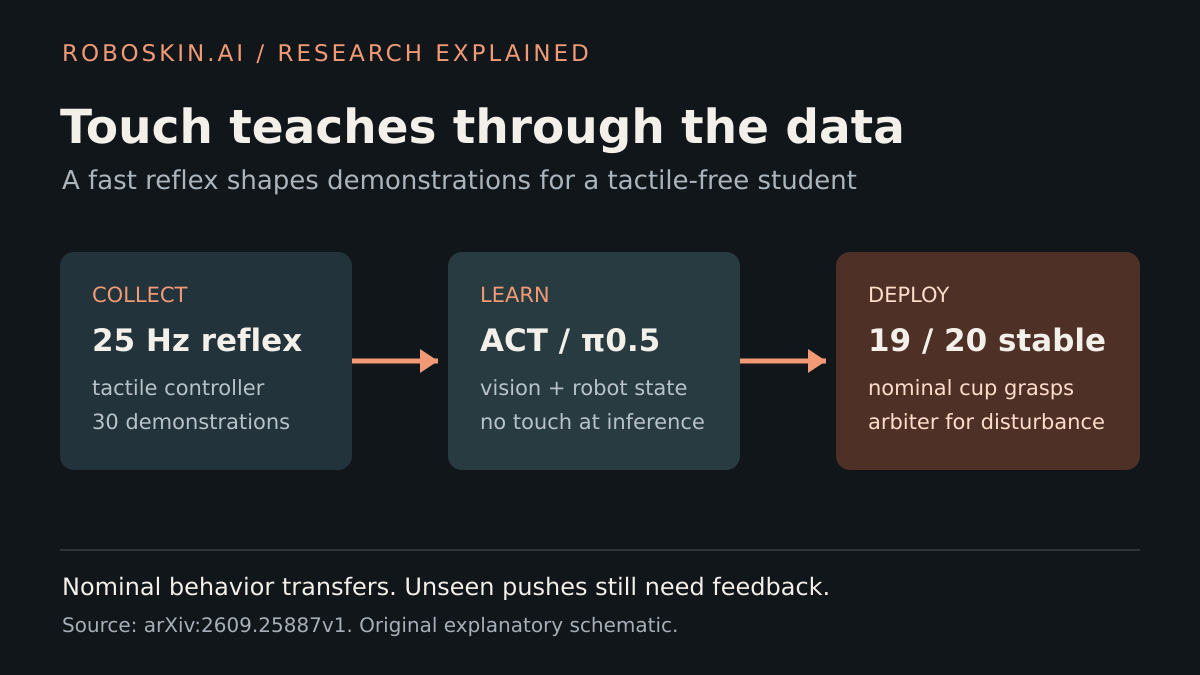
Ziyan Feng and colleagues introduced a different role for touch in a preprint submitted on September 22, 2026: use tactile feedback to shape demonstrations, then train a policy that does not require tactile input at inference. A deterministic 25 Hz controller called TactileReflex produced stable grasps of a thin plastic cup for both Action Chunking with Transformers (ACT) and pi0.5 students. The study also shows the boundary of that idea: a tactile-free student did not retain the controller's disturbance rejection. Paper and version record.
Key takeaways
- With 30 reflex-shaped demonstrations, ACT achieved 19 stable grasps in 20 nominal trials. ACT trained on 30 visually screened manual demonstrations achieved 3 in 20.
- The same data intervention produced 19 of 20 stable grasps with pi0.5, versus 1 of 20 for manual data. These are small physical trial sets on one fragile-cup setup, not a general manipulation benchmark.
- Under randomized lateral disturbances, the same reflex-data pi0.5 policy retained 11 of 20 grasps alone and 20 of 20 with a separate deployment-time tactile arbiter. Disturbance experiment.
What changed
The bottleneck is placed at collection time. Manual gripper commands are delayed and coarse relative to the narrow contact range of a 3.5-gram plastic cup with a 0.3-millimeter wall. The Piper arm uses two MC-Tac vision-based tactile sensors on its gripper. During demonstration collection, TactileReflex adjusts the gripper at 25 Hz from a vision-tactile force proxy while the human controls the arm.
The resulting trajectory still trains a tactile-free student. The ACT model runs at 15 Hz; the two-billion-parameter pi0.5 model uses LoRA and generates actions at 20 Hz, with policy queries observed at roughly 1.7 to 1.8 Hz. The reported training and inference hardware includes one RTX 5090. System description.
Results and the important comparison
The main ACT comparison uses 30 reflex demonstrations and 30 manual demonstrations selected by watching 100 manual trials. Outcomes were labeled stable, loose or dropped from video by five authors. In 20 nominal trials per policy, reflex data yielded 95% stable grasps, while manual data yielded 15%. Adding the tactile arbiter to the manual-data ACT policy raised stable grasps to 50%, still below the reflex-data result.
Could better screening explain the gap? The authors logged tactile contact for a fresh pool of 100 manual demonstrations, ranked them by contact quality and trained ACT once on the top 30. That policy recorded 6 stable grasps in 20 trials, versus 19 of 20 for reflex data. This is a useful control, but it is one training run and still does not randomize the order of data collection.
The unseen paper-cup test is exploratory: reflex-data pi0.5 reached 8 stable grasps in 10 trials and manual-data pi0.5 reached 3 in 10. The paper reports p=0.0698, so the result does not meet the study's conventional significance threshold.
What this means for robotics
RoboSkin analysis: touch can improve a vision-only policy without becoming another runtime modality. That matters when production hardware cannot carry the training sensor, or when a fast controller can generate cleaner contact behavior than a human operator. It also reframes robot demonstration data: the controller that creates the trajectory can be as important as model size.
The disturbance result prevents a stronger conclusion. A learned feed-forward policy can imitate nominal force-sensitive behavior, but cannot react to an unobserved external push. Contact-critical systems may still need a low-latency loop, whether from tactile sensors, motor current or a force-torque sensor. The separation between learned motion and a runtime arbiter is closer to a safety architecture than a complete removal of touch.
Limitations and availability
This is an arXiv v1 preprint and RoboSkin.ai has not reproduced it. The tactile controller signal is a dimensionless vision-tactile proxy, not a calibrated force measurement in Newtons. The approximately 0.5 N deformation observation describes the cup, not the controller's internal value. Collection order was not randomized, and the three outcome labels come from video rather than force ground truth.
The official project page exposes the paper, diagrams and videos. On September 23, it linked to an author's general GitHub profile but did not provide a dedicated code, dataset or model download, and no asset license was stated. Reproduction therefore requires details and artifacts beyond the visible project page.
Sources
Continue the topic