CableVLA combines cable topology with tactile residual control
CableVLA adds topology prediction and a contact-gated tactile residual to pi0.5. It improves a 345-rollout simulation benchmark, while real-robot transfer remains a 10-trial result.
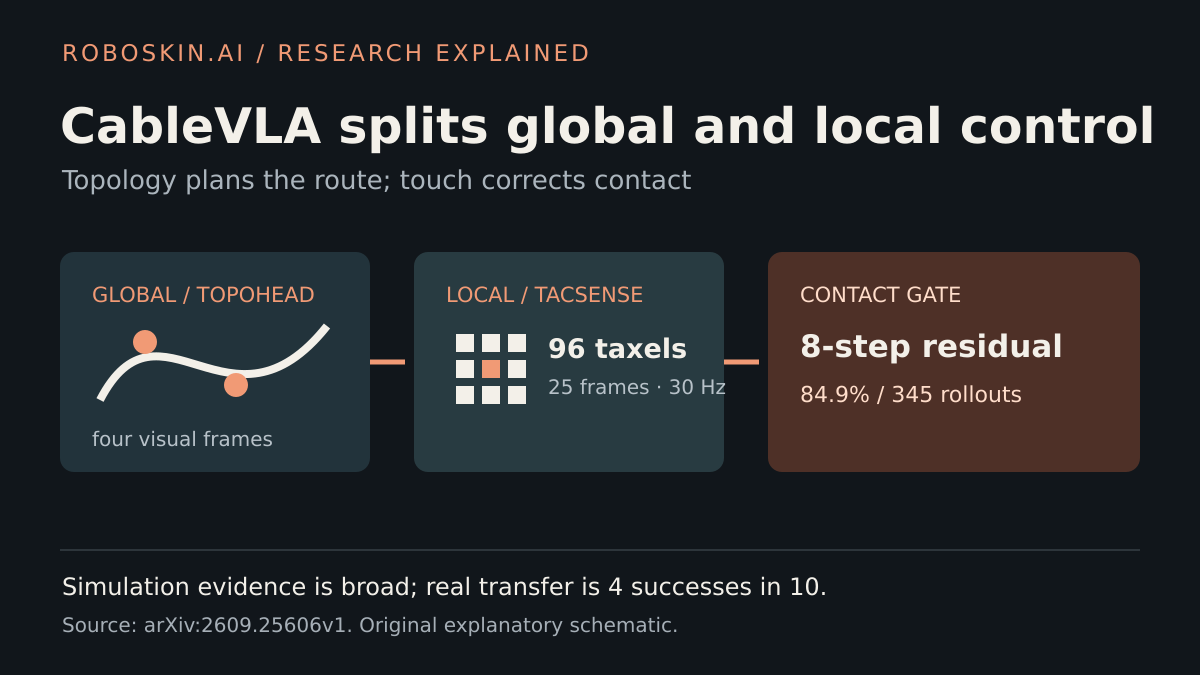
Researchers from Huazhong University of Science and Technology and Harbin Institute of Technology introduced CableVLA in an arXiv preprint submitted on September 22, 2026. Built around pi0.5, the framework distills global cable topology from simulation and learns local contact dynamics from tactile arrays. A contact gate then adds an eight-step force-tactile action residual to a frozen topology-conditioned policy. Paper and version record.
Key takeaways
- Across 345 MuJoCo rollouts, CableVLA reports 84.9% task success, versus 62.6% for the visual pi0.5-V baseline and 65.2% for the topology-only parent.
- Each tactile array contains 96 resistive taxels. TacSense uses 25 frames at 30 Hz and combines a spatial frame branch with a per-taxel temporal branch.
- Zero-shot real-hardware transfer reaches 4 successes in 10 trials under enhanced lighting, compared with 1 in 10 for the visual baseline. This is an early transfer result, not a robust real-world benchmark. Evaluation tables.
What changed
Cable routing mixes two scales. The robot must reason about the cable's overall relation to clips and obstacles, then react locally when friction, slip or contact changes at the gripper. CableVLA separates those roles. TopoHead observes four visual frames and learns current and future topology from simulator-only node and relation labels. TacSense learns tactile dynamics from simulated kinematics and contact events in addition to the measured force map.
The downstream policy uses a RealMan RM75-6F arm, an Inspire-Robots EG2-4C2 gripper, bilateral Loong96 tactile arrays and a wrist force-torque sensor. A contact threshold of 0.049 N opens the gate for the force-tactile residual. That number is a routing threshold, not the full sensor response range: the hardware arrays were calibrated over 5 to 100 gram-force.
Data and evaluation conditions
Topology pretraining uses 33,654 windows from 1,228 training episodes, plus 3,004 validation windows from 113 episodes. TacSense draws from 7,338 episodes across 57 simulated tasks, producing more than 2.19 million candidate windows. Policy adaptation uses 2,004 demonstrations divided by scene-layout pairs.
The 345-rollout benchmark is structured as 115 scenario-condition instances repeated three times. It includes 75 trials each for replay, in-distribution and out-of-distribution layouts, plus 30 each for weak light, strong light, low friction and camera-view changes. Success requires the target cable relations to hold for 2.5 seconds.
CableVLA's 84.9% aggregate success is 22.3 percentage points above pi0.5-V under those conditions. In a camera-view shift, the tactile residual succeeds in 23 of 30 trials versus 3 of 30 for its frozen parent. In a separate Isaac Sim transfer, CableVLA reaches 27 of 50, compared with 17 of 50 for the visual baseline.
Representation scores must not be confused with task success. TacSense reports slip-onset AUPRC of 0.8028 versus 0.1694 for a similarly sized CNN-LSTM, and slip-stop AUPRC of 0.3880 versus 0.1120. Those are simulated event-recognition tests, not physical cable-routing success rates.
What this means for robotics
RoboSkin analysis: CableVLA is a useful architecture pattern for deformable-object manipulation. Global visual planning can remain relatively slow and semantic, while tactile sensing supplies a gated correction only when contact begins. Freezing the parent policy also narrows what the local residual is allowed to change.
The data scale reveals the cost. Rich labels come from simulation, and the real system must reproduce camera geometry, tactile calibration and cable behavior closely enough for those representations to transfer. Teams comparing robotics datasets should distinguish the millions of sampled windows from the smaller count of independent episodes and physical trials.
Limitations and availability
This is an arXiv v1 preprint, and RoboSkin.ai has not run the code or hardware. The real test contains only 10 trials per method and still exposes a large simulation-to-real gap. The authors identify grasp alignment, viewpoint mismatch, arm compliance and cable dynamics as failure sources. Target-domain fine-tuning was not used in the zero-shot comparison.
As inspected on September 23, the arXiv record and full paper did not link a public code repository, project page, dataset download, checkpoints or an implementation license. The counts document internal research assets; they do not establish that those assets are downloadable.
Sources
Continue the topic