VisForce draws force goals into a dexterous robot policy
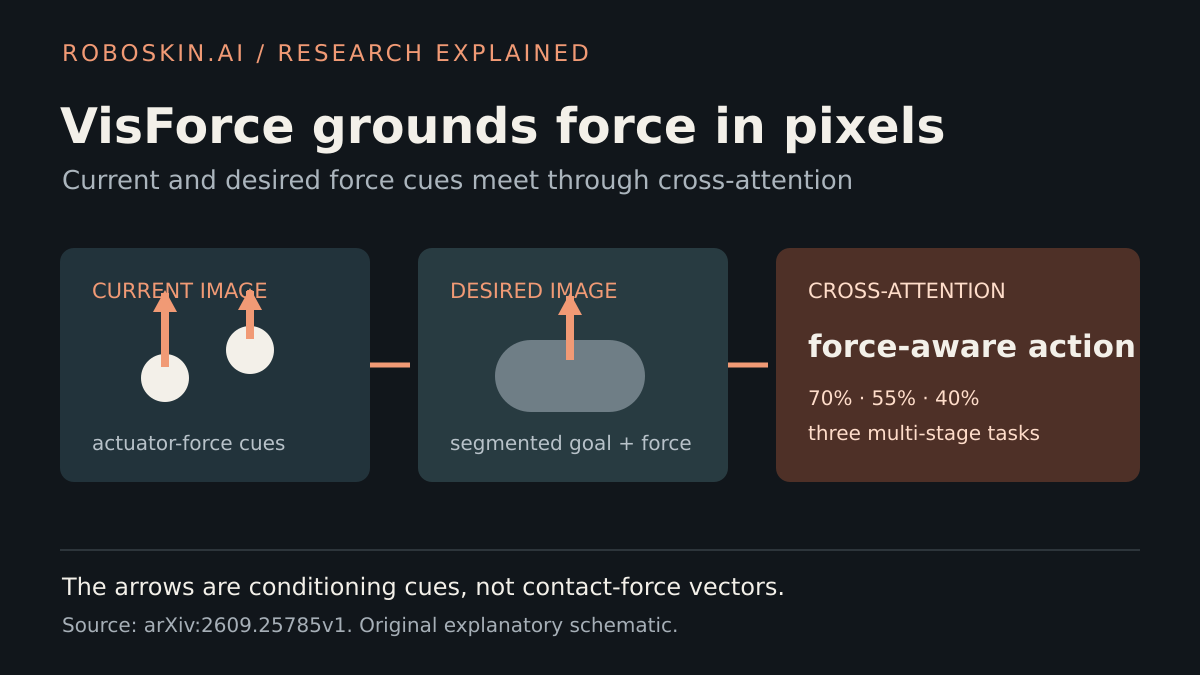
VisForce overlays actuator-force cues at fingertips and combines current and goal images through cross-attention. Real-robot trials improve over four baselines, but the arrows are not measured contact-force vectors.
Jung-Woo Lee and Soo-Chul Lim released VisForce on September 22, 2026, as an arXiv v1 preprint. The method turns present and desired finger-force values into spatial cues drawn over robot images, then uses cross-attention to condition a pi0.5-based dexterous manipulation policy. It is a direct test of whether a vision-language-action model can use force more effectively when the signal is placed where the fingertip appears. Paper and version record.
Key takeaways
- VisForce draws current force cues over a wrist-camera image and desired forces over a segmented goal image. The two representations meet in a single cross-attention block.
- Across 20 real-robot trials per task, final success was 14 of 20 for cup insertion and pouring, 11 of 20 for tong-assisted bread transfer, and 8 of 20 for slip-modulated peg insertion.
- The rendered arrows use actuator forces and estimated finger directions. The paper explicitly says they are visual cues, not estimated contact-force vectors. Method and experiments.
What changed
Many multimodal policies append force as a state vector. VisForce instead aligns the value with its visual location. A UR10 arm carries an Inspire RH56F1 six-degree-of-freedom hand and two Intel RealSense D405 cameras. Per-finger actuator forces are synchronized with images, states and actions: cameras run at 30 Hz, while the other streams are recorded at 200 Hz and matched by nearest timestamp.
Current-force arrows are placed at fingertip pixels in the wrist view. The desired force is rendered onto an object-only goal image. GroundingDINO and SAM2 isolate the goal object offline, while a MuJoCo model and edge-based Chamfer alignment connect the simulated hand to camera geometry. VisForce updates the SigLIP visual encoder and applies rank-16 LoRA to the larger model components.
Results under the reported conditions
The study collects 25 to 30 demonstrations for each of four tasks and evaluates every policy in 20 independent trials. For medium-force grasping, VisForce lifts an egg in 14 of 20 trials and a toothpaste tube in 16 of 20. The visual-force plus text-goal baseline reaches 8 of 20 and 4 of 20 respectively; the state-force plus text-goal baseline reaches 7 and 1.
The three multi-stage tasks make desired force part of task progress. VisForce obtains 70% final success for cup insertion followed by bottle pouring, 55% for grasping tongs and transferring bread, and 40% for a slip-triggered peg-in-hole task with 1-millimeter clearance. The unmodified pi0.5 baseline records 20%, 5% and 5%. A visual-input ablation without cross-attention records 10%, 5% and 15%, suggesting that simply drawing arrows is not the whole contribution.
These are final-stage successes, not average subtask completion. The same hardware, training demonstrations and 20-trial count make the within-paper comparisons useful, while the limited task set and trial count leave wide uncertainty for deployment.
What this means for robotics
RoboSkin analysis: visual grounding offers a practical interface between structured signals and pretrained visual backbones. Instead of asking a VLA to infer that the fifth number belongs to a particular finger, the representation encodes that relationship spatially. Similar interfaces could combine force, slip or robot skin regions with goal images.
However, localization depends on calibration and hand geometry. The visual cue does not remove the need to understand what the underlying sensor measures. Actuator load can include transmission friction and dynamics that differ from fingertip contact. For direct contact-force control, a calibrated tactile sensor or force-torque estimate may still be required.
Limitations and availability
This is a preprint, not independent validation, and RoboSkin.ai has not reproduced it. Experiments use one arm-hand configuration, four tasks and up to 30 demonstrations per task. Goal segmentation is performed offline, so the reported setup does not establish an online open-world goal-generation pipeline. Inference used an NVIDIA RTX A6000; latency and control frequency during deployment were not reported as a full end-to-end budget.
The arXiv record and full text were publicly accessible on September 23. Neither linked a project page, code repository, dataset or model checkpoint. The paper's Creative Commons license covers the manuscript, not unlisted software or training assets. Availability should therefore be described as paper-only until an official release appears.
Sources
Continue the topic