The Missing Touch tests spatial tactile feedback in robot teleoperation
A GelSight Mini and 32-DoF fingertip display made two teleoperation tasks more natural and consistent, but no autonomous robot policy was trained or evaluated.
Evidence review - August 2026
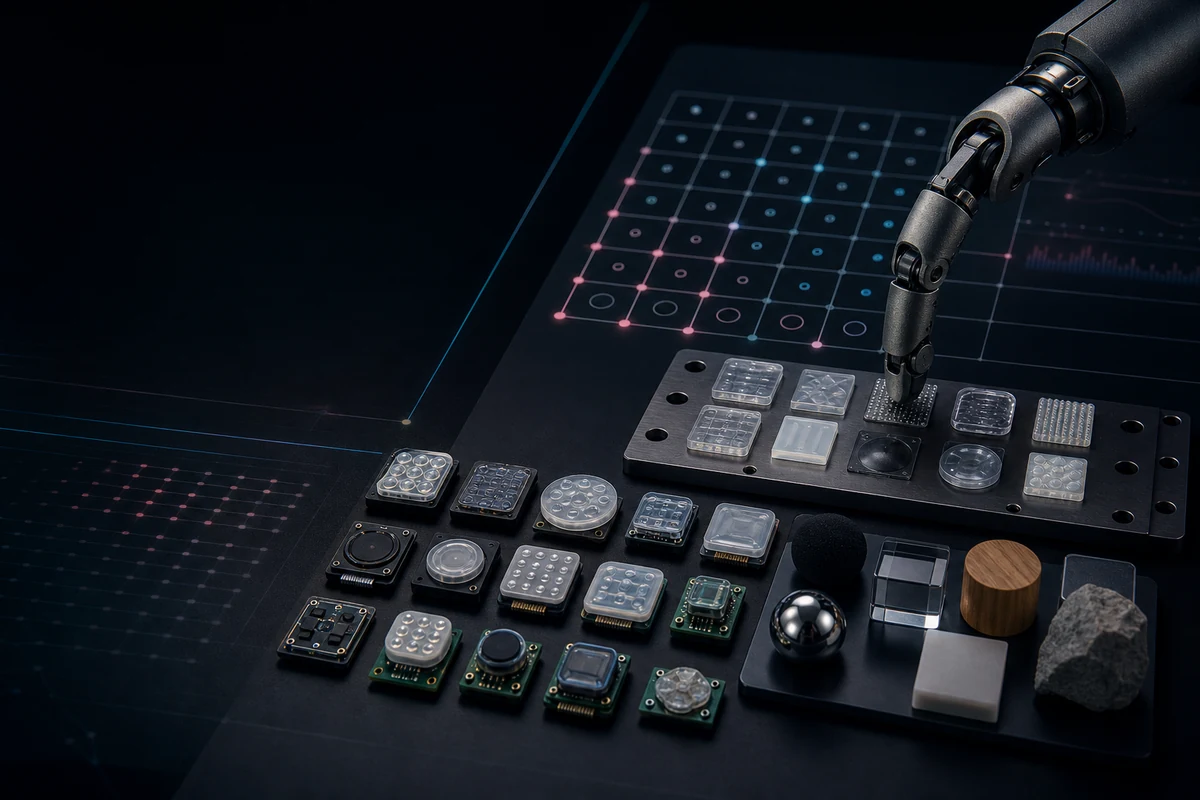
The Missing Touch is an August 19, 2026 arXiv preprint from Northwestern University's Center for Robotics and Biosystems. It asks whether transmitting the spatial pattern of robot-fingertip contact to a human operator can make teleoperated motion more like direct human manipulation.
The study uses a two-degree-of-freedom bilateral leader-follower device, a GelSight Mini as the robot finger, and a 32-degree-of-freedom cutaneous display under the operator's fingertip. Across a button task and a peg-rolling task, the source reports that more localized feedback produced more natural and consistent trajectories. It did **not** train or evaluate an autonomous policy.
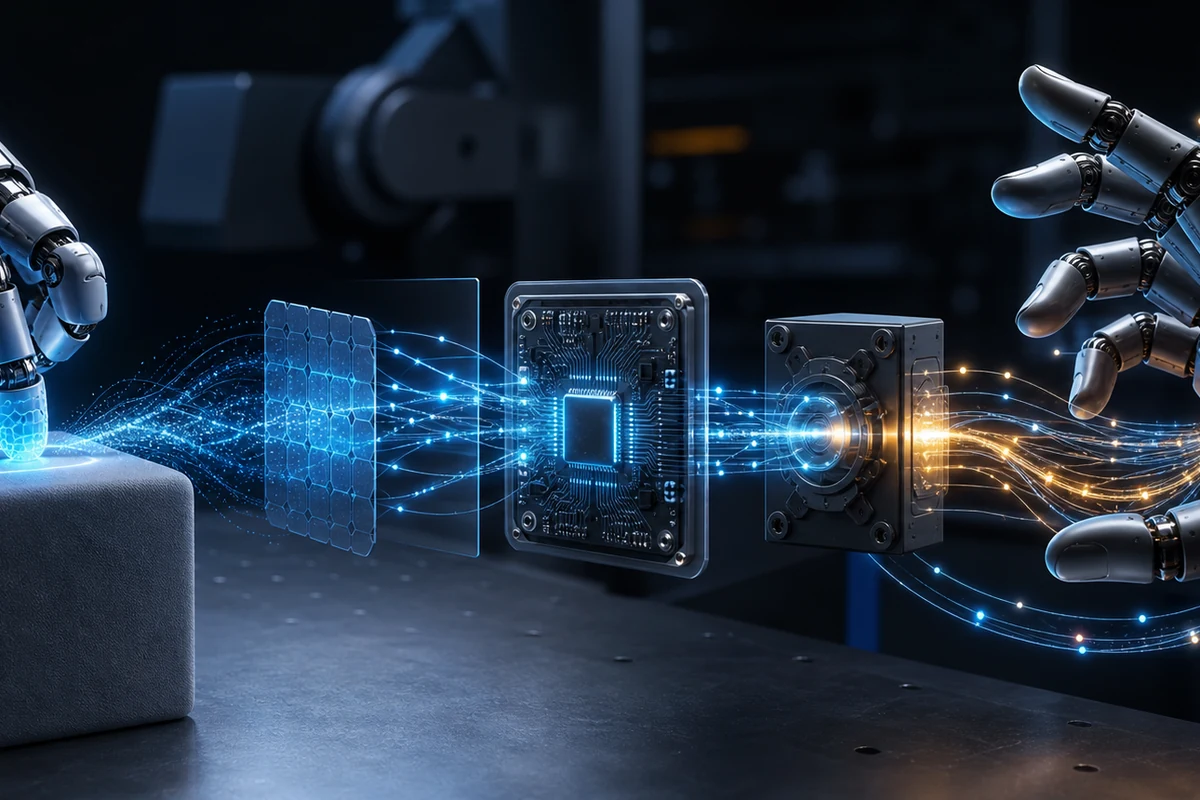
From robot contact to human fingertip
| Layer | Study implementation | Evidence boundary |
|---|---|---|
| Robot-side touch | GelSight Mini vision-based tactile sensor | The study uses contact images, not a generally calibrated force field for arbitrary tasks. |
| Contact mapping | Reference-frame subtraction, smoothing, thresholding, and a 32-pixel activation map | A task-specific binary inflation mapping; it is not a learned universal tactile representation. |
| Human-side display | 32 independently inflatable elastic domes at 3 mm center-to-center pitch | Fluid Reality provided the displays; that acknowledgment does not make the company an author or owner of the study. |
| Kinesthetic channel | Bilateral position-position force feedback | Kinesthetic feedback remained active in every cutaneous-feedback condition. |
| Motion measurement | Two-dimensional end-effector trajectories recorded at 50 Hz | The apparatus has two degrees of freedom and does not represent a multifinger dexterous hand. |
The four cutaneous conditions are Off, 1D, 2D, and Full. Off provides no cutaneous display output. In 1D, all 32 domes inflate together when contact is detected. In 2D, the upper or lower half inflates according to contact location. Full activates only the display locations mapped from the GelSight image.
Use the GelSight Mini sensor record for the commercial sensor identity and specifications. The paper's result belongs to its custom mapping, display, apparatus, and tasks; it is not a general GelSight Mini performance benchmark.
Two participant studies
| Task | Participants | Teleoperated trials | Direct baseline | Main task demand |
|---|---|---|---|---|
| Button discrimination | 12 | 48 per participant, 12 per feedback condition | 12 direct-manipulation trials per participant | Press one of two buttons 1 cm apart without vision. |
| Peg rolling | 10, in a separate participant group | 48 per participant, 12 per feedback condition | 6 direct-manipulation repetitions per participant | Roll a peg to a hard stop and back while managing strokes, loopbacks, and slips. |
Participants were blindfolded for the direct baseline and could not see the robot workspace during teleoperation. The direct finger trajectories supplied a participant-specific reference. The authors then used two-dimensional dynamic time warping, or DTW, to measure how far each teleoperated trajectory deviated from the corresponding direct-manipulation trajectories.
What the 29-79% result means
The abstract reports a 29-79% reduction in deviation between teleoperated and natural trajectories when distributed contact information is reproduced. That range is tied to the study's DTW comparisons across two tasks and feedback conditions. It is not a 29-79% improvement in robot dexterity, policy success, industrial throughput, or autonomous manipulation.
In the button task, every cutaneous condition reduced DTW distance relative to Off, while Full was more natural than 1D. Full was not significantly more natural than 2D after the reported correction, and completion-time differences between Full and 1D or 2D were also not significant after correction. The paper notes that coarse feedback can make very small features easier to perceive.
In peg rolling, Full produced lower DTW distance than 1D and 2D, longer strokes, fewer strokes, fewer roll-offs, and faster completion under the authors' protocol. The difference between Off and 1D was not significant for DTW distance or completion time, which the authors relate to redundancy between uniform cutaneous feedback and kinesthetic force cues.
The sharper conclusion is task-dependent: spatial resolution helps most when the task needs localized contact information that kinesthetic feedback does not already provide and when the display can represent the relevant feature at a useful scale.
Implication for learning from demonstration
The study also finds that Full feedback produces more concentrated state-space occupancy and lower within- and between-operator trajectory variability. This is directly relevant to robot teleoperation, where operator corrections, overshoots, and inconsistent contact can enter the training data.
However, the paper connects these properties to prior evidence about data quality; it does not train ACT, Diffusion Policy, a VLA, or another autonomous policy on the collected trials. The safe claim is that spatial tactile feedback changed demonstration trajectories in ways that may support learning. The unsafe claim is that it was proven to improve autonomous policy success.
The robot learning hub explains the additional steps required: release a dataset, define splits, train matched policies, evaluate held-out tasks, and measure whether the demonstration change survives model and deployment variation. Physical AI + touch places the same human-operator evidence inside the wider touch-to-action loop without turning an implication into an autonomous result.
Limitations that should travel with the result
- DTW is one trajectory-similarity measure and does not capture every property of long-horizon or articulated manipulation.
- The custom leader-follower apparatus has two degrees of freedom.
- Evidence comes from two tasks and two small participant groups, not high-degree-of-freedom multifinger teleoperation.
- Kinesthetic force feedback was always present, so the experiment compares cutaneous resolution on top of that channel.
- Full resolution was not uniformly superior for every speed or naturalness comparison.
- The study did not release or evaluate an autonomous-policy training benchmark.
- Generalization to surgical systems, hazardous environments, robot hands, and complex dexterous tasks requires new experiments.
Evaluation checklist
- Keep cutaneous and kinesthetic feedback conditions explicit.
- Report participant groups, practice trials, direct baselines, and all four feedback resolutions.
- Separate task completion time, DTW naturalness, task-specific errors, and trajectory variability.
- Test whether display pitch and mapping resolution match the physical feature size.
- Add high-degree-of-freedom, multifinger, visual, and longer-horizon tasks before making dexterity claims.
- Train matched autonomous policies only after creating leakage-resistant trajectory splits.
- Report whether any learning gain persists across operators, sensors, robots, and tasks.
Related RoboSkin resources
- Robot teleoperation
- Robot learning
- Tactile AI
- Physical AI + touch
- Robot manipulation
- GelSight Mini sensor record
Primary sources
Continue the topic