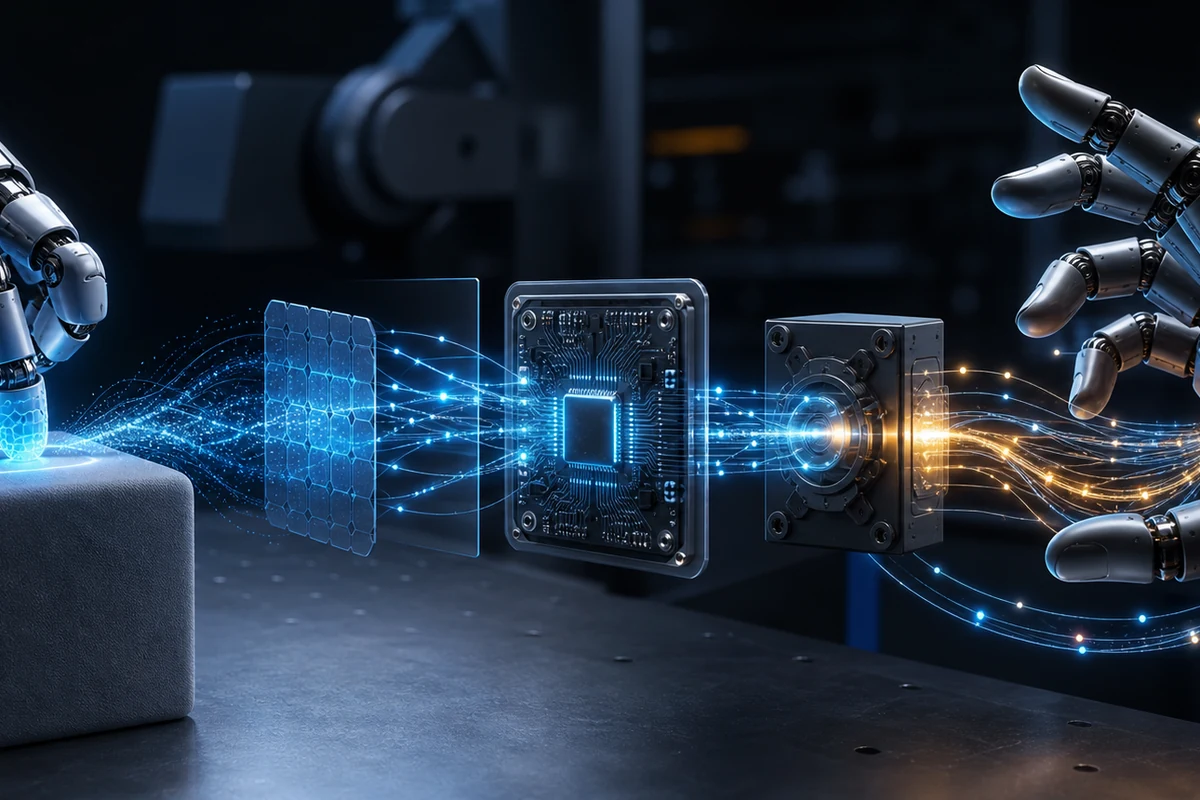
Sparsh-X multisensory touch representations for tactile AI
Sparsh-X fuses image, audio, motion, and pressure from Digit 360, showing how multisensory touch can improve tactile AI for robot manipulation.

Updated technical brief - June 2026
Sparsh-X is a self-supervised tactile representation system for contact-rich robot manipulation. It combines touch signals beyond a single tactile image, addressing how tactile AI can retain deformation, vibration, motion, and pressure cues in one reusable representation. For robot skin, the result matters because useful contact data must transfer into perception and control tasks instead of remaining sensor-specific output.
Source findings
Most robot skin pages treat tactile data as a pressure map or a camera-like tactile image. The Sparsh-X paper is useful because it frames touch as a multisensory signal family: image, audio, motion, and pressure. That matters for robot skin because a real contact event can include deformation, vibration, impact, sliding, pressure change, and motion history.
The source describes Sparsh-X as a self-supervised representation system trained on contact-rich interactions collected with the Digit 360 sensor. For RoboSkin.ai, the value is not the model name. The value is a clearer way to discuss tactile AI: touch representations should preserve complementary contact signals instead of flattening everything into one channel.
RoboSkin analysis
Sparsh-X fuses several tactile modalities into a shared representation. That gives downstream policies a richer contact embedding than a single tactile image can provide. In robot skin terms, the system points toward skin data pipelines where pressure, vibration, motion, and visual tactile deformation are synchronized before they are used for control.
| Tactile modality | What it may capture | Robot value |
|---|---|---|
| Tactile image | Local deformation and contact geometry | Contact shape and pose clues |
| Audio or vibration | Fast events and impacts | Slip, tapping, and texture cues |
| Motion | Sensor movement during interaction | Contact dynamics |
| Pressure | Load and contact intensity | Grip adjustment and force context |
Engineering implications
Multisensory representation learning makes the technical boundary explicit. It is not enough to say a robot uses touch: an evaluation must identify the signals, their synchronization, whether the model receives raw data or features, and which task the representation improves.
This is also relevant for robot skin hardware. A skin that exposes only a low-rate pressure number may be easier to integrate, but it may lose high-frequency contact information that could help with slip or impact. A richer sensor creates a harder data problem, but it can support stronger manipulation policies.
Readers can compare the representation problem with FreeTacMan data collection and the synchronization problem with the ROS 2 tactile sensor pipeline.
Evaluation checklist
- Check which tactile modalities are actually recorded and synchronized.
- Ask whether the representation is trained with labels or self-supervision.
- Review whether downstream tasks use real robot manipulation, not only offline classification.
- Separate physical-property prediction from policy success.
- Ask whether the representation transfers across objects, actions, and sensor placements.
- Compare performance against single-modality tactile baselines.
What this does not prove yet
This source does not mean every robot skin should use Digit 360 or a transformer backbone. It also does not prove multisensory touch solves all manipulation tasks. The result depends on sensor availability, data volume, temporal alignment, policy design, and task distribution.
The practical lesson is that tactile AI combines representation design with sensor design. Robot skin data is not automatically useful until a model can convert it into task-relevant state.
Source
arXiv: Tactile Beyond Pixels: Multisensory Touch Representations for Robot Manipulation
Continue the topic