2026 world-model guide
Visuo-tactile world models for robot manipulation
Compare VT-WM, Dream-Tac, TouchWorld, ViTacWorld and FeelWorld: what each predicts, how it guides robot actions, reported results and limits, with primary sources.
Published 2026-08-15 | Updated 2026-09-20 by RoboSkin.ai Editorial Team
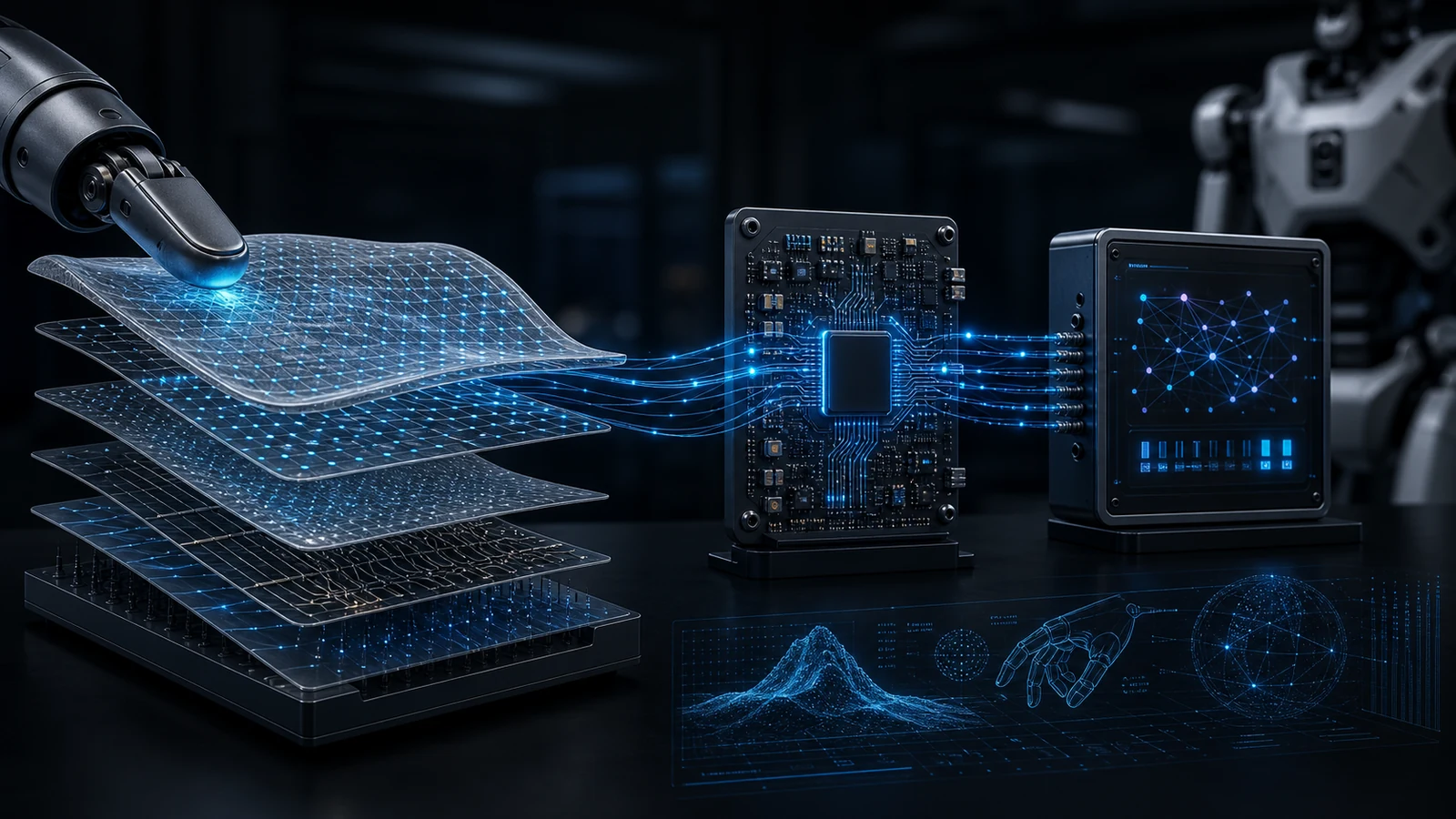
Choose by research task
What does each tactile world model do?
Start with the prediction or control problem you need to study. These are source-reported research roles, not a ranking under one shared benchmark.
VT-WM
Learns multi-task visual and tactile contact dynamics for imagination and planning.
Read the VT-WM primary paper ↗Dream-Tac
Jointly models robot actions, future visual observations, and tactile dynamics with contact-gated fusion.
Read the Dream-Tac primary paper ↗TouchWorld
Combines predicted tactile subgoals with visuo-tactile action generation and fast tactile residual correction.
Read the TouchWorld primary paper ↗ViTacWorld
Generates aligned visual-tactile-action rollouts for data augmentation and action-conditioned policy evaluation.
Read the ViTacWorld primary paper ↗FeelWorld
Predicts contact state, a force-related 3D tactile latent, slip, and visual futures for contact-aware planning.
Read the FeelWorld primary paper ↗Short answer
What you need to know
- 1
A visuo-tactile world model predicts how visual and tactile state may change after a robot action. Touch grounds the imagined future in contact that cameras may miss, including contact onset, force-related state, slip, and hidden object motion.
- 2
The useful test is not whether a generated rollout looks plausible. Evaluation should show physical consistency, tactile prediction, planning or policy improvement, real-robot outcomes, and transfer beyond the training objects, sensors, tasks, or embodiment.
- 3
VT-WM, Dream-Tac, TouchWorld, ViTacWorld, and FeelWorld solve different parts of the problem. Their source-reported metrics are not a common leaderboard because their targets, tasks, baselines, horizons, sensors, and control roles differ.
Topic 01
What is a visuo-tactile world model?
A robot world model estimates a future state conditioned on the current observation and a candidate action. A visuo-tactile world model adds measured or predicted touch to that future. Depending on the system, the tactile target may be an image, a learned latent, contact state, force-related information, slip, or a tactile subgoal used by a policy.
This matters most after contact begins. The hand can occlude the object, an insertion can look visually aligned while mechanically jammed, and a grasp can appear stable while beginning to slip. Touch does not make the prediction automatically correct, but it exposes physical interaction evidence that a visual-only model may not observe.
Topic 02
2026 visuo-tactile world model comparison
The rows below preserve the role and evidence boundary of each source. Relative improvements are included only when the arXiv abstract states them, and every number remains tied to the authors’ protocol.
| System | World-model role | Source-reported evidence | What it does not establish |
|---|---|---|---|
| VT-WM | Learns multi-task visual and tactile contact dynamics for imagination and planning. | The preprint reports 33% better object permanence, 29% better compliance with motion laws, and up to 35% higher zero-shot real-robot success. | The relative gains are tied to the reported tasks and baselines; they do not establish universal sensor or embodiment transfer. |
| Dream-Tac | Jointly models robot actions, future visual observations, and tactile dynamics with contact-gated fusion. | Across six tasks, the preprint reports 31.7% average action-accuracy improvement, up to 2.9x faster training, and 1.8x faster inference. | The relative gains are tied to the reported tasks and baselines; faster inference does not by itself prove safe control or hardware transfer. |
| TouchWorld | Combines predicted tactile subgoals with visuo-tactile action generation and fast tactile residual correction. | Across six tasks, the preprint reports 65.0% clean success and 53.7% under perturbations, 15.7 and 18.5 percentage points above its strongest reported baseline. | It is a hierarchical predictive-and-reactive system, not a common-score comparison with the other rows. |
| ViTacWorld | Generates aligned visual-tactile-action rollouts for data augmentation and action-conditioned policy evaluation. | The preprint reports physically meaningful rollouts, downstream policy improvement, and policy evaluation using public real data plus simulation. | Its abstract does not provide one universal gain; simulation-to-real behavior and policy-evaluation accuracy remain setup-specific. |
| FeelWorld | Predicts contact state, a force-related 3D tactile latent, slip, and visual futures for contact-aware planning. | The preprint reports 10-step LPIPS from 0.084 to 0.058, 61% lower LPIPS than the visual baseline after 80 steps, and 81.7% average zero-shot planning success. | LPIPS is not a direct force or safety metric, and the three reported task setups do not prove broad robot transfer. |
Topic 03
How predicted touch enters robot planning
A candidate action can be rolled through the model to produce an imagined visual and tactile sequence. A planner can then score that sequence for contact creation, stability, slip, task progress, or failure risk. ViTacWorld adds another use: generating rollouts to augment tactile policy data and evaluating candidate policies under controlled action sequences.
Prediction and feedback have different jobs. TouchWorld explicitly separates slower semantic and predictive planning from high-frequency tactile residual correction. That division is important because an imagined contact future can guide an action, while measured touch still has to correct errors when the real object, friction, alignment, or force differs from the model.
- Observe: synchronize vision, tactile data, robot state, and the action that caused contact
- Predict: generate future visual, contact, tactile, or slip state for candidate actions
- Score: define task progress and contact-risk costs that can be checked in the predicted rollout
- Act: execute only the selected action or short action chunk
- Correct: use fresh tactile feedback when real contact diverges from the prediction
- Log: preserve prediction error, measured touch, robot state, and outcome for later evaluation
Topic 04
A minimum evaluation protocol
World-model evaluation needs both offline and embodied evidence. Image similarity can diagnose visual rollout quality, but contact prediction needs its own labels or measurements. Planning claims need repeated real-robot trials, comparable baselines, trial counts, held-out conditions, and failures that can be replayed.
Split sequential tactile data by complete trajectory, object, task, sensor, or embodiment according to the transfer claim. Random frame splits can place nearly identical moments from one contact event on both sides of evaluation and make prediction look more general than it is.
- Visual-only, tactile-reactive, and no-world-model baselines
- Contact onset, tactile-state, slip, and visual prediction reported separately
- Short- and long-horizon rollout error with uncertainty
- Real-robot success, failure mode, disturbance, and trial count
- Held-out objects, surfaces, tasks, sensors, and robot embodiments
- Online latency, planning budget, tactile update rate, and correction-loop rate
Topic 05
Claim boundary for the 2026 evidence
All five systems in this comparison are 2026 arXiv preprints as reviewed on August 15, 2026. Their reported results are useful research evidence, but they are not independent validation, certification, production benchmarks, or proof that one model is best across robots.
Do not compare isolated percentages across rows. Each paper uses different prediction targets, horizons, tasks, policies, sensors, baselines, and success definitions. Open the primary source, confirm the current version and released assets, then reproduce the relevant task and hardware contract before making an engineering decision.
Topic 06
September update: human touch and synthetic policy data
DexTouch-WM adds a separate data-transfer question to the five-system comparison above. Its September 17 preprint keeps robot pretraining data fixed while adding human tactile demonstrations with a shared taxel layout and retargeted pose representation. The largest human-data condition improves contact prediction, but that improvement does not consistently carry into policies trained with generated observations.
In the reported four-task real-robot evaluation, the mixed-data world model produces lower policy-training scores than the real-data baseline for all three tested policies. These are normalized task scores, not binary success rates. Prediction quality, policy-ranking agreement, and final task behavior therefore need separate evaluation. This source update was checked on September 18, 2026; the original five-system table retains its own review scope.
Paper routes
Start with source-backed RoboSkin briefs
 Tactile AI / 2026-08-15FeelWorld predicts contact, tactile force states, and slip for robot planningFeelWorld adds explicit contact, force-related tactile, and slip prediction to a visual world model for contact-rich robot planning.Tactile AI / 2026-08-15Dream-Tac: A Unified Tactile World Action Model for Contact-Rich Robot ManipulationDream-Tac models action-conditioned tactile futures for contact-rich robot manipulation, showing why robot skin data needs prediction, not only reaction.
Common questions
FAQ for this topic
What is a visuo-tactile world model?
It is an action-conditioned model that predicts future visual and tactile state. The tactile output may represent contact, force-related state, slip, a tactile image, a learned latent, or a policy subgoal.
Why add touch to a robot world model?
Touch exposes contact dynamics that cameras may miss under occlusion or ambiguous alignment. It can help a model represent whether contact begins, remains stable, slips, jams, or changes after an action.
Is a tactile world model the same as a tactile foundation model?
No. World model describes an action-conditioned predictive role. Foundation model implies broad pretraining and transfer across downstream tasks. A system can be one, both, or neither depending on its actual training and evidence.
Which metric should compare visuo-tactile world models?
There is no single sufficient metric. Use modality-specific prediction error, physical consistency, planning or policy improvement, real-robot task outcomes, latency, and held-out transfer under the same protocol.
Are 2026 visuo-tactile world models production ready?
The sources reviewed here are preprints. Production readiness still needs independent reproduction plus evidence for latency, calibration drift, durability, failure recovery, sensor replacement, and the target robot environment.