TouchWorld separates tactile prediction from fast contact correction in robot manipulation
The TouchWorld preprint proposes a hierarchical tactile foundation model that combines contact prediction with fast feedback for dexterous, contact-rich robot tasks.
News brief - July 2026
TouchWorld is a July 2026 preprint that treats touch as both a prediction target and a fast feedback signal for dexterous robot manipulation. Its central idea is that high-level task reasoning and low-level contact correction should not be forced into one control loop running at one speed.
What the preprint proposes
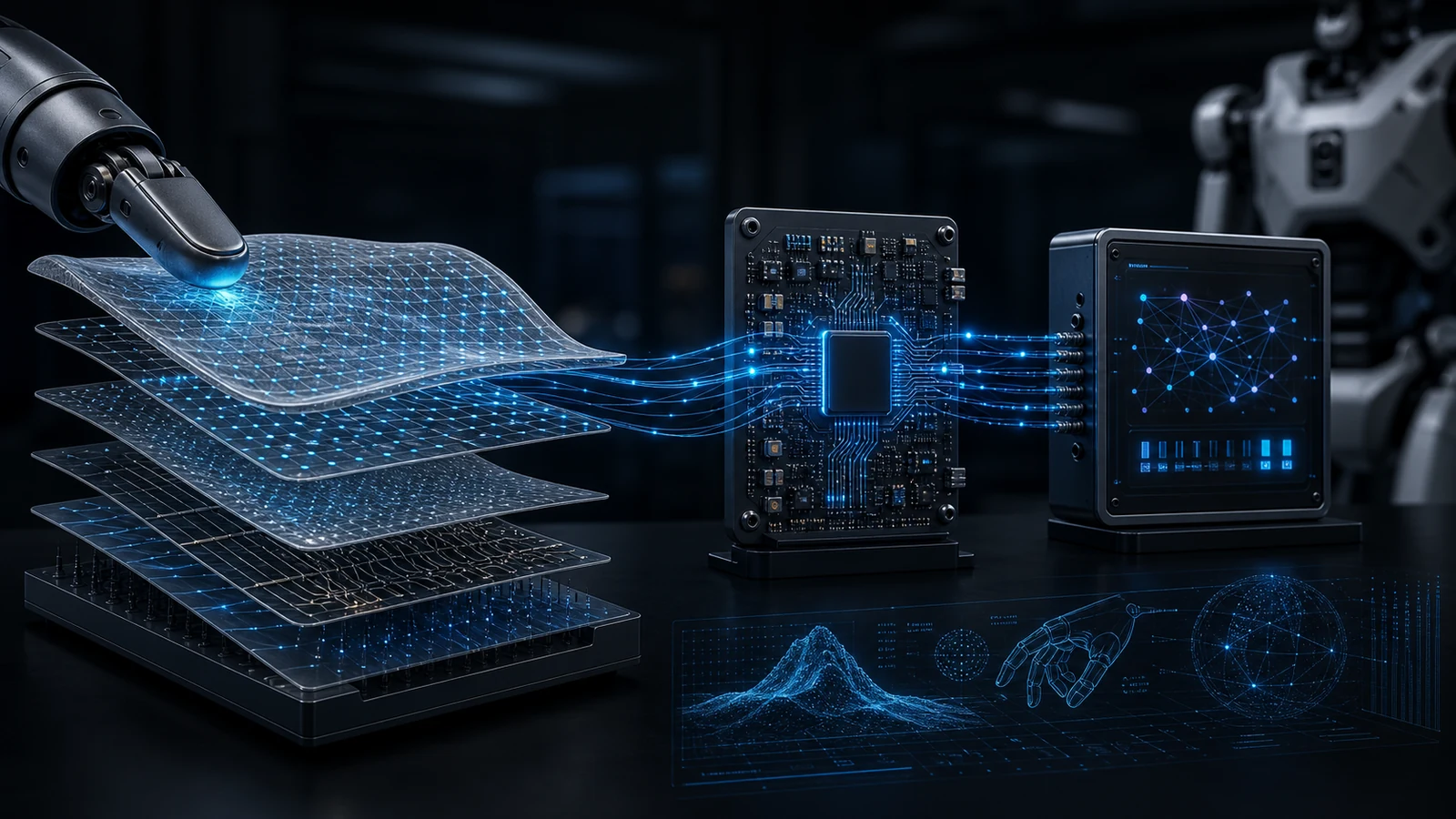
The system uses a hierarchy with vision-language subtask planning, tactile world-model prediction, visuo-tactile action generation, and a tactile-conditioned refinement policy. The high-level layer predicts executable subtasks and tactile subgoals. The lower-level policy uses recent tactile and proprioceptive feedback to correct local errors such as slip, misalignment, unstable grasping, or force mismatch.
The predictive component is first pretrained on EgoTouch, a human bimanual dataset with synchronized egocentric and wrist video, hand pose, and wearable pressure maps, before robot-specific fine-tuning. The TouchWorld model record connects that training claim to its exact primary-source boundary; it does not imply that every module is trained on EgoTouch or that the hosted dataset upload is complete.
The paper also defines a six-task real-robot evaluation protocol with clean and human-perturbation settings. It reports 200 teleoperated training trajectories and 100 evaluation rollouts per task. This is an author-defined, single-platform protocol rather than an independent cross-model leaderboard.
Across six long-horizon, contact-rich manipulation tasks, the authors report 65.0% average success in the clean setting and 53.7% under human perturbations. Those results were 15.7 and 18.5 percentage points above the strongest baseline reported in the paper.
Why this matters for tactile AI
Vision and language can describe a task and guide a hand toward an object, but they do not directly reveal hidden contact states. Once a plug meets a socket, a cup begins to slip, or a soft object deforms, the controller needs evidence from the physical interaction itself.
TouchWorld is useful as a systems idea because it assigns different jobs to different layers. A slower planner handles semantics and task phases, while a faster tactile pathway handles local contact errors. This is closer to how a practical robot stack may need to divide reasoning and response.
What this does not prove yet
TouchWorld is a preprint, not a peer-reviewed final publication. Its reported success rates are specific to the paper's task suite, sensors, training data, baselines, and evaluation protocol. They should not be treated as a general benchmark for all robot hands or tactile foundation models.
Where this fits next
The robot world models pillar explains the broader prediction-and-control role. The visuo-tactile world model guide compares TouchWorld with Dream-Tac, ViTacWorld, FeelWorld, and VT-WM, while the robot hand tactile sensor route explains the sensing coverage and integration questions behind contact-rich manipulation.
Practical questions
- Why split planning and tactile correction? Semantic reasoning and contact response operate at different time scales and use different evidence.
- Does a tactile foundation model replace robot control? No. It still depends on sensors, calibration, proprioception, action interfaces, and task-specific validation.
- What should readers watch next? Independent reproduction, cross-sensor transfer, unseen-object performance, latency, and robustness outside the six reported tasks.
Source boundary
This brief summarizes an arXiv preprint and adds RoboSkin.ai analysis. The results have not been independently validated by RoboSkin.ai and should be interpreted within the authors' reported setup.
Source
Continue the topic