MiTaS multi-resolution tactile imitation learning for robot hands
A technical note on MiTaS, heterogeneous tactile sensors, GelSight and event-based touch fusion, and why tactile frequency matters for robot hand learning.
Updated technical brief - June 2026
Why this source matters
Robot touch is not one sampling rate. A frame-based tactile sensor can capture geometry, while an event-based tactile sensor can capture fast contact changes. The MiTaS paper is useful because it focuses on combining tactile sensors that operate at different temporal resolutions.
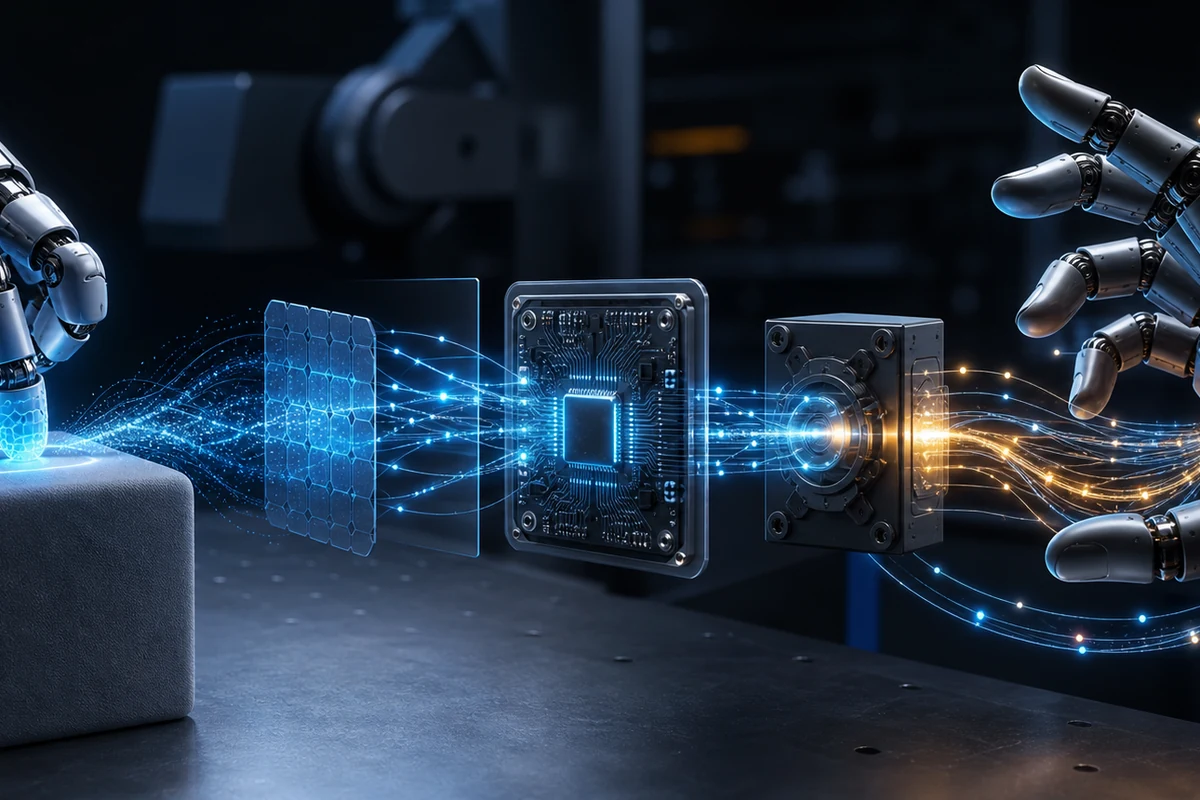
The source describes Multi-Resolution Tactile Sensing, or MiTaS, as a framework that fuses RGB, GelSight Mini, and event-based Evetac signals for contact-rich manipulation. For RoboSkin.ai, this is useful because it turns "tactile sensor" into a sharper question: what kind of touch signal is needed at each phase of the task?
Core idea
MiTaS separates spatial detail from fast temporal detail. A GelSight-style sensor can show local deformation and contact shape. An event-based tactile sensor can react to rapid impact, slip, or vibration. A manipulation policy may need both, especially for tasks where the object moves quickly or the contact state changes before a conventional frame updates.
| Sensor stream | Strength | Risk if missing |
|---|---|---|
| RGB vision | Global object and scene context | Contact remains hidden |
| GelSight-style touch | Local geometry and deformation | Fast slip can be missed |
| Event-based touch | High-frequency contact changes | Shape detail may be sparse |
| Fused representation | Task-level contact state | Calibration and synchronization burden |
Engineering implications
Multi-resolution tactile learning is important for robot skin roadmaps because full-body or full-hand skins may combine sensor families. A fingertip may use high-resolution imaging touch, while a palm or gripper side uses lower-resolution pressure or event sensing. Treating those signals as equivalent hides the integration problem.
The key engineering question becomes synchronization. If one signal is high rate and another is low rate, the policy needs a coherent time base. Without that, the robot may react to stale contact data or align a slip event with the wrong hand pose.
Evaluation checklist
- Identify the sampling rate and latency of each tactile stream.
- Ask which task phases need geometry and which need fast event response.
- Check whether sensor fusion is trained end-to-end or through fixed features.
- Review whether ablations show the value of each tactile modality.
- Ask how missing sensors are handled at inference time.
- Verify whether the policy can replay and inspect failed contact events.
What not to infer
This source does not prove every robot needs multiple tactile sensors on every finger. Extra sensors add cost, wiring, calibration, and data complexity. The practical lesson is narrower: tactile sensing frequency and modality should match the contact dynamics of the task.
For RoboSkin.ai, MiTaS supports a content distinction between frame-based tactile sensing, event-based tactile sensing, and multi-resolution tactile fusion.
Source
arXiv: Multi-Resolution Tactile Imitation Learning for Contact-Rich Robotic Manipulation
Continue the topic