Sensor evidence / Vision-based fingertip
DIGIT tactile sensor: from RGB frames to robot touch
Evaluate the original DIGIT tactile sensor: paper specifications, Python stream settings, design files, calibration needs, repository status, and reuse terms.
Published 2026-09-12 | Updated 2026-09-16 by RoboSkin.ai Editorial Team
- 6
- sections
- 4
- questions
- 5
- next routes
Short answer
What you need to know
- 1
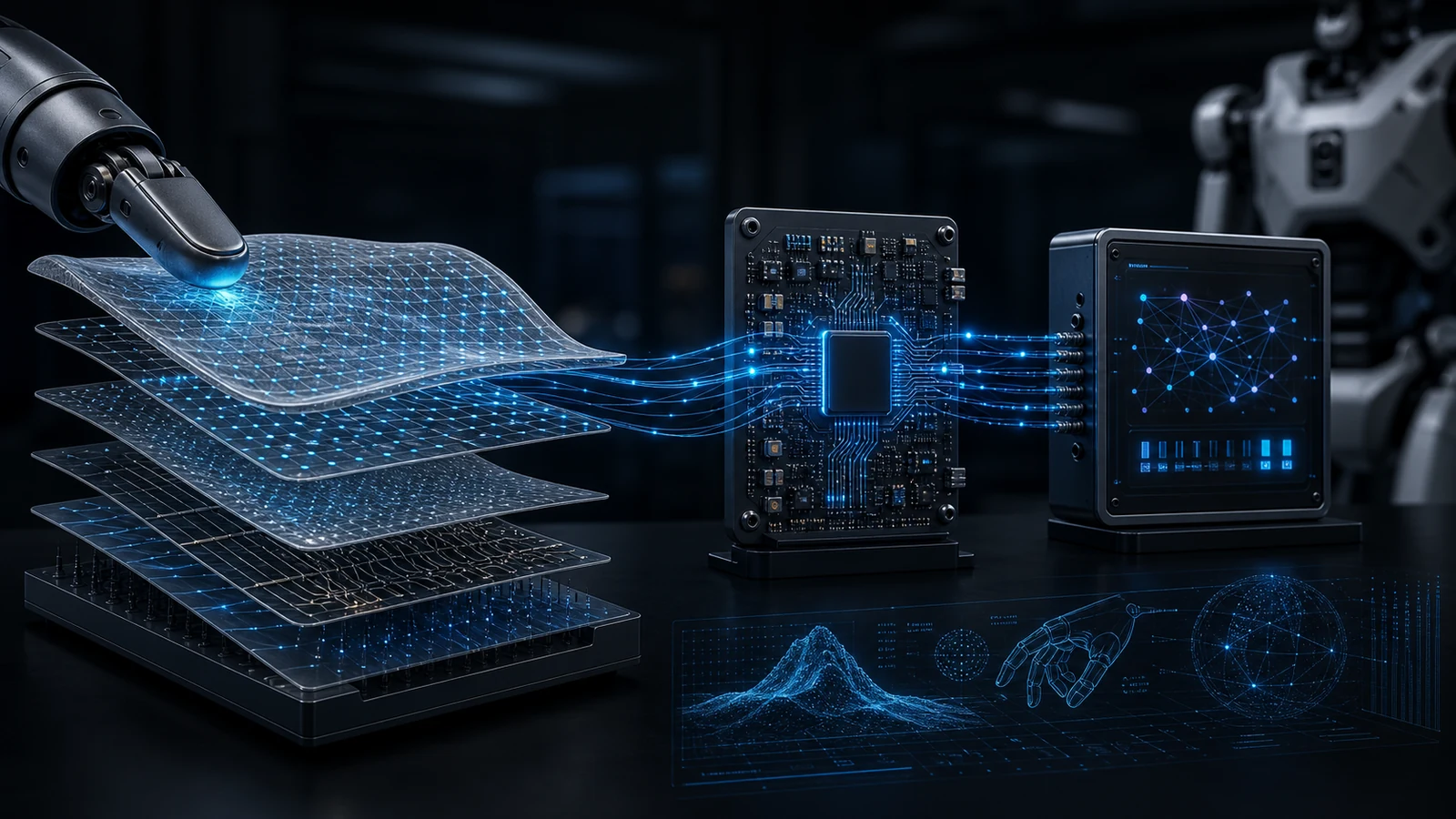
DIGIT is a compact optical tactile fingertip introduced by Lambeta and colleagues in IEEE Robotics and Automation Letters in 2020. An internal camera observes an illuminated deformable gel; the direct output is an image of contact-induced deformation.
- 2
For initial software integration, the official digit-interface README documents a default 640 × 480 stream at 30 FPS. Table I of the original paper reports 60 FPS for the paper hardware. These describe different evidence: a documented default and a reported hardware configuration. Inspect the formats your physical unit actually supports.
- 3
This guide covers the original DIGIT. Digit 360 and DIGIT Pinki have separate hardware designs and research claims. Source review is documentary; RoboSkin.ai has not built or bench-tested a unit.
Topic 01
Specifications with their source and scope
The paper provides a compact hardware reference. Use the manufacturer documentation for the revision you acquire, and record the image format, lighting, gel condition, and capture timestamps used in your experiment.
| Property | Reported value | Source and interpretation |
|---|---|---|
| Housing / mass | 20 × 27 × 18 mm; 20 g | 2020 paper, Table I; original research design |
| Sensing field | 19 × 16 mm | 2020 paper, Table I; distinct from housing dimensions |
| Image resolution / rate | 640 × 480; 60 FPS | 2020 paper, Table I; not the Python default |
| Default Python stream | 640 × 480 at 30 FPS | Official digit-interface README, Usage |
| Measured output | Tactile RGB image | Contact geometry and force estimates require processing beyond image acquisition |
Topic 02
A practical route through the official interface
The official package is named digit-interface. Its documented workflow lists attached sensors using DigitHandler.list_digits(), connects a Digit instance by the serial number printed on the device, and retrieves an image with get_frame(). The example viewer uses show_view(). Follow the repository installation and device-access instructions for your operating system.
Before collecting a dataset, inspect Digit.STREAMS and choose a supported resolution and frame rate explicitly. Save the serial number, stream format, illumination settings, unloaded reference image, gel replacement history, and robot timestamps with the recordings. This makes later differences between sensors and sessions interpretable.
The interface and design repositories are archived as checked on September 12, 2026. Their instructions remain useful reference material, but compatibility with a current Python, operating system, camera stack, or replacement component needs local verification. We have reviewed the documentation rather than run a connected-sensor test.
Topic 03
What the image establishes—and what needs calibration
The image can reveal where the gel contacts an object and how its appearance changes as contact moves. A depth map, force vector, slip decision, or grasp-success estimate is a separate model output. Evaluate that model using independent reference measurements appropriate to the claimed quantity.
For geometric reconstruction, specify the reference objects and the part of the gel included in calibration. For force estimation, synchronize a force reference with the images. For a manipulation policy, compare trials on the same robot, objects, controller budget, and success criterion. Camera FPS is not the latency of that complete feedback loop.
Topic 04
Hardware files, software, simulation, and reuse terms
The digit-design repository contains enclosure, elastomer, electronics, and firmware-binary resources, including a manufacturing quick-start document and component-substitution notes. Check those notes against the exact board revision before ordering parts.
Both the reviewed design and Python-interface repositories carry Creative Commons Attribution-NonCommercial 4.0 terms. Publicly available files should not be treated as unrestricted commercial-use software or hardware designs. Commercial sensor purchase and reuse of repository material are separate questions.
The official project also links TACTO, a tactile simulator. Simulated observations can support development, but their appearance and contact dynamics do not validate a physical sensor calibration or a robot policy. Keep simulation and physical results separate in your records.
Topic 05
Choosing between DIGIT, GelSight Mini, and ReSkin
DIGIT is relevant when a compact visual fingertip and an established research interface fit the robot geometry. GelSight Mini offers a separate commercial optical-sensor workflow and replaceable gel cartridge. ReSkin uses magnetic measurements from a replaceable elastomer, producing a different observation space.
Choose using mounting geometry, signal requirements, calibration effort, component access, and maintainable software. A camera pixel count cannot be compared directly with a magnetic channel count as a universal measure of tactile quality. The linked sensor guides preserve these distinctions.
Topic 06
Prepare a calibration record before interpreting contact
The calibration workflow separates no-contact image baselines, reference geometry for depth reconstruction and independently measured force targets. Use the blank record to retain units, repeats, environmental conditions and invalid samples. The workflow is source-based; no new hardware measurements are claimed.
Common questions
FAQ for this topic
Does DIGIT run at 30 or 60 FPS?
The original paper reports 60 FPS at 640 × 480. The official Python README initializes a 640 × 480 stream at 30 FPS. Check the supported formats on the actual unit and explicitly record the mode used.
Does DIGIT output force directly?
The documented interface returns camera frames. Calibrated force, depth, slip, and task outcomes depend on additional models, reference data, and validation.
Is DIGIT a $15 sensor?
The paper lists $15 in component cost under an assumption of manufacturing 1,000 pieces. That is a historical research cost estimate, not a current retail price or the cost of a complete calibrated robot system.
Are DIGIT and Digit 360 the same sensor?
No. This page covers the original 2020 DIGIT. Digit 360 and DIGIT Pinki are distinct designs; their sensing modalities and performance claims must be checked in their own sources.