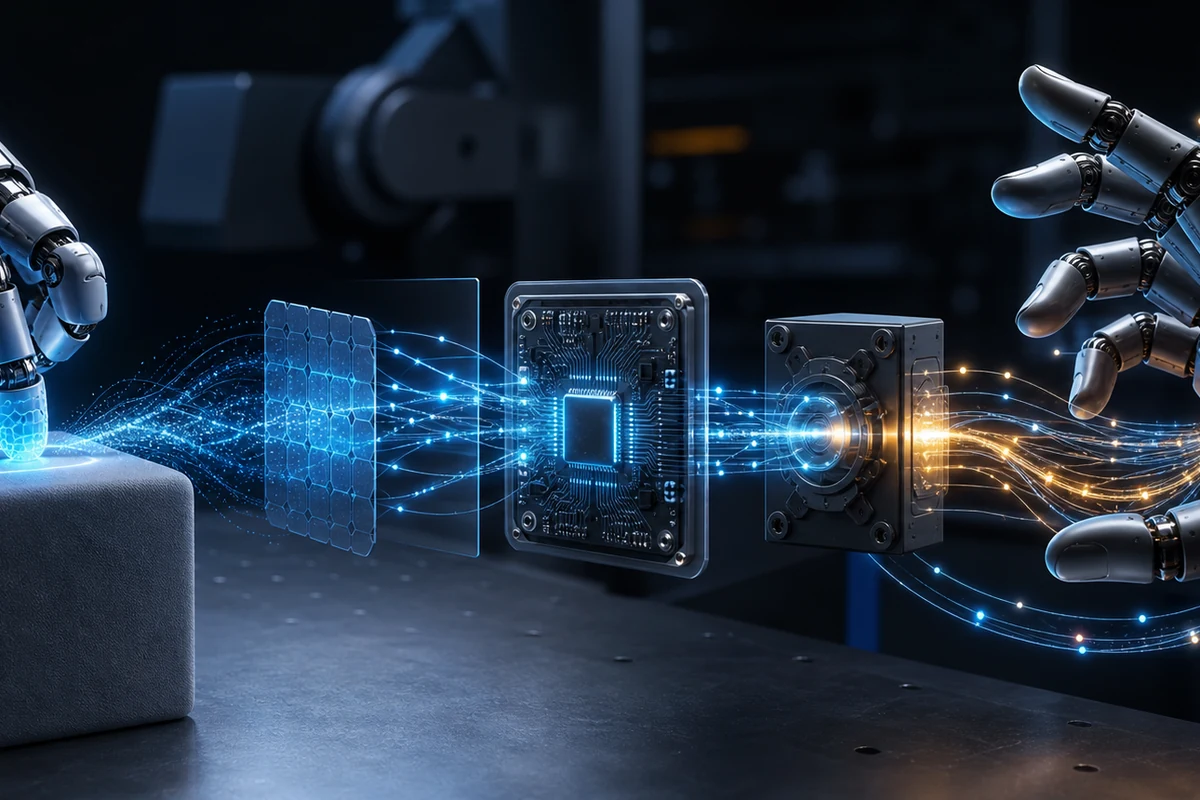
Open-source magnetic tactile calibration for gripper-agnostic touch
A practical research note on open-source magnetic tactile calibration, three-axis force sensing, in-situ calibration, and why low-cost sensors still need repeatable setup.
Updated technical brief - June 2026
Why this source matters
Magnetic tactile sensors are attractive because they can provide multi-axis force information with relatively affordable components. The hard part is often calibration. A sensor that performs well after careful manual calibration may be less useful when installed on a different gripper or replaced in the field.
The open-source magnetic tactile sensor paper is useful because it focuses on automatic, in-situ, gripper-agnostic calibration. For RoboSkin.ai, this is exactly the kind of deployment detail that separates a sensor demo from a usable robot skin route.
Core idea
Magnetic tactile sensing typically tracks the movement of magnets through magnetic field measurements. From that movement, the system estimates forces or deformation. Calibration maps raw magnetic readings to meaningful force outputs. If the sensor can calibrate automatically after being mounted, it reduces setup friction.
| Calibration issue | Why it matters | What to verify |
|---|---|---|
| Manual data collection | Slow and operator-dependent | Repeatability across users |
| Mounting geometry | Sensor behavior changes after installation | In-situ calibration |
| Three-axis force | More useful than scalar pressure | Ground-truth force validation |
| Open-source hardware | Easier reproduction | Fabrication tolerance and documentation |
Engineering implications
Open-source magnetic tactile calibration matters for robot skin because low-cost sensors are only useful if they can be reproduced and maintained. A cheap sensor that takes hours to calibrate is not cheap at system level. The better question is total setup cost: fabrication, mounting, calibration, validation, and replacement.
This topic also connects to robot hand experiments. Grippers vary widely in jaw geometry, material, compliance, and payload. A gripper-agnostic calibration method is valuable because it lets teams test tactile feedback without redesigning calibration for every embodiment.
Evaluation checklist
- Check whether calibration happens after the sensor is mounted on the gripper.
- Ask what ground-truth force device was used.
- Review normal and shear force accuracy separately.
- Test repeatability after sensor removal and replacement.
- Inspect whether fabrication files and calibration code are actually available.
- Compare calibration time against manual procedures.
What not to infer
This source does not mean magnetic tactile sensors are universally better than capacitive, optical, resistive, or piezoelectric designs. Magnetic sensing has its own limits around interference, magnet placement, deformation range, and packaging.
Calibration belongs in any serious tactile sensor evaluation. Without calibration details, the evidence is incomplete.
Source
arXiv: Automatic Calibration for an Open-source Magnetic Tactile Sensor
Continue the topic