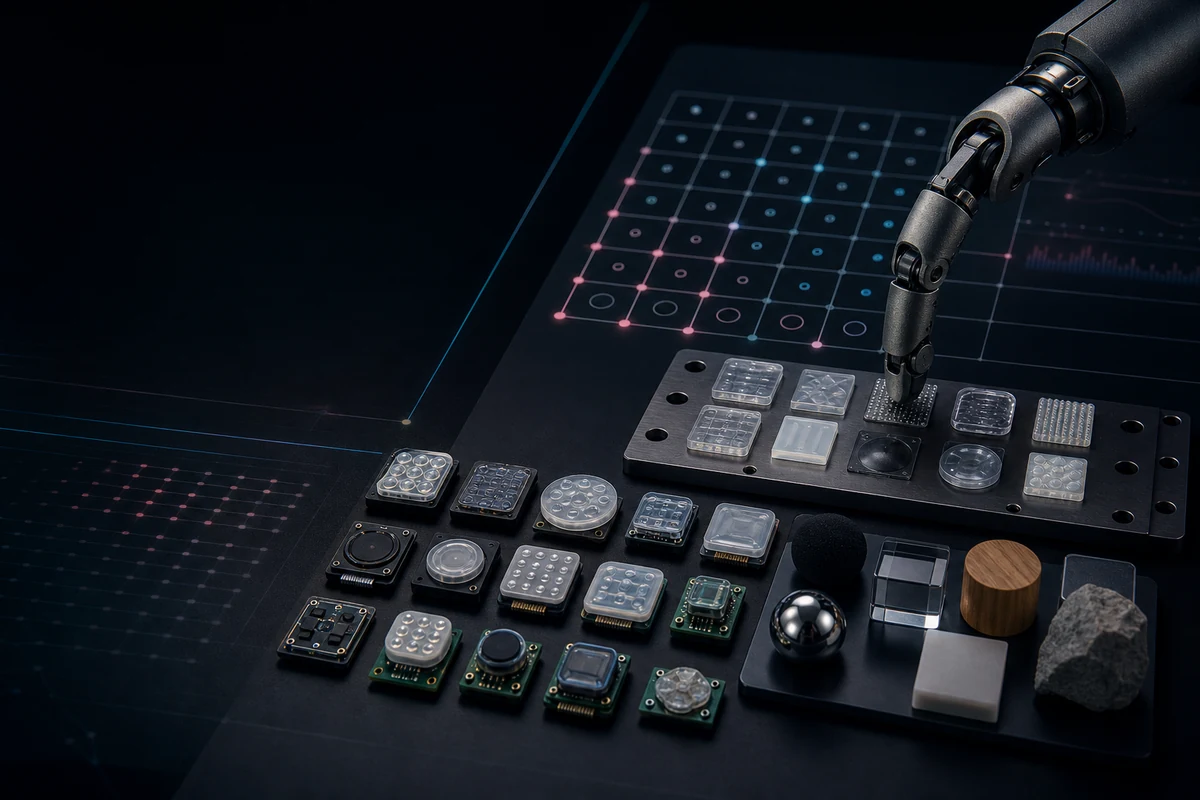
TacPrint reconstructs contact from 24 tactile cells
A wearable capacitive fingertip sensor predicts a dense contact map for human-to-robot replay. We separate simulation labels, physical measurements, and closed-loop grasping results.
Evidence review — July 31, 2026 preprint; analyzed September 11, 2026
TacPrint is a wearable fingertip tactile sensor that converts 24 capacitive taxel readings into a predicted 35 × 26 depth map. Researchers led by the Institute of Automation, Chinese Academy of Sciences, use the reconstructed contact geometry to adjust human-to-robot replay and robot grasping. The July 31 preprint reports both controlled physical measurements and manipulation experiments.
The strongest comparison is a 40-trial grasping study: dense-depth feedback succeeds in 35 trials, compared with 27 using raw-taxel feedback and 15 using contact detection alone. That is useful evidence for this setup. It does not mean the sensor has 910 physical sensing cells, that its entire predicted depth surface has been physically validated, or that it provides a fast reflex controller.
From sparse capacitance to a dense contact map
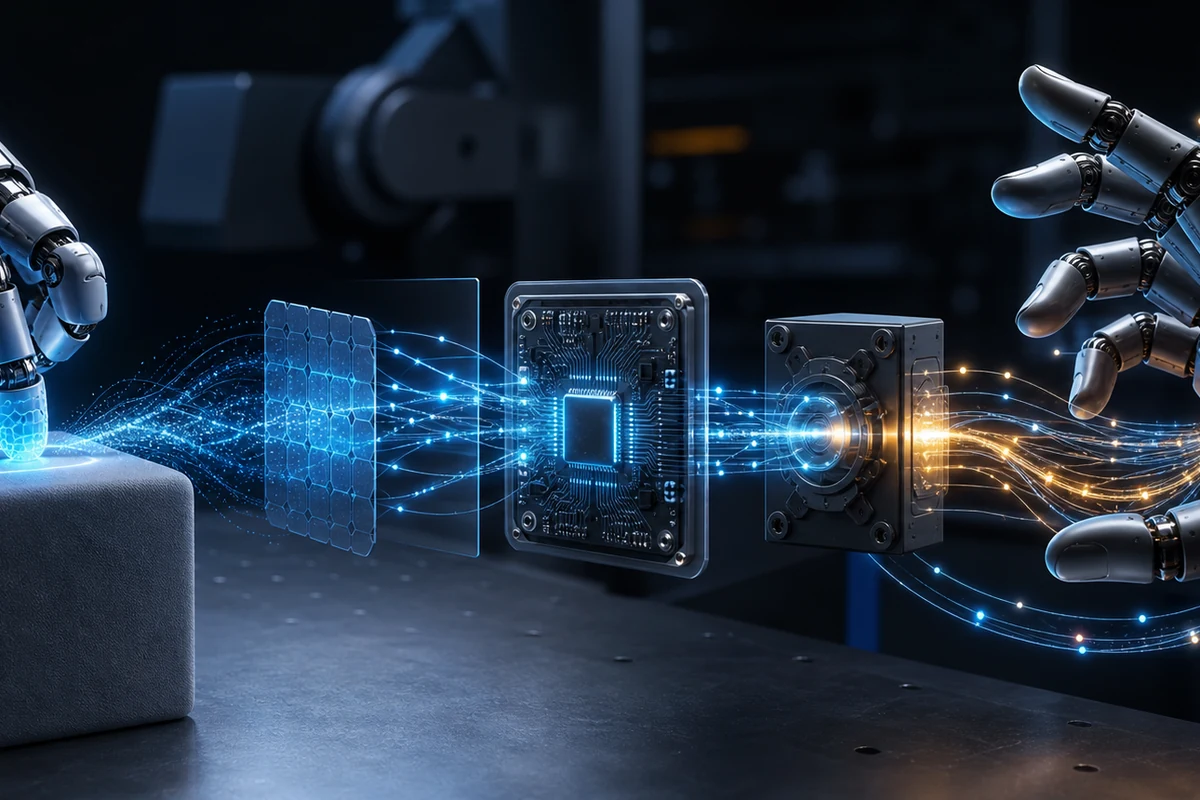
The sensor measures deformation through 24 capacitive cells. A learned reconstruction model maps their signals to a 35 × 26 spatial prediction. Dense output provides an estimated contact region and indentation pattern, while the actual electrical observations remain sparse.
The reconstruction relies on simulation-generated depth labels. A predicted map can interpolate useful geometry, but a larger output grid does not independently create more physical measurements. The paper therefore evaluates several different questions: agreement with simulated depth labels, agreement at controlled physical reference positions, and whether the representation changes a robot’s behavior. Full paper and methods.
This distinction is relevant when choosing a tactile sensor for a robot hand: physical sensing density, reconstruction resolution, calibration error, and task success describe different parts of the system.
Keep simulation and physical errors separate
The following values are reported in the paper’s reconstruction and indentation experiments. The ± values are standard deviations, not confidence intervals.
| Evaluation | Reported error or score | Scope |
|---|---|---|
| Contact-region reconstruction against simulation labels | RMSE 0.223 ± 0.161 mm | Agreement with the simulated depth reference |
| Contact centroid against simulation labels | 1.213 ± 2.379 pixels | A pixel-space localization measurement |
| Contact-region overlap against simulation labels | IoU 0.829 ± 0.169 | Overlap with the simulated contact region |
| Physical center-depth measurement | MAE 0.085 ± 0.057 mm across 40 trials | Predicted depth at a guide-calibrated contact center |
| Primary physical contact-position measurement | 0.250 ± 0.208 mm across 37 trials | Excludes three reference regions truncated by the sensing boundary |
| Physical contact-position measurement including boundary cases | 0.285 ± 0.240 mm across all 40 trials | Includes the three boundary-truncated reference regions |
The three excluded trials remain in the center-depth measurement. The exclusion applies only to the primary contact-position statistic and is determined from the reference contact regions. Reporting both position results makes that choice visible instead of presenting the smaller error without its denominator.
The physical experiment validates center depth and contact position under controlled indentation. It does not provide full-field physical ground truth for every pixel of the deforming gel. That remains a limit on how literally the reconstructed surface should be interpreted.
The 40-trial grasping comparison
In Experiment 3, an RM65-B arm with a Tesollo DG-2F-M gripper and two TacPrint sensors grasps an orange model. Each strategy is tested at eight lateral positions, five times per position: 40 trials per strategy. Four positions form the edge-contact subset, giving 20 trials per strategy in that subset. Success means lifting the object 50 mm and holding it for five seconds. Experiment 3 and Figure 11.
| Feedback strategy | All positions | Edge-contact subset |
|---|---|---|
| Contact detection only | 15/40 successful, 37.5% | 4/20 successful, 20% |
| Raw capacitive taxels | 27/40 successful, 67.5% | 9/20 successful, 45% |
| Reconstructed dense depth | 35/40 successful, 87.5% | 17/20 successful, 85% |
Dense-depth feedback improves the reported success rate over raw-taxel feedback by 20 percentage points overall and 40 percentage points at the edge positions. These are absolute differences between success rates, not relative percentage gains. The edge trials are a subset of the 40, so they must not be added as another independent 20-trial experiment.
The result supports the authors’ argument that a reconstructed contact region helps when a sparse taxel centroid is biased toward the interior of the sensing surface. Its scope is the tested model object, gripper, positions, and adjustment procedure; it does not establish the same improvement across object categories or robot hands.
Better success did not mean fewer corrections or faster control
Among successful trials, the raw-taxel strategy required 1.07 ± 1.36 lateral adjustments on average; the dense-depth strategy required 2.14 ± 1.24. The improved success therefore came with more average corrections in this reported comparison, rather than a reduction in every measure of effort.
The protocol averages tactile estimates over a five-second window and does not cap the number of adjustments. Separately, the nine-frame centered input at 30 Hz introduces approximately 0.13 seconds of latency. Those choices make this a deliberate contact-adjustment experiment, not a benchmark for rapid slip recovery. A deployment comparison should report end-to-end task time as well as success.
Human-to-robot contact reproduction is a separate experiment
The paper also studies demonstration replay on an RM65-B with a LinkerHand O20. Tactile-guided compensation adjusts the fingertip commands derived from a human demonstration. It reports aggregate grasping success of 91.67% and wiping success of 90%, versus 0% for direct replay in those settings.
Those percentages belong to a different hand and protocol from the 40-trial comparison above. The reviewed text does not clearly establish their trial denominators, so they should not be combined with the orange-model counts. The compensation also uses empirical finger gains; this is not a demonstrated improvement to a general-purpose vision-language-action model.
For a broader contact area, AIST’s TWINS demonstration system captures pressure and proximity on the arms and chest. TacPrint instead targets local fingertip geometry. Together they show why demonstration transfer depends on contact representation and embodiment, not just matching joint trajectories.
Access and reproduction boundary
TacPrint is an arXiv preprint. The reviewed paper and record did not provide an official downloadable code or dataset release. RoboSkin reviewed the paper and checked its quantitative comparisons; we did not build the sensor, obtain the raw trials, or reproduce the experiments. No independent replication is claimed.
A useful follow-up should retain all boundary contacts, separate simulated and physical ground truth, repeat the strategies on multiple objects, and report both time and failed adjustment sequences. For representation transfer between sensor designs, compare the TacVerse dataset audit. For the policy context, see tactile AI and tactile manipulation.
Sources
Continue the topic