TacVerse tests whether touch transfers between sensors
TacVerse compares shape, grating, and force perception across tactile sensors. Its public code and gated dataset are now identifiable, but transfer quality depends strongly on the task.
Dataset and benchmark review — June 24, 2026 preprint; access checked September 11, 2026
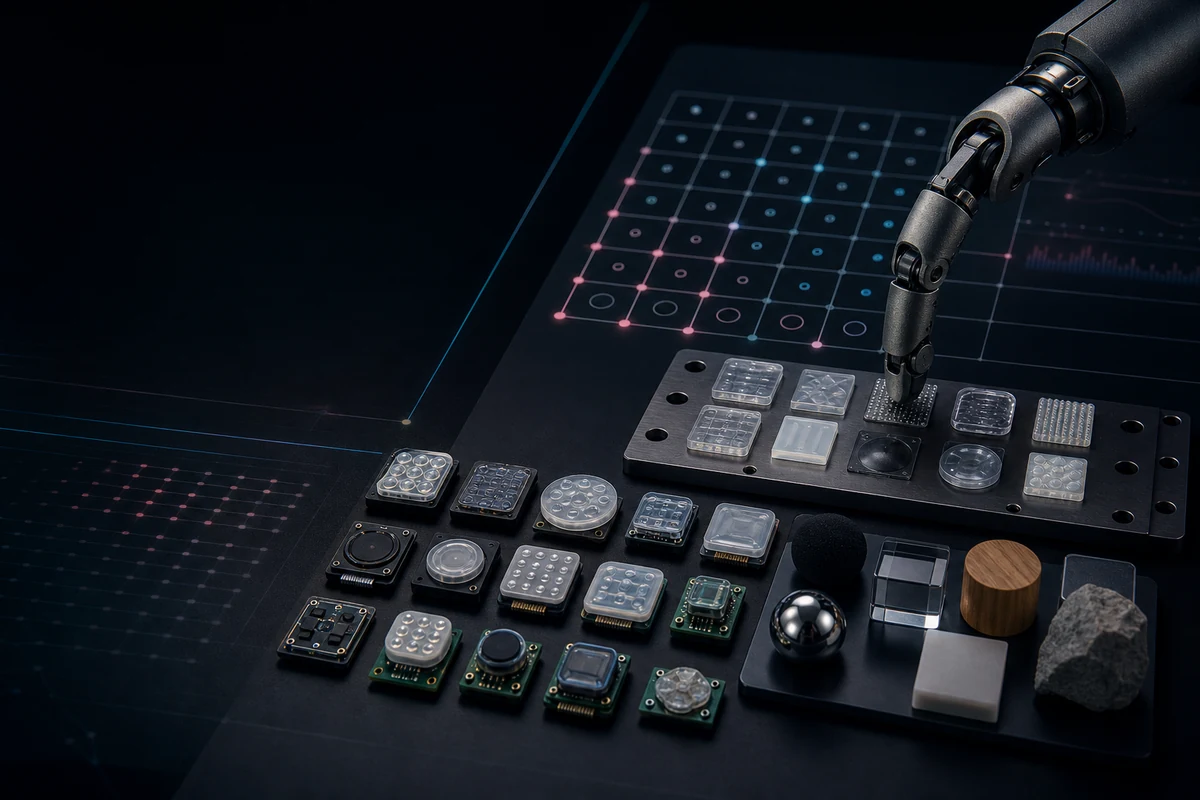
TacVerse is a dataset and benchmark for comparing vision-based tactile perception across seven sensor designs. Its authors, affiliated with Imperial College London, Queen Mary University of London, and King’s College London, report 106,800 images across shape classification, grating classification, and force regression. The June 24 preprint asks whether a model trained on one tactile sensor remains useful on another.
The answer depends on the task. In the paper’s transfer study, a shape classifier trained on GelSightMarker reaches 98.1% accuracy on GelSightNoMarker. A grating classifier using the same source–target sensor pair reaches only 24.8%. Sensor similarity alone does not establish transferable performance across perception tasks.
The official code repository, project page, and Hugging Face dataset listing were verified on September 11. The dataset is publicly listed but gated. RoboSkin did not download or independently recount the images.
What the reported 106,800 images contain
The sensor counts below come from the paper, not from an independent file inventory. GelSightNoMarker and GelSightMarker refer to GelSight Mini configurations without and with markers. Dataset description.
| Sensor | Paper-reported images |
|---|---|
| GelSightNoMarker | 16,917 |
| GelSightMarker | 15,487 |
| MagicGripper | 16,892 |
| MagicTac | 12,496 |
| TacTip | 11,000 |
| ViTac | 11,000 |
| ViTacTip | 23,008 |
| Total | 106,800 |
The same collection is organized by task into 30,094 shape-classification images, 40,509 grating-classification images, and 36,197 force-regression images. These also sum to 106,800; they are a second breakdown of the collection, not additional images. The shape task has nine classes and the grating task has 30.
This is a controlled tactile-perception resource. It is not a dataset of 106,800 robot demonstrations or successful manipulation episodes. See the tactile dataset catalogue for its place among image, sequence, and robot-interaction datasets.
Three protocols answer different questions
| Protocol | What is trained and evaluated | Main boundary |
|---|---|---|
| Within-sensor learning | Train and test on separate partitions from the same sensor | Measures performance inside a sensor domain |
| Zero-shot cross-sensor transfer | Train on one source sensor and test on a different sensor without target-task training | Measures sensor shift; shape uses a seven-by-seven comparison, while grating and force use fixed source sensors |
| Few-shot adaptation | Add 0.5%, 1%, 2.5%, 5%, or 10% of the target sensor’s training data | Reported for force regression; target validation labels are also used, so this is not zero-shot transfer |
For grating classification the fixed source is GelSightMarker. For force regression it is GelSightNoMarker. The scope differs from the exhaustive shape-transfer matrix; the paper does not report a complete seven-by-seven transfer study for every task.
The authors describe keeping complete contacts, trials, or trajectories together and dividing them chronologically into 60% training, 20% validation, and 20% testing. Few-shot examples come from the target training partition, with validation and test partitions unchanged. Experimental setup.
Transfer results: the task changes the answer
The following accuracies are transcribed from Tables 2 and 3. All rows use GelSightMarker as the source sensor; each task has its own trained classifier.
| Task | Evaluation sensor | Protocol | Accuracy |
|---|---|---|---|
| Shape classification | GelSightMarker | Within-sensor | 95.5% |
| Shape classification | GelSightNoMarker | Zero-shot cross-sensor | 98.1% |
| Grating classification | GelSightMarker | Within-sensor | 90.3% |
| Grating classification | GelSightNoMarker | Zero-shot cross-sensor | 24.8% |
| Grating classification | MagicGripper | Zero-shot cross-sensor | 5.4% |
| Grating classification | ViTacTip | Zero-shot cross-sensor | 4.1% |
The shape result is a counterexample to a blanket claim that every sensor change lowers accuracy. It also does not prove that the target sensor is inherently better: the within-sensor and cross-sensor rows use different test data. The grating result shows how poorly that favorable transfer can carry over to finer spatial distinctions.
The representation study needs the same care. Table 5 reports useful masked-autoencoder pretraining results in several settings, but it does not show universal improvement. For GelSightMarker shape classification, ViT with ImageNet initialization reports 95.8%, while ViT with MAE pretraining reports 84.8%. These are separate representation-study results and should not be substituted for Table 2’s transfer-study baseline.
Public code, gated data, and separate licenses
At the reviewed repository revision, the official code contains shape, grating, force, and pretraining components. The Hugging Face listing exposes task archives named Shape_Classification.zip, Grating_Classification.zip, and Force_Regression.zip, alongside other assets.
| Asset | Verified on September 11, 2026 | Limit of this review |
|---|---|---|
| Official code | Repository and source files inspected at commit abe33c1e896d9529f0798cc75e36a63da9753e79 | Not executed; no root license file identified at that revision |
| Dataset listing | Public metadata reports automatic gating and CC BY 4.0; revision 0bc27afe0d8f6c878b79e1eb0825255541ccaceb | File listing verified; gated content not downloaded or independently counted |
| Paper | Public arXiv v1 preprint | Paper license and peer-review status are separate from code and dataset access |
An anonymous attempt to read the dataset’s raw README returned HTTP 401. A public listing therefore should not be described as unrestricted anonymous download access. The CC BY 4.0 statement comes from dataset-card metadata; it should not be extended to the code repository, and any asset-specific terms still need review before reuse.
A split detail to check before reproducing the benchmark
The reviewed code’s ordered-split helper sorts unique sample_id values and assigns the default 60/20/20 partitions. The shape pipeline groups by sensor and label, while the force pipeline groups by sensor. That source inspection confirms how identifiers are partitioned; it does not by itself verify that each identifier maps to a complete physical contact trial.
Because the raw dataset was not downloaded, RoboSkin could not audit that identifier-to-trial mapping against the paper’s stated no-trial-overlap protocol. A reproducer should resolve it before claiming independent confirmation of trial isolation. This is an unverified mapping, not evidence that the published split leaks data.
For a lab selecting data, the next checks are concrete: obtain permitted access, pin the archive and code versions, inspect the sample identifiers, preserve whole interactions across partitions, and report both source and target sensor results. Keep the target-label budget visible when comparing few-shot adaptation with zero-shot transfer.
What TacVerse can support
TacVerse is useful for testing how tactile appearance, marker patterns, and sensor mechanics affect learned perception. It offers controlled tasks and named transfer protocols that are more informative than a single pooled accuracy. Its results remain author-reported preprint evidence and do not establish cross-sensor closed-loop manipulation success.
For comparisons, use the benchmark record, tactile foundation model guide, and vision-based tactile sensing survey. For a physical manipulation experiment that compares raw measurements with a learned contact representation, see TacPrint’s grasping study.
Sources
Check the data behind this research
Compare the reported collection with the publicly listed files, dataset license, split documentation and dated access evidence.
Read the directory’s public availability and reproduction analysis.
Continue the topic