SlipSense: from pressure and vibration to a timely regrasp
Pressure and vibration improve slip recognition together. Independent motion labels and five failed recoveries explain why detector quality and controller quality need separate tests.
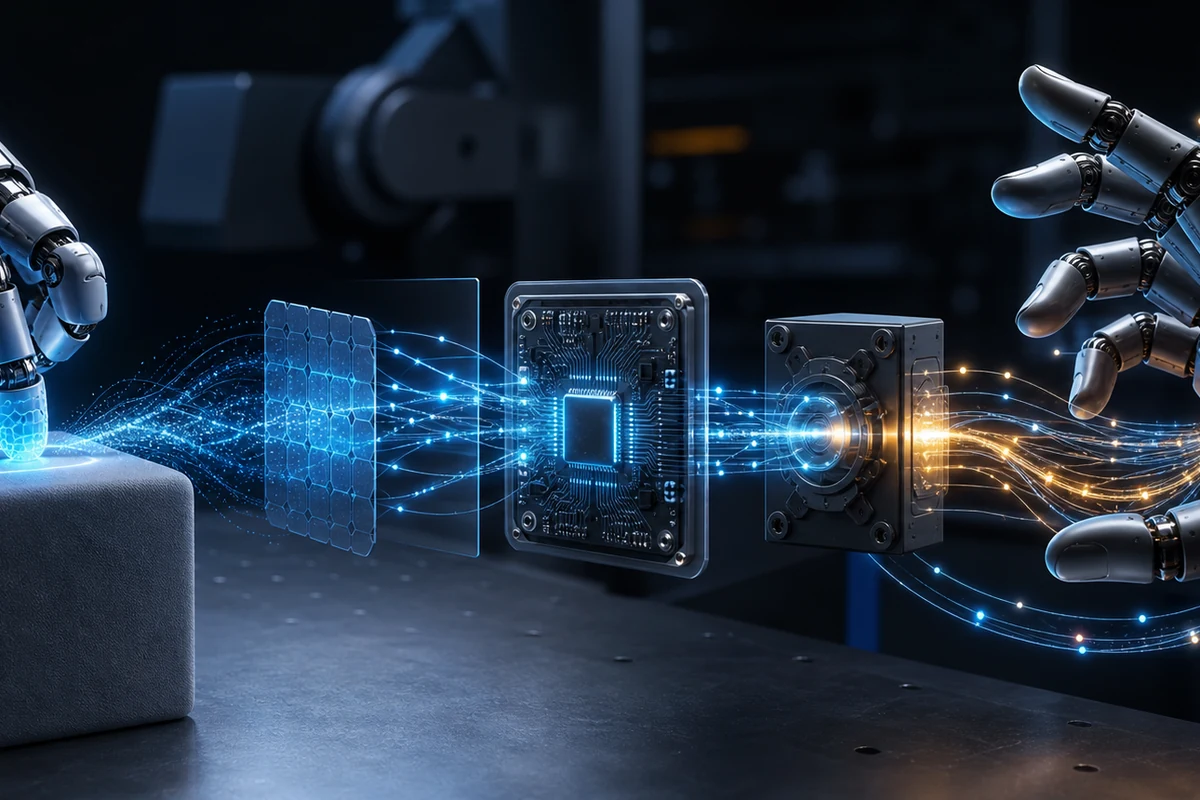
SlipSense studies a practical question: can a robot detect slipping early enough to intervene? The paper reports strong classification and fast detection, then tests a regrasp controller. Its most instructive result is the separation between those stages: all 100 induced slips were detected, but five objects were still lost. A correct alarm does not determine a successful recovery. SlipSense v1, Section 5.3.
This review focuses on the detector's measurement contract and the controller's remaining work. For comparisons with cable policies and visual contact overlays, see From Tactile Sensing to Robot Action.
What TacV5 measures
TacV5 combines a 32 × 32 piezoresistive pressure layout with 942 active taxels at 240 Hz and a three-axis MEMS accelerometer at 8 kHz. The synchronized output uses 240 Hz frames. Pressure describes the contact distribution; acceleration captures vibration associated with frictional motion. The pressure array measures normal pressure, not direct shear force. Hardware and acquisition.
The detector encodes pressure maps and acceleration spectrograms, fuses their features with cross-attention, and uses temporal context to distinguish no contact, contact without slip, and slip. These signals are complementary: pressure can describe sustained loading while acceleration captures faster changes. Robot motion can also excite acceleration, which makes negative examples and independent slip labels essential.
Labels should come from outside the detector
The authors induce linear slip with a Mark-10 F105-EM test stand. Its crosshead displacement supplies the labeling reference, rather than thresholding the same pressure or vibration signal the model must classify. Slip begins when cumulative displacement exceeds 0.07 mm, above the encoder's 0.02 mm resolution. The paper also collects control cases without induced slip. Collection protocol.
The collection exceeds 1.4 million synchronized frames across 37 objects: 28 training objects and nine held out for evaluation, with programmed speeds from 2 to 18 mm/s. Frames are not independent trials. The controlled displacement reference supports reproducible labels for this collection geometry; it does not automatically validate slip onset under every moving-robot condition.
Fusion improves more than the headline F1
The following is the held-out-object UMI OOD comparison from v1 Table 1. Latency is the mean of per-seed median detection delay over three seeds, in 240 Hz frames. It is not the maximum delay.
| Detector input | Macro F1 | False-positive rate | Detection latency, frames |
|---|---|---|---|
| Pressure only | 81.91% | 8.43% | 36.17 |
| Acceleration only | 81.33% | 3.24% | 3.00 |
| Pressure + acceleration | 95.75% | 1.57% | 1.50 |
The fused condition improves classification and false alarms while retaining a short median delay. The often-quoted approximately 96.7% F1 corresponds to the in-distribution result, 96.77%; the held-out-object figure is 95.75%. Keeping those columns separate makes the transfer claim assessable.
A latency distribution is not a control guarantee
The paper reports that 76% of slip events are detected within 20.8 ms of sensing delay, plus approximately 2.3 ms of mean inference time, yielding 23.1 ms. Inference was measured on an NVIDIA RTX A4500 workstation. The remaining events take longer, and an embedded processor may have a different inference budget. Latency analysis and implementation.
The slowest programmed slips show a longer tail: at 2 mm/s, Appendix Table 6 reports a three-frame median, a 14.9-frame mean, and a 106-frame maximum for 36 events. A single percentile-style statement hides that variation. The model's 250 ms history describes past observations available to inference; it should not be added as a fresh 250 ms wait on every steady-state decision. Delay by slip speed.
For integration, log physical slip onset, model decision, command dispatch, force response, and final object outcome separately. Communication, actuation and contact mechanics remain after a detector produces its answer.
Why five correctly detected slips still failed
Four operators performed 100 controlled pull trials on ten unseen objects using the Tesollo hand. Detection succeeded in 100/100 trials; the controller prevented loss in 95/100. Detection-to-peak-grasp-force time was approximately 50 ms. These are author-reported controlled disturbances, not 100 autonomous manipulation tasks. Closed-loop experiment.
The five failures involved a cable near the sensor edge: the inward recovery motion pushed it out despite correct detection. Increasing grasp force cannot fix every geometric loss of contact. A recovery policy may need contact-location awareness or a different motion, an engineering implication rather than a result evaluated by this paper.
Cross-platform tests reuse TacV5 units on UMI and Tesollo hardware. The three-finger Tesollo condition reports 87.24% F1, below the two-finger condition's 94.39%. This is transfer across sensor units and arrangements of the same sensor design, not evidence of transfer to arbitrary optical or magnetic sensors. Quantitative latency during active robot manipulation remains unvalidated. Transfer Table 2 and limitations.
Before attempting a reproduction
- Preserve the independent displacement reference and object-level splits; do not create a test set by randomly mixing adjacent frames.
- Recheck no-slip robot-motion negatives, sensor synchronization and false alarms after mounting.
- Benchmark the full latency distribution on the intended computer, then measure command-to-force response separately.
- Score object retention and failure geometry in addition to slip classification.
The tactile AI system guide places these steps in the sensing-to-action chain. The dataset directory distinguishes verified file access from paper-described collections. No official SlipSense project, code or dataset download was identified in the arXiv record and paper checked on September 19, 2026. Their release status and reuse licenses remain unverified; the paper's collection is not listed as a downloadable dataset here.
This review uses the September 14, 2026 v1. The arXiv comments report acceptance to CoRL 2026; conference proceedings were not independently verified. All experiments and measurements above belong to the authors. RoboSkin has not independently reproduced them.
Sources
Continue the topic