Large-area flexible tactile arrays for curved robot surfaces
A deployment-focused article on large-area tactile arrays, curved-surface coverage, adjustable resolution, slip detection, and manufacturing tradeoffs.
Updated technical brief - May 2026
Why this source matters
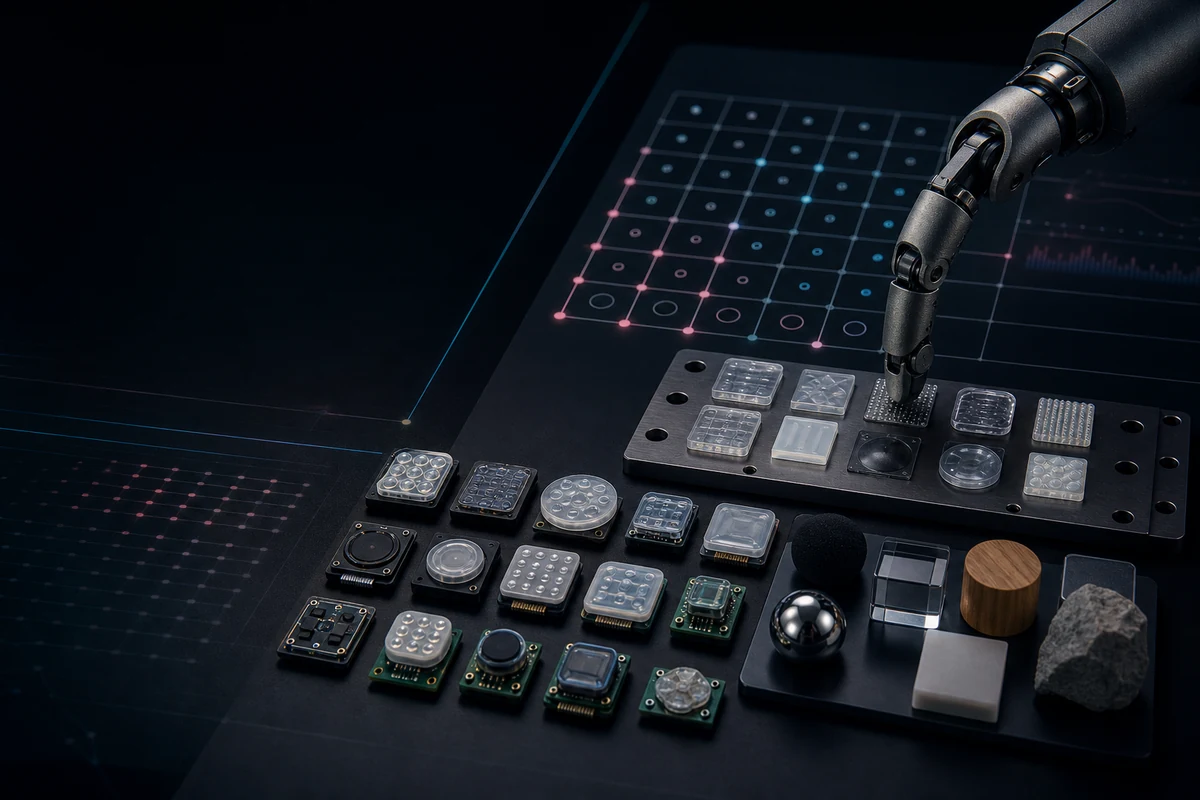
Many tactile sensor demonstrations begin with a small flat sample. Robot skin rarely ends there. A useful robotic surface may need to cover a curved gripper, palm, forearm, torso panel, prosthetic socket, or assistive device. Large-area flexible tactile arrays are relevant because they move the discussion from isolated sensing pixels to coverage, routing, durability, and manufacturability.
The cited ACS Applied Electronic Materials article is useful as a research signal because it connects skin-inspired flexible tactile sensing with larger surface coverage and robotic electronic skin. For RoboSkin.ai, the key editorial issue is how to evaluate scale. A sensor that works as a square sample is not automatically practical as a robot skin.
Core idea
Large-area tactile arrays must balance coverage, resolution, wiring, cost, and mechanical fit. Higher resolution can reveal more detailed contact patterns, but it also increases channel count, data volume, and calibration effort. Larger coverage helps detect unexpected contact, but it may make repair and replacement harder.
| Design choice | Benefit | Tradeoff |
|---|---|---|
| High spatial resolution | Better contact pattern detail | More channels and data |
| Large surface coverage | Detects contact across more robot area | More routing and attachment complexity |
| Flexible substrate | Fits curved surfaces | Durability and drift must be tested |
| Modular tiles | Easier replacement | Seams may create blind spots |
Curved surfaces change the problem
Flat-sample testing is useful for material characterization, but curved robot surfaces introduce new failure modes. A sensor may stretch on the outside of a curve and compress on the inside. Adhesives may fail at edges. Cables may pull during joint motion. A protective layer may change sensitivity. Cleaning and abrasion may matter more than peak sensitivity.
This is why large-area robot skin should be evaluated as a mechanical system, not only an electrical sensor. Mounting, strain relief, connector placement, replaceable sections, and surface protection can determine whether the skin is useful.
Slip and gesture context
Large-area arrays can support more than touch detection. If the array captures contact movement over time, it may help estimate slip direction, sliding velocity, or gesture-like interactions. For grippers, slip direction can guide grip adjustment. For human-robot interaction surfaces, contact movement can help distinguish accidental bumps from intentional touch.
But these use cases require temporal data quality. It is not enough for the sensor to detect a contact point. The system must track how that point moves, how quickly, and whether the pattern is reliable under repeated loading.
Reader value
The value of this source is that it forces a scale discussion. Large-area robot skin is not just a bigger sensor. It changes how engineers think about routing, maintenance, replacement, data compression, and coverage gaps. A small pad can be judged mostly by sensitivity and response time. A large surface must also be judged by how it survives being installed on a robot.
For readers comparing technologies, the key is to separate array performance from system performance. A high-resolution array may look impressive in a figure, but the real question is what resolution remains usable after bending, protective covering, connector routing, and calibration. A lower-resolution modular skin may be more useful if it can be repaired quickly and covers the places where contact actually occurs.
| Scale issue | Why it appears | What to verify |
|---|---|---|
| Wiring density | More sensing points need more routes or multiplexing | Channel count and connector design |
| Calibration drift | Large soft surfaces see uneven strain | Baseline before and after mounting |
| Repair cost | Exposed skin wears out | Replaceable sections and service time |
| Blind spots | Seams and edges interrupt coverage | Contact tests across module boundaries |
Evaluation checklist
- What area can the array cover without losing signal quality?
- How does the sensor behave on convex and concave surfaces?
- What is the channel count and data rate at full size?
- Are seams, connectors, and cable exits included in the design?
- Does repeated bending change baseline or sensitivity?
- Can damaged sections be replaced without replacing the whole skin?
- Does the system detect slip direction or only contact location?
Manufacturing and service implications
Manufacturing matters because robot skin is a consumable surface in many applications. A hand or gripper that works in a demo may require replacement after abrasion, contamination, or mechanical damage. If the skin is difficult to manufacture consistently, field service becomes expensive.
Modular approaches can help. A large surface divided into replaceable tiles may be easier to maintain than a single continuous skin. However, modular seams can create blind spots and mechanical edges. A continuous skin may improve coverage but complicate repair. The correct choice depends on the robot and task.
What not to infer
The ACS source should not be treated as proof that large-area flexible tactile arrays are ready for every curved robot surface. It supports a research direction and a set of engineering questions. Real deployment still depends on mounting, calibration, environmental exposure, data handling, and maintenance strategy.
Large-area robot skin evaluation should cover geometry, channels, data rates, attachment, damage, replacement, and slip behavior. Without those details, the deployment limits remain unclear.
Source
Continue the topic