Graphene and liquid metal 3D force sensing for robot fingertips
A source-backed technical brief on miniaturized tactile sensors that separate normal force, shear force, slip, and texture signals for dexterous robot hands.
Updated technical brief - May 2026
Why this source matters
Robot skin is often described as a pressure layer, but pressure alone is a weak description of real contact. A gripper usually needs to know not only that it touched an object, but how force is distributed, whether the object is sliding, and whether the surface texture changes the required grip strategy. The University of Cambridge report on graphene and liquid metal 3D force sensing is useful because it frames touch as a multi-axis measurement problem rather than a single pressure value.
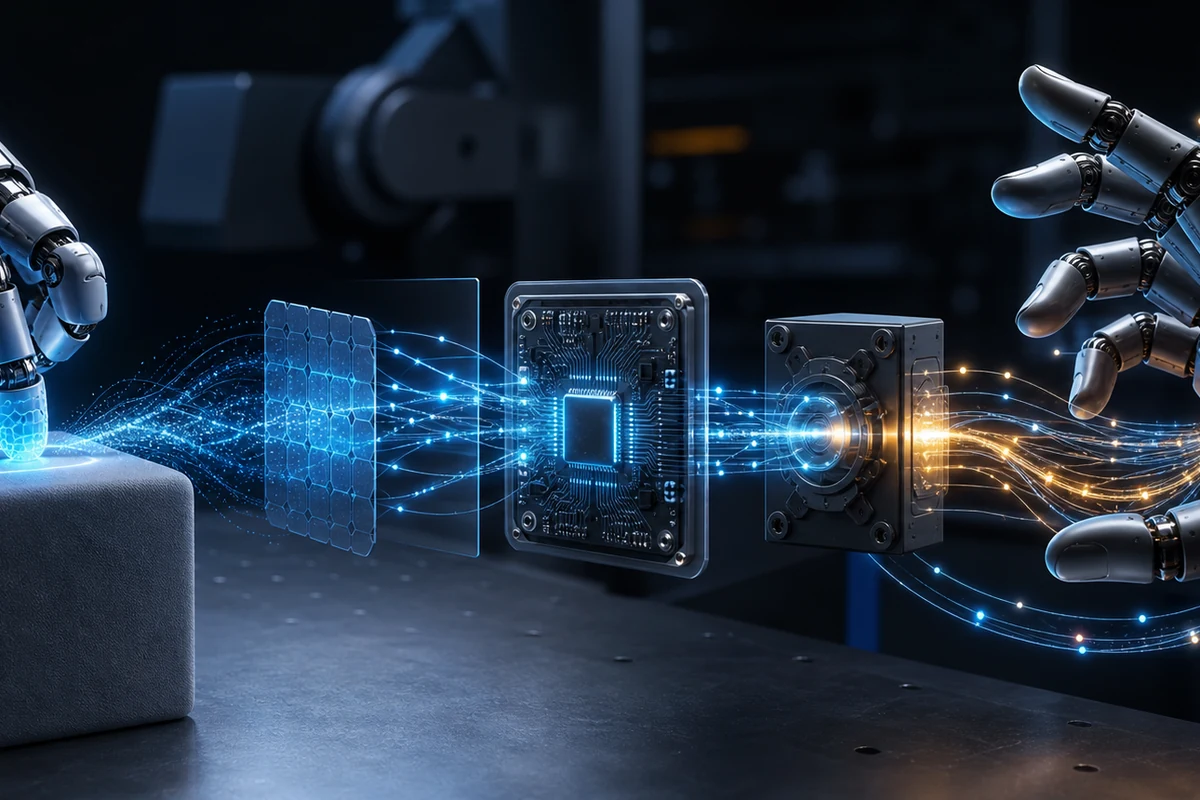
The Cambridge team describes a miniature tactile sensor architecture based on graphene, liquid metal composites, nickel particles, and skin-inspired microstructures. The public report says the sensor can detect how hard a robot is pressing, the direction of applied forces, whether an object is slipping, and surface roughness. That combination is important for robot fingertips because fingertips are small, curved, mechanically constrained, and often the first place where contact-rich manipulation fails.
Core idea
The important idea is vector contact. A scalar pressure sensor gives a controller one simplified number or map: more pressure here, less pressure there. A 3D force sensor is more informative because it separates normal pressure from tangential force. Normal force tells the robot how strongly it is pushing into an object. Tangential force tells the robot whether the object may be sliding across the contact surface. Texture response gives another signal that can help distinguish a smooth object from a rough or deformable one.
For a robot hand, this matters before the object visibly moves. Vision may see the object before grasping, but vision often loses useful information after contact because fingers cover the object. A tactile sensor that can detect early slip gives the controller a chance to adjust grip force or finger pose before the grasp fails.
| Contact signal | What it tells the robot | Why it matters |
|---|---|---|
| Normal force | How hard the finger presses into the object | Prevents under-gripping and crushing |
| Shear force | Whether load is moving sideways at the contact patch | Helps detect slip before a drop |
| Texture response | How the surface interacts with the fingertip | Supports material and handling decisions |
| Spatial pattern | Where contact occurs across the fingertip | Helps adjust pose and contact strategy |
Practical design implications
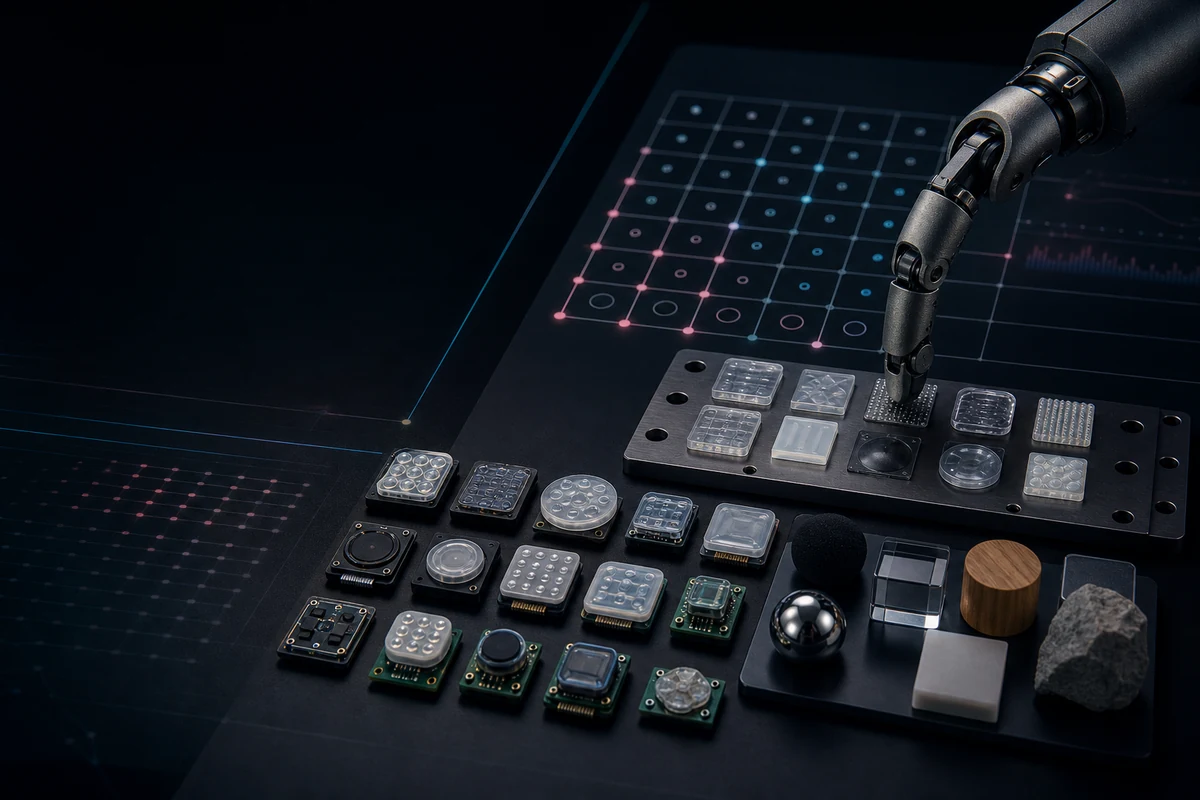
Miniaturization is more than a laboratory convenience. A fingertip sensor has to fit into a small mechanical envelope without making the finger too bulky, too stiff, or too fragile. The smaller the sensing unit, the easier it becomes to place arrays around curved surfaces, fingertip pads, and narrow gripper jaws.
The public Cambridge description also matters because it combines material choice with geometry. Graphene and liquid metal composites provide electrical behavior, while skin-inspired microstructures concentrate stress and help the sensor respond to small forces. In robot skin design, the sensing material and the surface geometry cannot be treated as separate decisions. A material that performs well as a flat coupon may behave differently once molded into pyramids, bonded to a gripper, routed through wires, and cycled through thousands of grasps.
How to read the result
The strongest use of this source is as a design lens, not as a purchasing shortcut. A robot fingertip team can use it to separate three questions that are often mixed together. First, does the sensor produce a physically meaningful contact signal? Second, can that signal be preserved after packaging, bending, and repeated use? Third, can the robot controller react to that signal quickly enough to change the grasp?
Those questions keep the article useful even when a reader is not building the same sensor. They also prevent a common mistake in robot skin coverage: treating material novelty as the whole story. For manipulation, the output format, calibration method, mounting geometry, and control-loop timing are as important as the sensing material.
Evaluation checklist
- Confirm whether the sensor measures normal force only, shear force only, or a reconstructed 3D force vector.
- Check whether slip detection is demonstrated during real grasping, not only in a bench press test.
- Ask how calibration changes when the sensor is mounted on a curved fingertip.
- Separate sensitivity claims from usable operating range.
- Review whether surface texture recognition is task-relevant or just a demonstration.
- Look for repeated loading, bending, temperature, and contamination tests before assuming deployment readiness.
What not to infer
This source does not mean every graphene or liquid metal tactile sensor is ready for commercial robot skin. It also does not mean a single fingertip demonstration transfers directly to a full humanoid hand. Scaling from one small contact patch to a full hand introduces wiring density, data bandwidth, calibration drift, replacement strategy, and mechanical packaging problems.
For RoboSkin.ai, the useful lesson is narrower: robot skin content should distinguish pressure sensing from multi-axis tactile sensing. Articles that treat all tactile sensors as generic pressure pads miss the most important engineering difference. A high-value tactile AI stack needs contact direction, slip information, timestamped data, and a controller that can use those signals.
Source boundary
This article summarizes the public Cambridge report and adds RoboSkin.ai editorial analysis for research orientation. Performance values, patents, demonstrations, and researcher statements should be attributed to the cited source, not to RoboSkin.ai.
Source
University of Cambridge: Graphene-based artificial skin brings human-like touch closer to robots
Continue the topic