GenForce transferable force sensing for robot skin and tactile sensors
GenForce explores transferable force sensing across tactile sensors, reducing repeated calibration work for robot skin replacements and hardware changes.
Updated technical brief - June 2026
GenForce is a framework for transferring force-sensing knowledge across tactile sensors. It addresses repeated calibration and force-label collection when sensor instances, geometries, or sensing principles change. For robot skin, that matters because hands and distributed surfaces contain many patches that wear, drift, or require replacement, turning calibration reuse into a deployment and maintenance problem rather than a one-time benchmark.
Source findings
Robot skin systems do not fail only because a sensor is not sensitive enough. They also fail because each sensor instance often needs its own calibration data, force labels, and model training. That problem becomes expensive when a robot hand uses many tactile sensors across fingertips, palms, grippers, or replaceable skin modules.
The Nature Communications article on GenForce is useful because it frames tactile sensing as a transfer problem. The authors describe a framework intended to let force prediction models trained with one tactile sensor transfer to other tactile sensors, including sensors with different sensing principles and physical configurations. For a robot skin research map, the important signal is not just model accuracy. The important signal is the possibility of reducing repeated calibration work across many tactile surfaces.
RoboSkin analysis
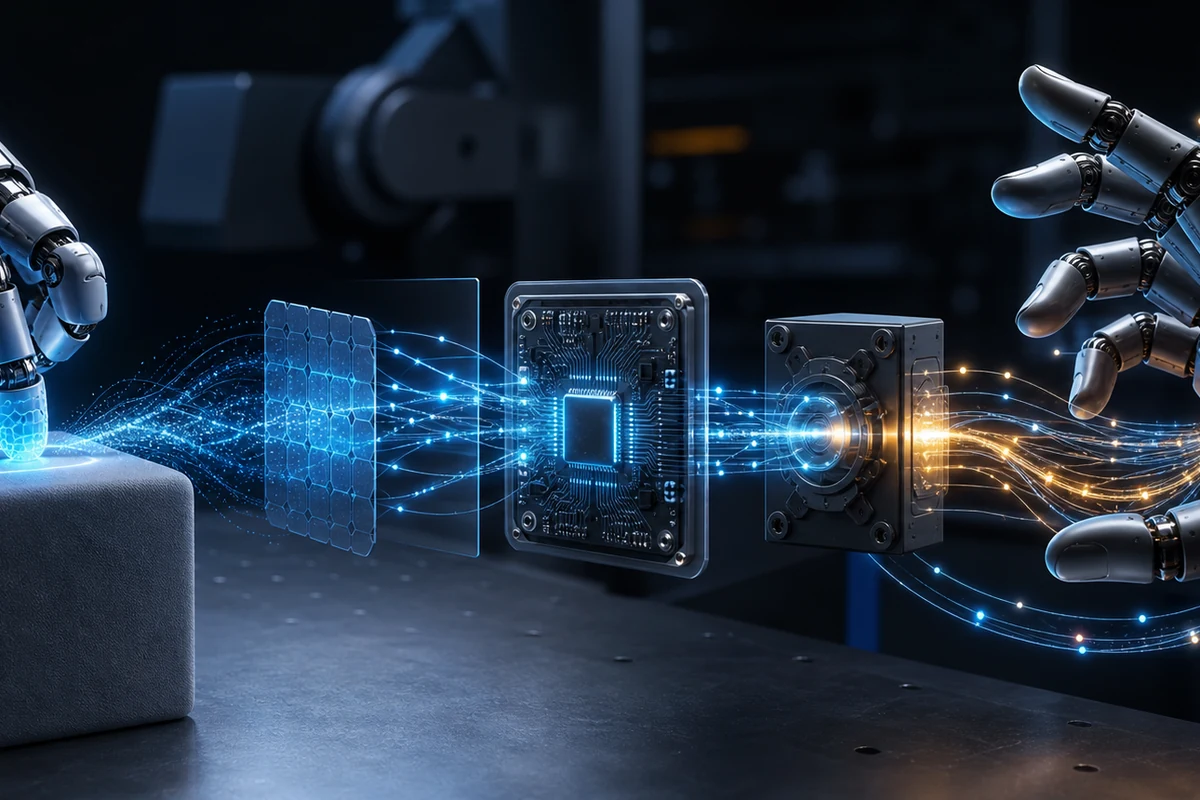
GenForce treats tactile sensor outputs through a shared marker-style representation. The source paper describes a route where tactile signals from calibrated sensors can be transformed toward uncalibrated sensors, then used for force prediction. That matters because robot skin is rarely one perfect sensor. It is usually a collection of sensor patches, batches, repairs, replacements, and geometries.
| Deployment problem | Why it matters | What GenForce points toward |
|---|---|---|
| Sensor-to-sensor variation | Same design can behave differently after fabrication | Cross-sensor representation alignment |
| New skin replacement | Recalibration slows service and repair | Reuse of prior force-labeled data |
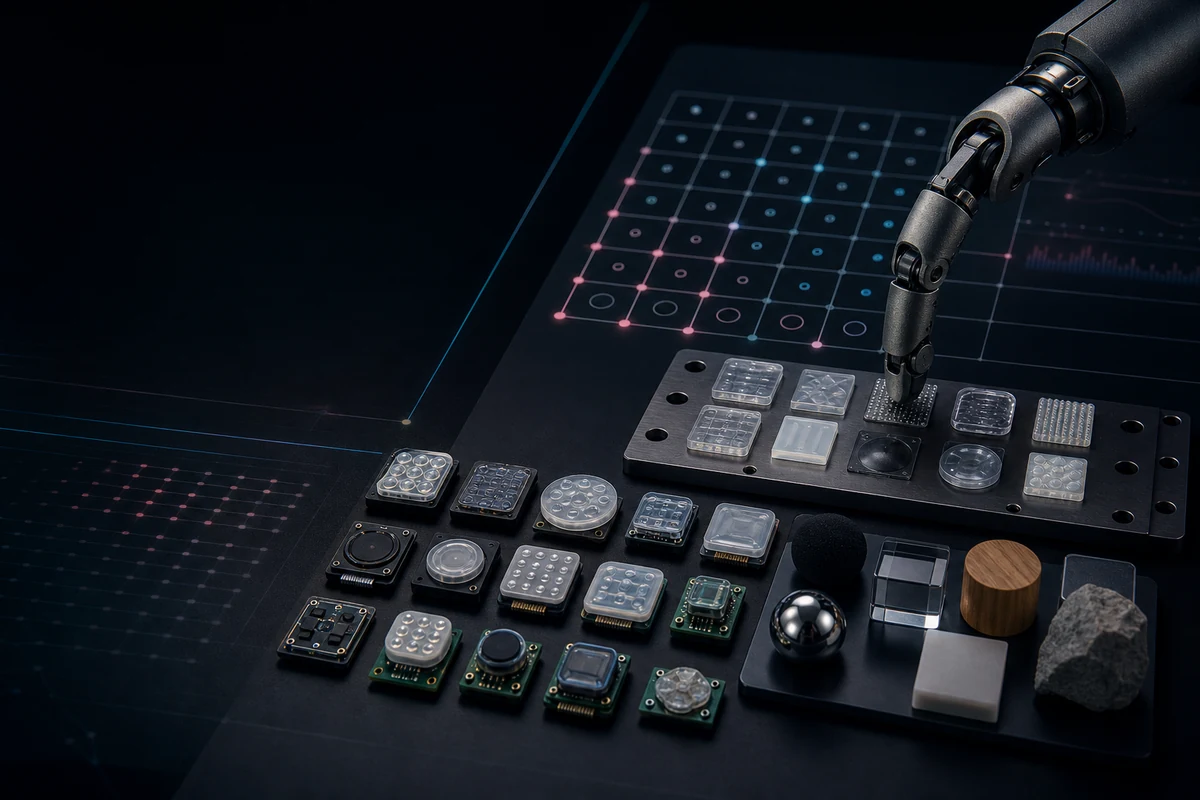
| Mixed tactile modalities | Hands may combine optical, magnetic, and electronic sensors | A shared representation layer |
| Force prediction | Controllers need calibrated values, not just raw patterns | Transferable force estimation |
Engineering implications
Most public robot skin coverage focuses on the material: hydrogel, graphene, elastomer, liquid metal, textile, or flexible circuit. That misses the software burden. A tactile sensor that looks promising in one lab setup may become hard to use when the robot has many copies of it. Every fingertip can drift. Every pad can wear. Every replacement can shift the signal baseline.
Transferable force sensing is a practical response to that maintenance problem. It asks whether tactile experience can be reused instead of recollected from scratch. For Physical AI and contact-rich manipulation, that is a stronger story than simply saying robots need touch. Robots need touch that can be calibrated, transferred, replayed, and trusted across hardware changes.
What this means for robot skin
For robot skin, GenForce is a reminder that sensing surfaces are maintained, replaced, and recalibrated. A hand with many tactile patches cannot depend on one-off calibration forever. Transferable force sensing gives readers a concrete way to think about sensor-to-sensor variation, replacement skins, and learned tactile representations.
Read this alongside the Dream-Tac world-action model, where predictive control depends on reliable tactile values, and the ROS 2 tactile sensor pipeline, where calibration metadata travels with recorded touch data.
What this does not prove yet
GenForce does not prove that any tactile sensor can learn from any other tactile sensor without constraints. Transfer depends on representation quality, sensor similarity, task distribution, ground-truth force data, and what happens after wear or replacement. A strong robot skin claim still needs application-specific validation.
Where this fits next
The next route is operational: record raw and calibrated tactile data, preserve calibration metadata, test transfer after sensor replacement, and compare policy performance before and after transfer. That makes GenForce part of a maintenance and learning workflow, not only a model benchmark.
Practical questions
- What is transferable force sensing? It is the attempt to reuse force-sensing knowledge across tactile sensors instead of rebuilding every calibration from zero.
- Why does it matter for robot skin? Robot skin often means many sensors on one robot, so calibration cost and replacement behavior become system-level problems.
- What should readers open next? Use ROS 2 tactile sensor pipeline for replay and metadata, then Dream-Tac world-action model for predictive tactile AI context.
How to evaluate the claim
The useful reader question is not whether one framework solves calibration forever. It does not. The useful question is which assumptions make transfer possible. Does the tactile signal contain spatial structure? Can the source and target sensors be mapped into a common representation? Does the new sensor have enough similarity for force prediction to remain meaningful? What happens after wear, replacement, or surface damage?
| Evaluation question | Strong evidence would show | Weak evidence would show |
|---|---|---|
| Cross-sensor transfer | Multiple sensor families and geometries | One sensor batch only |
| Force accuracy | Force prediction tested against measured labels | Visual similarity only |
| Manipulation relevance | Grasping or slip tasks using transferred sensing | Offline reconstruction only |
| Maintenance value | Less relabeling after replacement | Full new calibration still required |
Evaluation checklist
- Check which tactile sensor types were included in transfer experiments.
- Separate representation transfer from force prediction accuracy.
- Ask whether slip detection, grasping, or manipulation tasks used transferred sensing.
- Look for evidence on both homogeneous sensors and heterogeneous sensors.
- Check whether the method still needs a small target-domain calibration set.
- Treat replacement, wear, and batch variation as deployment tests, not footnotes.
What not to infer
This source does not mean any tactile sensor can automatically learn force sensing from any other sensor. It also does not remove the need for ground-truth measurements, calibration discipline, or application-specific validation. Transfer works only within the limits of the representation, the training data, and the physical behavior of the sensors involved.
Calibration transfer is critical to robot skin evaluation. A serious tactile AI stack must explain how force labels, sensor drift, replacement, and cross-sensor learning are handled. Without that, the evidence still describes a sensor sample rather than a deployable tactile system.
Source
Nature Communications: Training tactile sensors to learn force sensing from each other
Continue the topic