VisTacAlign turns human touch into robot training data
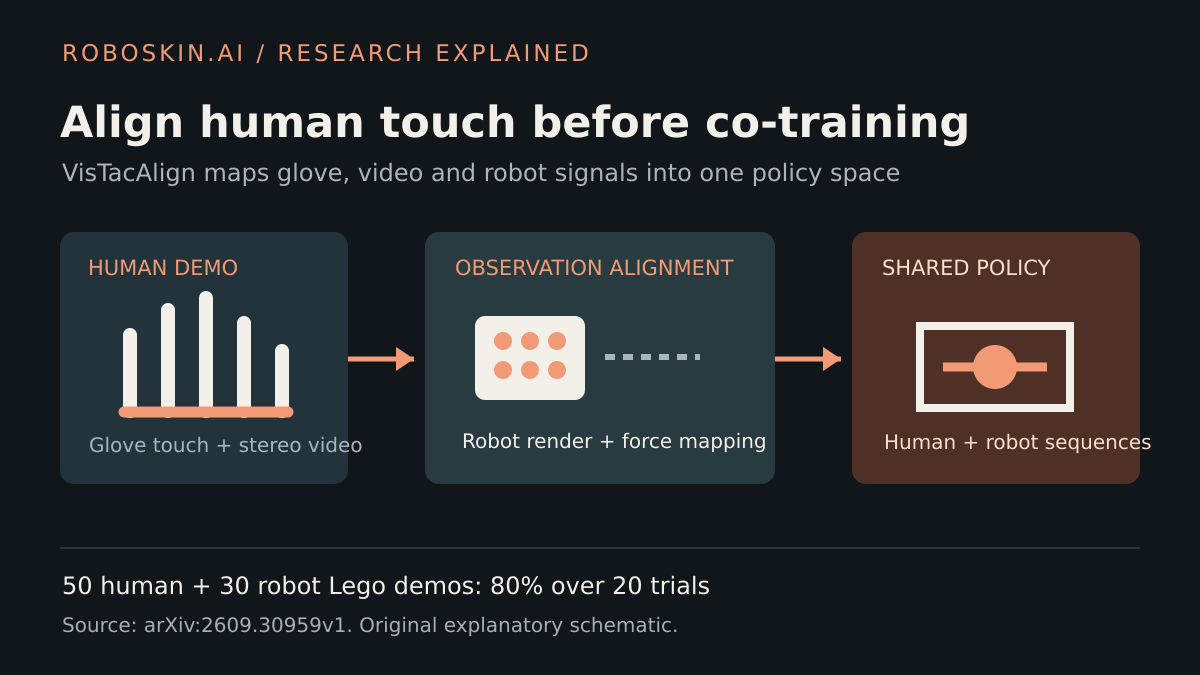
VisTacAlign retargets a human glove and stereo camera rig into a tactile robot hand’s observation space, then co-trains one policy on human and robot demonstrations.
ETH Zurich and Stanford University researchers released VisTacAlign on September 25, 2026. The method records human hand motion, stereo video and capacitive glove signals, maps them into a 17-degree-of-freedom tactile robot hand's observation space, and co-trains a diffusion policy with ordinary robot demonstrations. The goal is to make fast human demonstrations usable without pretending that human and robot sensing are naturally identical. Paper and version record.
Key takeaways
- In the drill task, 26 aligned human demonstrations added to 26 robot demonstrations raise reported lift success from 50% to 70%.
- In Lego insertion, 50 human plus 30 robot demonstrations reach 80% over 20 trials, compared with 10% for 30 robot demonstrations alone.
- The alignment is task-specific and compresses each fingertip to one normal-force value. It does not preserve full taxel geometry or shear.
What changed
Human demonstrations are fast to collect but differ from robot data in embodiment, camera geometry and contact signals. VisTacAlign tackles both visual and tactile mismatch. It retargets the glove pose to an ORCA Hand, renders a robot-textured hand into the human stereo sequence and recomputes depth. Separately, it maps capacitive glove measurements into the range of the robot's fingertip taxels.
The resulting human observations and robot observations train the same 23.5-million-parameter diffusion transformer. The policy predicts 64 action steps, executes the first 32—about 1.1 seconds—and replans. The authors report 269 milliseconds per inference on an RTX 4080. Human glove data arrives at 60 Hz, stereo video at 20 Hz and robot tactile data at 30 Hz. Architecture and implementation.
Results and comparison conditions
For drill pickup, 26 robot demonstrations alone reach 50% lift success. Adding 26 aligned human demonstrations raises the result to 70%. In the low-robot-data setting, ten robot demonstrations reach 35%; adding 26 human demonstrations without tactile alignment produces 30%, while adding aligned touch reaches 55%. This comparison supports the alignment mechanism more directly than the larger-data result.
The strawberry task combines 124 human and 84 robot demonstrations. Over ten trials for each fruit size, the multimodal policy reaches 90%, 80% and 70% on small, medium and large strawberries. A robot-only policy without tactile input reaches 60%, 70% and 0%. The paper does not quantify strawberry damage, so the numbers measure task completion rather than gentle handling.
For Lego insertion, 50 human plus 30 robot demonstrations reach 80% across 20 trials; 30 robot demonstrations alone reach 10%. Removing visual retargeting from the combined-data pipeline reduces success to 10–25% at comparable robot-data budgets, while the full alignment reaches 40–60%. Removing tactile input from the best configuration costs ten percentage points. Task results and ablations.
The alignment diagnostics are also useful. For thumb and index touch distributions, the reported Kolmogorov-Smirnov distances fall from 0.33 and 0.42 to 0.08 and 0.08. A domain classifier drops from 92% to 58%, near but not at 50% chance. Visual Chamfer distance falls from 13.3 to 10.2 mm, while the 10 mm F-score rises from 0.40 to 0.59.
What this means for robotics
RoboSkin analysis: VisTacAlign turns embodiment mismatch into an explicit engineering step instead of asking a large policy to absorb it implicitly. That is promising for robot teleoperation programs where human collection is two to three times faster than robot teleoperation, as the authors report.
The method is not a universal human-to-robot converter. Its force mapping is fitted per task from separate human and robot force samples, and it still requires a short robot recording. Teams should budget for calibration whenever the object, glove fit, fingertip material or sensor gain changes.
Limitations and availability
VisTacAlign is an arXiv v1 preprint labeled “under review” for ICRA 2027; it should not be described as an accepted conference paper. RoboSkin.ai has not reproduced it. The study covers three short-horizon, mostly quasi-static tasks. Per-fingertip force discards spatial pressure, shear and incipient slip, and there is no comparison against learning a shared latent space without handcrafted mappings.
The official project page labels both paper and code “coming soon,” even though the arXiv manuscript is available. No code repository, dataset, checkpoint or software license was verified. The paper carries CC BY-NC-ND 4.0; this does not authorize unrestricted modification or commercial reuse of the manuscript.
Sources and related resources
Continue the topic