DITTO-X makes a robot hand align the operator before takeover
DITTO-X runs an actuated hand exoskeleton in both directions, rendering robot contact to a human and matching the operator to the robot before intervention.
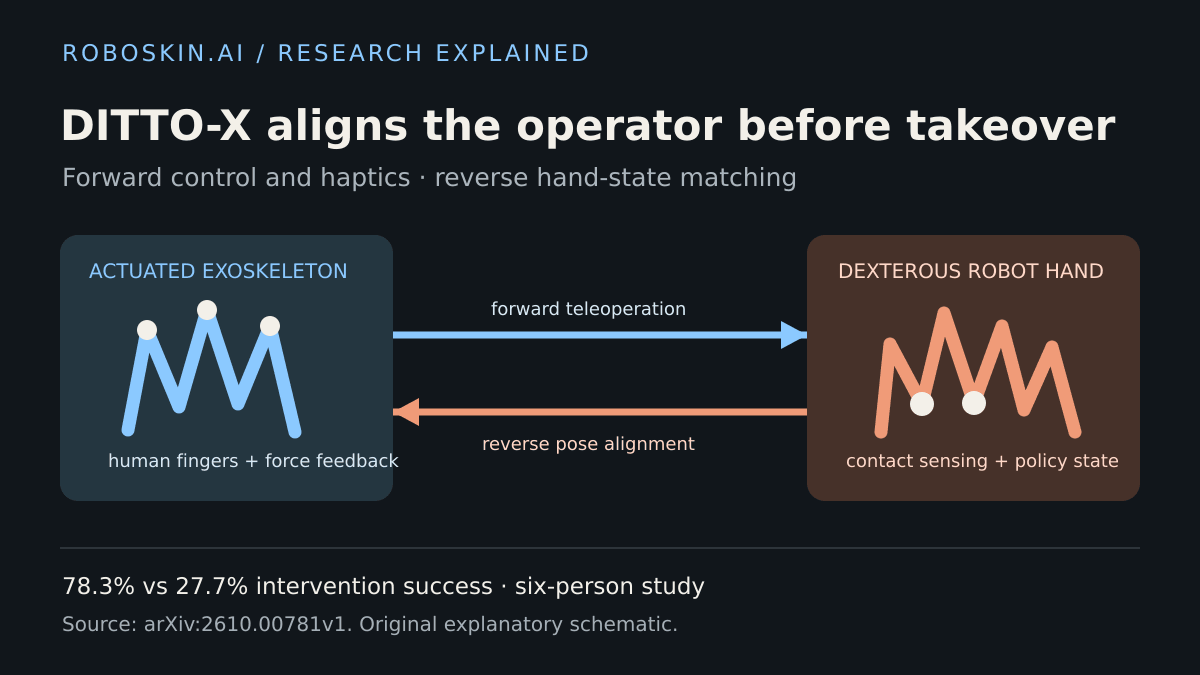
Stanford and Columbia researchers released DITTO-X on September 30, 2026. The actuated exoskeleton sends a person's finger motion to three commercial dexterous hands, renders joint-force and fingertip-contact feedback, and can reverse direction so the robot moves the operator into its current finger configuration before control transfers. In a six-person study, that matched takeover improved a contact-rich tool-use intervention from 27.7% to 78.3% success against a tracking-glove baseline. Paper and version record.
Key takeaways
- Forward teleoperation closes the loop with force feedback from robot joint currents plus vibrotactile contact cues at the operator's fingertips.
- Reverse teleoperation maps the robot's commanded hand configuration back to the exoskeleton before takeover, reducing the pose jump that can release a held object.
- The project describes 1,888 episodes and more than 16 hours at 30 Hz, but its Code, Dataset and Hardware Guide controls all still say “coming soon.”
How bidirectional control works
DITTO-X aligns actuator axes with human finger joints. Index and middle fingers can map joint-to-joint on the 22-DoF Sharpa and 20-DoF Wuji 2 hands. Thumb motion is retargeted in task space, and the six-DoF Inspire hand receives a lower-dimensional flexion mapping. Supported hands expose either joint-current estimates or fingertip force sensing; DITTO-X converts those signals into exoskeleton torques and fingertip vibration. Hardware and mapping details.
During autonomous execution, the robot's current command is projected back onto the exoskeleton. The operator's fingers follow the robot until the operator takes over; after correction, the same mapping returns control. Safety measures reported by the authors include software joint limits, motor-current limits below 200 mA with torque no greater than 0.08 N·m, and an emergency stop.
Results under the reported conditions
Six participants completed blinded size and compliance discrimination, regular tool-use teleoperation and mid-policy intervention. With both feedback modes, size discrimination is 86.1% and compliance discrimination 91.7%, against 33.3% chance. Removing either force or vibration reduces the scores; the experiment supports complementarity within this prototype, not a universal ranking of haptic modalities.
For collecting tong-use demonstrations, DITTO-X succeeds on 70.0% of trials versus 46.7% for the Manus Pro tracking glove, a 23.3-point gap. Mean time per success falls from 85.5 to 56.1 seconds. In intervention, success is 78.3% versus 27.7%, while time per success falls from 97.4 to 35.7 seconds. Each participant performs ten trials per condition; the sample is therefore repeated-measures evidence from six people, not a large operator population.
Policy tests use 30 paired starting configurations per task. Before DAgger, DITTO-X data produces final-stage success of 63.3% on tong use, 63.3% on raspberry placement and 40.0% on battery insertion; Manus data yields 13.3%, 43.3% and 36.7%. After two DAgger rounds with 20 interventions per round, the DITTO-X policies reach 86.7%, 93.3% and 90.0%. The paper also quantity-matches extra demonstrations, helping separate on-policy failure coverage from data volume.
RoboSkin analysis
The most important change is at the authority boundary. Conventional human intervention switches the controller, but the operator may begin with fingers in a different pose from the robot. With a dexterous hand already holding a tool or fragile object, that mismatch is itself a disturbance. DITTO-X treats body alignment as part of robot teleoperation, while force and contact feedback give the operator evidence that cameras can lose under occlusion.
The interface also shows why haptics should be evaluated downstream. Better blind discrimination is useful, but the stronger evidence is that contact-aware demonstrations produce better autonomous policies and that matched interventions cover failure states. This connects human feedback to the broader robot learning pipeline.
Limitations and availability
DITTO-X is an arXiv v1 preprint and RoboSkin.ai has not reproduced its hardware or results. The main user study has six participants, most policy experiments use the Sharpa hand, and mappings still require known hand kinematics and per-hand scaling. The design is not demonstrated on full-body teleoperation or unknown hands.
The official page says it releases the DITTO-Human Dataset: 847 teleoperated, 379 human-intervened and 662 autonomous episodes, totaling 1,888. However, on October 2 the Code, Dataset and Hardware Guide controls were non-links explicitly marked coming soon. No downloadable episodes, repository or license was verified. The paper's CC BY-NC-ND 4.0 license does not license absent code or hardware files.
Sources and related resources
Continue the topic