InternW0 links asynchronous world prediction with contact-aware pipetting
Shanghai AI Laboratory combines slower world prediction with faster action updates and contact-aware post-training. Its laboratory results require careful separation of task progress, full completion and model-side latency.
Shanghai AI Laboratory's Physical Intelligence Team introduced InternW0, a foundational physical world model for efficient real-world interactions, in a technical report submitted to arXiv on September 23, 2026. The system separates slower video prediction from faster action generation and adds force and tactile channels during contact-aware post-training. Its dexterous pipetting experiment connects world-model research to tool contact, but the headline laboratory scores measure task progress rather than complete-workflow success. Paper and submission record.
Key takeaways
- InternW0 reuses predictive video context while updating actions from incoming observations. Force and tactile histories can condition the action expert during downstream post-training.
- The five-stage pipetting task reports 65.3% average progress over 15 trials, versus 46.7% for π0.5 and 18.7% for Fast-WAM. These percentages do not mean that the complete procedure succeeded that often.
- The paper reports 7,233.5 pretraining hours and 60.73 ms critical-path action latency on RTX 5090D. Neither figure describes a downloadable tactile dataset or an end-to-end robot control guarantee; official model and code buttons were disabled when checked. Real-robot results, efficiency and project page.
How does the model keep predictions useful during contact?
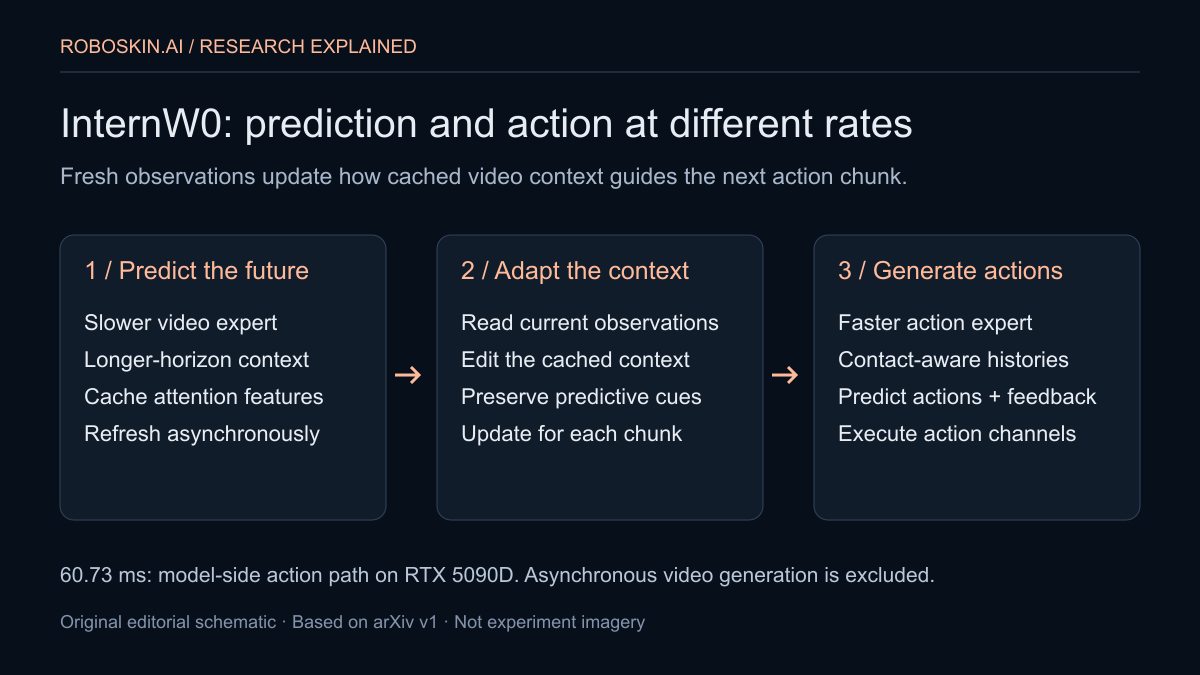
A predicted future becomes less useful when an object slips or a tool encounters unexpected resistance. Regenerating an entire video prediction for every action update is expensive, however. InternW0 uses separate video and action experts in a mixture-of-transformers architecture to operate at different timescales.
The video expert produces longer-horizon context. Its internal attention keys and values are cached, then an observation-conditioned editor adapts how that context is exposed to each action chunk. Fresh visual observations can therefore change local control without requiring the full video predictor to finish another pass first. The video pathway uses a frozen Wan variational autoencoder, while a frozen DINOv3 encoder represents current visual observations.
For contact-rich post-training, the action expert additionally receives available force and tactile histories. It jointly predicts future actions and interaction signals; action channels are executed, while the predicted contact channels represent expected feedback. This is a task-specific extension of the action interface, not evidence that every pretraining trajectory includes tactile measurements. Architecture and contact-aware post-training.
What does the pipetting experiment establish?
The setup combines a 20-degree-of-freedom hand with a seven-degree-of-freedom arm and hybrid force-position control. Its five stages are pickup and reorientation, tip attachment, aspiration, dispensing, and tip ejection with return. The authors run 15 trials per real-world task with randomized initial object positions and orientations. For multi-stage tasks, the compared methods share the same vision-language model for subtask generation.
The 65.3% pipetting score is the proportion of correctly completed, ordered subtasks averaged over trials. Table 7 separately lists 46.7% for InternW0's final tip-ejection-and-return stage. Keeping both figures visible prevents average progress from being mistaken for full-sequence reliability. π0.5 also scores higher on the initial pickup and reorientation stage, 93.3% versus 86.7%, while InternW0 leads on the four subsequent stages. Evaluation protocol and Table 7.
The related 15-stage metal-organic-framework preparation task follows the same distinction: InternW0 reports 68.4% average progress, but 26.7% at the final listed stage. These are manipulation measurements, not proof of chemical synthesis quality. Likewise, the pipetting results do not provide a volumetric-accuracy benchmark merely because the task is named quantitative pipetting.
RoboSkin analysis: these experiments make compliant tool interaction a useful evaluation target for robot world models and tactile AI. They do not isolate the contribution of tactile input from pretraining, predictive modeling and low-level control. The reported comparison should therefore guide integration questions, not be read as a controlled measurement of the benefit of adding a particular touch sensor.
What is in the reported training mixture?
Table 1 totals 7,233.5 hours and 811,969 episodes across seven datasets and 25 training domains. Those domains reflect data sources and configurations, rather than 25 distinct robot bodies. The mixture contains real-robot trajectories, simulated manipulation and EgoLab egocentric laboratory videos; it is not a 7,200-hour tactile corpus.
EgoLab contributes 275.4 hours and 3,192 episodes. Although hand trajectories are reconstructed to assist filtering, its pretraining contribution uses a video-only pathway without robot-action labels. Other robotics datasets supply action supervision through a unified 37-dimensional interface with validity masks for missing channels. The report also states that dexterous-hand robot data is excluded from this pretraining corpus, making downstream specialization important to interpreting the pipetting example. Data recipe.
How fast is the action path?
On the same RTX 5090D hardware and numerical-precision setting used for its comparison, the paper reports 60.73 ms per critical-path action update, corresponding to a maximum model-side rate of 16.47 Hz. This includes observation encoding, context routing and action denoising, but excludes asynchronously scheduled video-plan generation. The reported 3.13-fold speedup is relative to Fast-WAM under that action-generation protocol.
Engineers still need to budget sensor acquisition, communication and actuator behavior. A model-side update rate is not the same as a tactile sampling rate or a certified contact-control loop. This distinction also matters when comparing visuo-tactile world-model systems. Timing definition.
Limitations and availability
This is an arXiv v1 technical report, and RoboSkin has not independently reproduced its results. Laboratory evidence is limited to the reported tasks and trials; sustained operation, disturbance recovery and transfer to other instruments need further evaluation.
On September 25, the official project provided the paper and demonstration videos, but its GitHub, Hugging Face and ModelScope buttons were disabled rather than linked to releases. No downloadable InternW0 weights, complete implementation or EgoLab archive was verified there. The paper's CC BY 4.0 license does not establish a license for unreleased software, models or data. Reported training scale and accessible release assets must remain separate. Official availability.
Sources and related resources
Continue the topic