Torque-change alignment transfers a simulated grasp policy to a direct-drive hand
Sogang University researchers calibrate motor current, subtract consecutive torque readings and inject measured noise. The hand succeeds in 208 of 210 object trials without vision or tactile sensors.
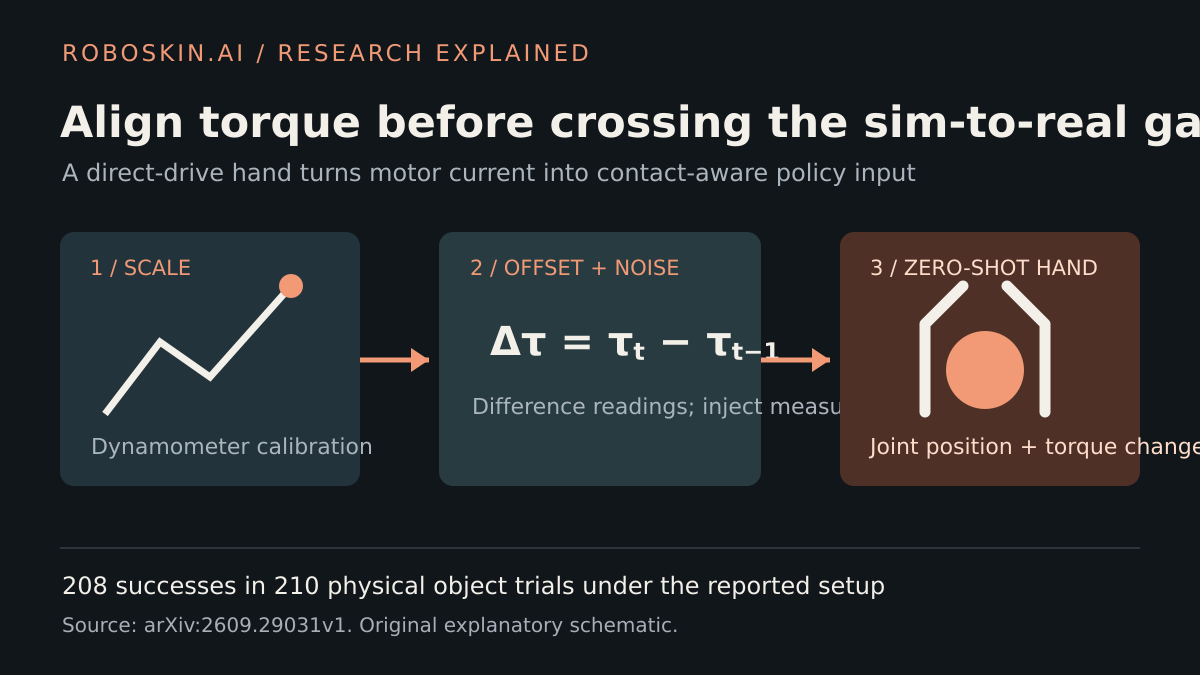
Sogang University researchers released a torque-observation alignment method on September 24, 2026 for zero-shot transfer to a multifingered direct-drive gripper. Instead of adding tactile sensors, the method turns motor current into a contact cue: it calibrates the torque scale, differences consecutive readings to suppress offset, and injects measured noise during simulation training. The deployed policy then uses only joint positions and torque changes. Paper and version record.
Key takeaways
- The complete method records 100% success on nine in-distribution object variants, with ten physical trials per object.
- Across 21 objects and 210 trials, it succeeds 208 times: 100% on nine training-shape objects and 98.3% on 12 objects with unseen geometry, material or surface properties.
- Torque differencing removes a slowly varying baseline, but also hides sustained absolute load. The result should not be read as a replacement for calibrated force or tactile sensing in every task.
What changed
Direct-drive actuators expose interaction through motor current, but a policy trained on ideal simulated torque sees the wrong distribution on hardware. The paper separates that gap into scale, offset and noise.
First, a dynamometer estimates a motor-type-specific current-to-torque constant. Second, both simulator and robot feed the policy the change in torque from one 50 ms step to the next rather than the absolute reading. If the hardware bias changes slowly, subtraction cancels most of it. Third, Gaussian noise fitted from the dynamometer measurements is injected during training.
A privileged teacher learns in simulation, then a student policy is distilled for deployment. Training uses three object families—cuboids, cylinders and spheres—with three sizes each. The student runs at 20 Hz and controls a six-degree-of-freedom direct-drive gripper through grasp, lift and hold stages.
Results under the reported conditions
The ablation evaluates five observation variants on nine in-distribution objects, ten trials per object and condition. A position-only student transfers poorly despite 68.9% simulated success. Torque-aware policies behave differently depending on alignment: using raw absolute torque reaches 26.7% on hardware, while the scale-and-difference variants reach 100% in the reported test. Ablation and protocol.
The broader evaluation adds 12 out-of-distribution household objects. The full method succeeds on all 90 in-distribution trials and 118 of 120 out-of-distribution trials, for 208 of 210 overall. The two failures are a light bulb and a tennis ball; the paper attributes them to insufficient contact torque for the light bulb and overshoot or oscillation during tennis-ball grasping.
These are repeated trials from a prescribed non-contact starting condition on a fixed gripper. The objects are within its workspace, and the test does not include arm motion, clutter, deformable-object safety or arbitrary initial hand-object geometry.
What this means for robotics
RoboSkin analysis: for direct-drive hands, actuator telemetry can serve as a low-cost contact channel if the learning pipeline respects how that telemetry changes between simulation and hardware. Scale calibration and temporal differencing are simple enough to inspect, unlike a learned black-box adaptation layer.
The result also draws a useful boundary between proprioceptive contact detection and robot skin. Torque changes can reveal contact onset and changing load throughout the mechanism, but they do not localize pressure across a surface or preserve static force. Engineers should choose between them based on the task state that must be observed.
Limitations and availability
This is an arXiv v1 preprint, not an independently reproduced system. Training runs for 2,000 iterations on an RTX 5090, but the paper does not establish that GPU as a minimum requirement. Calibration is tied to the tested motor type and dynamometer conditions; variation across individual motors and operating temperatures remains unknown.
The authors explicitly note that differenced torque suppresses sustained load and assumes slowly varying offsets. Faster dynamics may need more compensation. No official public code, trained policy, calibration dataset, CAD package or software license was verified. The Sogang RIM Lab page lists the publication, but listing a paper is not an implementation release.
Sources and related resources
Continue the topic