VTAM v2: a tactile world-action model without tactile pretraining
VTAM’s November 5 revision separates video pretraining from tactile adaptation. We explain that distinction and how to assess its inference and transfer claims.
VTAM's November 5 revision describes a world-action model that adapts a pretrained video backbone using task demonstrations. “Without tactile pretraining” does not mean without pretrained weights, tactile observations or robot training. That distinction is the starting point for deciding whether the method fits a lab with limited contact data.
Read the revision as a training and inference contract
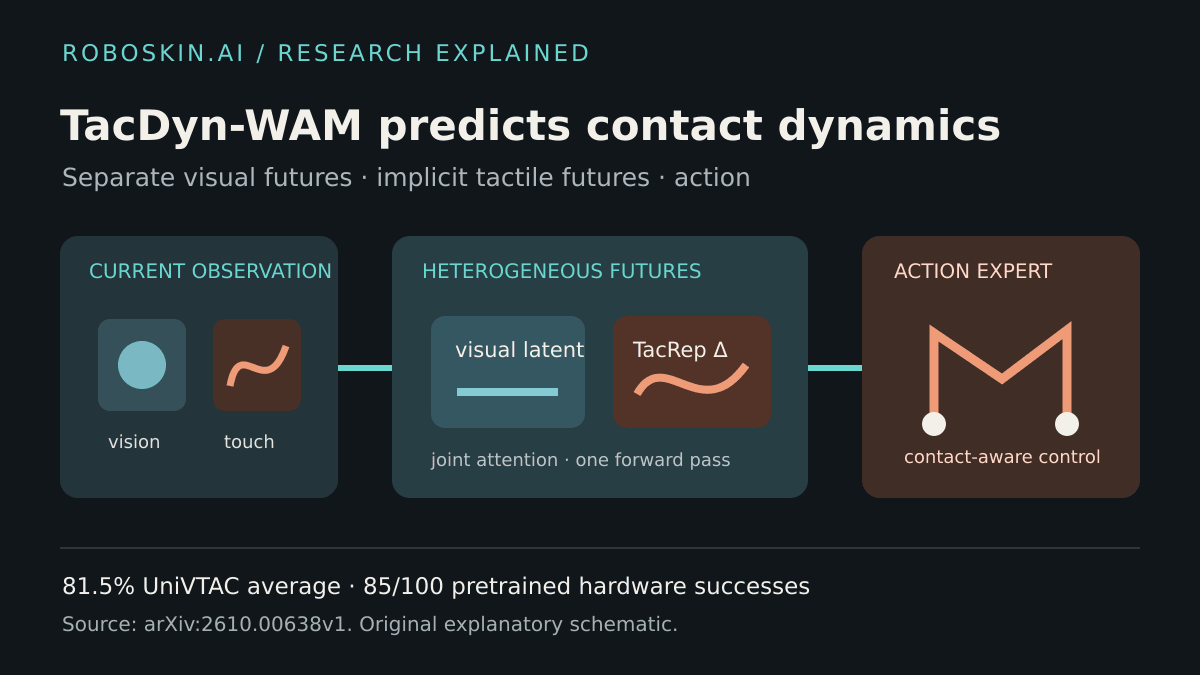
The v2 manuscript first adapts visual and tactile future prediction, then trains an action expert jointly with the backbone. A tactile optical-flow proxy provides auxiliary supervision; it is not a calibrated force sensor. At inference, the method avoids full video denoising. The authors evaluate eight simulated tasks and four physical tasks across two robot/sensor configurations. Their encoder-transfer evidence should not be read as an untouched robot policy transferring to any sensor.
The paper was first submitted on March 24; November 5 is the revision date. This article reviews v2 rather than presenting the work as a new November invention. We have not run its code, verified a reusable checkpoint or reproduced its latency measurements.
Compare three different costs
RoboSkin analysis: a useful model comparison separates preparation, training and runtime. A method can reduce one without reducing all three. Record costs at the level where your team will incur them.
| Stage | Record before comparing |
|---|---|
| Preparation | Available pretrained weights, terms, sensor representation and the work needed to align demonstrations |
| Adaptation | Task examples, training hardware, optimization time and which components change |
| Runtime | Observation encoding, action generation, communication, command execution and the age of each observation |
A headline inference multiplier cannot decide whether a controller meets your loop deadline. Match hardware, precision, compilation, input resolution and action-chunk length, then time the complete path. Keep warm-up separate from steady operation and report a distribution rather than a single favorable run.
Ask whether the policy actually uses touch
A policy accepting a tactile tensor is not proof that contact affects its action. A useful evaluation compares the same task and demonstration budget under visual-only, visual-plus-touch and controlled tactile perturbation conditions. State which weights and other inputs remain fixed; otherwise the comparison mixes changes in sensing with changes in model capacity or training.
Define what a meaningful response would look like before testing. For example, a contact change might require a pause, a small correction or a release. Inspect whether the action responds at the right time, and whether that response improves the independently judged task outcome. Attention plots can help investigate behavior, but they are not a substitute for that outcome test.
Keep sensor transfer and robot transfer separate
An encoder can preserve useful information from a second sensor while the action policy still needs demonstrations for that robot and task. Treat those as separate experiments. Document sensor geometry, calibration, frame alignment, robot action space and task setup, then state exactly which component was reused without training.
For a first comparison, choose one task and one sensor that your lab can reproduce consistently. Keep a held-out set of contact conditions and log failures as carefully as successes. Expand to another sensor only after the original observation and action contract is stable. This isolates the adaptation work that a broad transfer claim can hide.
Where VTAM belongs in the research map
Use the VTAM evidence record to inspect the prediction and action interface alongside other world models. The VLA directory covers language-conditioned policy choices, while the tactile dataset directory helps identify the demonstrations and reuse conditions available to you. These are different selection tasks; a model name alone does not answer all of them.
Our conclusion is a research recommendation: assess VTAM when you want to study task-level tactile adaptation of a video-pretrained system. Its reported experiments do not establish general superiority, universal sensor transfer or a production-ready robot controller.
Continue the topic