LeRobot v0.6 connects world models, VLAs, evaluation, and corrective data collection
LeRobot v0.6 turns more of the robot-learning loop into shared infrastructure: world-model policies, VLAs, reward models, datasets, simulation evaluation, deployment, and corrective demonstrations.
Open-source robotics release review — source published July 7, 2026
Hugging Face released LeRobot v0.6.0 with a wider goal than adding another policy. The update connects model training, rollout, failure capture, human correction, dataset enrichment, reward estimation, and simulation evaluation inside one open-source robotics stack.
For robot learning, that integration may be more consequential than any individual model name. A vision-language-action policy becomes useful only when teams can record compatible observations and actions, evaluate the policy under controlled variation, preserve failures, and turn corrections into the next training set.
What changed in LeRobot v0.6?
LeRobot v0.6 is the July 2026 release of Hugging Face’s open robotics framework. It adds three world-model policy integrations, five VLA integrations, a unified reward-model API, six simulation benchmark integrations, richer dataset support, and a dedicated rollout command with human correction strategies.
| Layer | Additions named in the official release | Role in the loop |
|---|---|---|
| World-model policies | VLA-JEPA, LingBot-VA, FastWAM | Learn or use predicted future representations during policy training or design |
| VLA integrations | GR00T N1.7, MolmoAct2, EO-1, Multitask DiT, EVO1 | Convert visual and language context into robot actions |
| Reward models | Existing HIL-SERL and SARM plus Robometer and TOPReward | Estimate task progress or success from trajectories |
| Simulation benchmarks | LIBERO-plus, RoboTwin 2.0, RoboCasa365, RoboCerebra, RoboMME, VLABench | Test robustness, bimanual manipulation, household tasks, long horizons, memory, and reasoning |
| Dataset tooling | Depth, timestamped language annotations, configurable video encoding, parallel decoding | Record and load richer training observations |
| Deployment | lerobot-rollout strategies, including DAgger-style correction | Run policies and save failures or human interventions as data |
The word “integration” is important. LeRobot provides common interfaces and workflows around projects developed by multiple organizations. The release itself is not evidence that every model outperforms every previous policy.
Three different uses of a robot world model
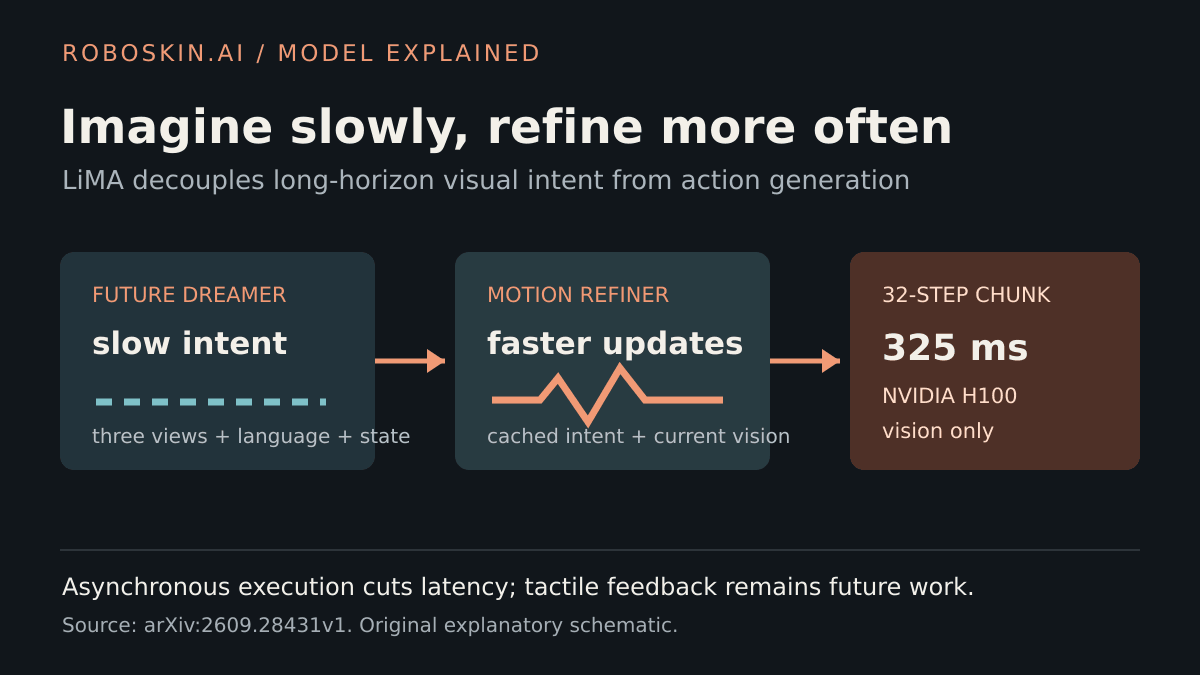
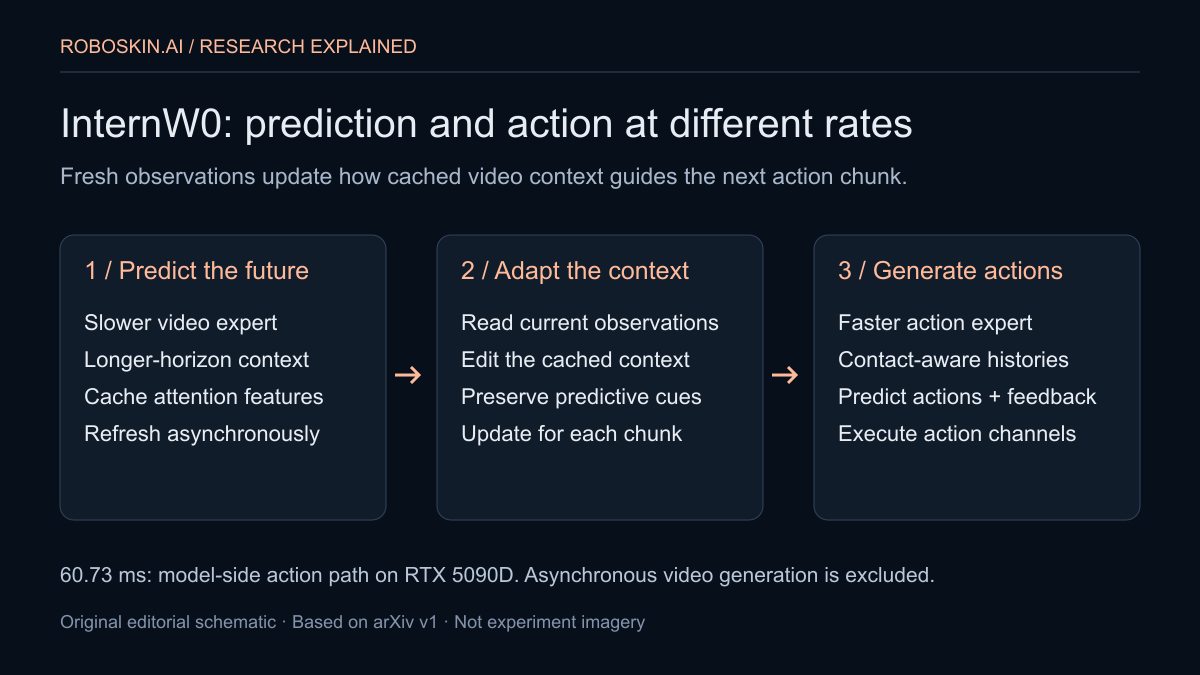
The release groups VLA-JEPA, LingBot-VA, and FastWAM under world-model policies, but they do not use prediction in the same way.
- VLA-JEPA predicts future representations during training, while the world-model component is removed at inference.
- LingBot-VA predicts video and actions autoregressively and can save predicted video for comparison with the actual rollout.
- FastWAM combines video-generation and action experts during training but skips explicit future generation at inference.
This distinction prevents a common SEO shortcut: “world model” is not one fixed architecture. For a useful comparison, record what the model predicts, whether prediction runs at test time, how actions condition the prediction, and whether the imagined state is evaluated against actual robot outcomes. The robot world models guide organizes those questions.
Six simulation benchmark integrations
The new environments target different failure modes rather than one universal score. The official release describes LIBERO-plus as robustness testing under perturbations, RoboTwin 2.0 as bimanual manipulation, RoboCasa365 as kitchen-task coverage, RoboCerebra as long-horizon subgoal execution, RoboMME as memory testing, and VLABench as knowledge and reasoning for manipulation.
All six run through the lerobot-eval interface and have their own environment dependencies. A common CLI reduces integration friction; it does not make their tasks, observations, success criteria, or scores directly interchangeable. Benchmark reports should still identify the environment version, policy checkpoint, number of episodes, random seeds, and evaluation hardware.
From deployment failure to training data
The dedicated lerobot-rollout command separates policy deployment from ordinary dataset recording. Its strategies include continuous recording, saving selected recent windows, episodic rollouts, and a DAgger-style mode in which an operator can interrupt a failed action, take control through a leader device, record the correction, and return control to the policy.
Intervention frames are tagged in the resulting dataset. That creates a concrete robot teleoperation path:
Robot policy rollout → observed failure → human correction → labeled intervention frames → fine-tuning → another rollout.
The quality of the correction still depends on timing, operator skill, sensor calibration, action alignment, and whether the corrected states cover the failures the deployed policy will actually encounter.
Dataset changes and the tactile-data gap
The release adds end-to-end depth recording, timestamped language annotations, configurable video encoding, and faster multi-camera decoding. The language schema can carry subtasks, plans, corrections, speech, and visual question-answer pairs rather than one sentence for an entire episode.
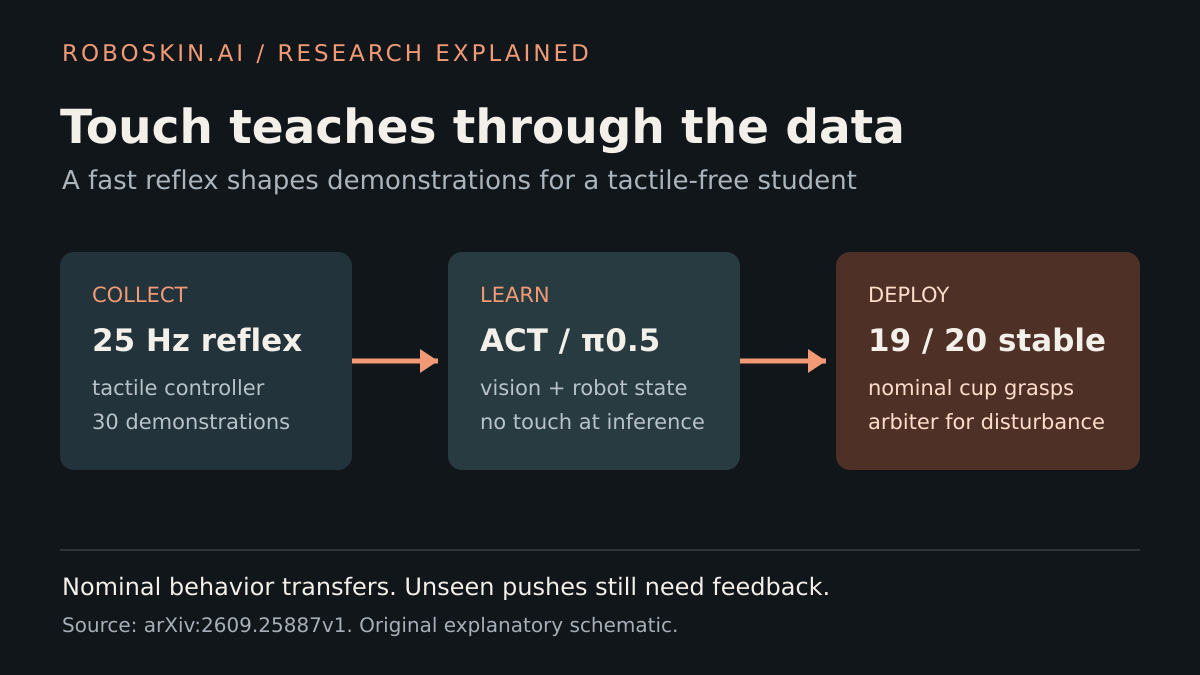
Those improvements matter to robotics datasets, but the official release does not announce a standard tactile modality for LeRobot datasets. A tactile extension would still need to define sensor identity, taxel geometry, coordinate frames, calibration, units, sampling rate, timestamps, compression, missing samples, and alignment with cameras, proprioception, and actions. Adding an array without those fields produces bytes, not reusable tactile evidence.
What the release does not prove
LeRobot v0.6 makes many models and benchmarks easier to run through common interfaces. It does not provide one independent comparison showing which VLA, world model, or reward model is best across real robots. The release’s speed claims and benchmark descriptions come from the project announcement and should be validated in each team’s environment.
Simulation success also does not establish real-world robustness. Camera calibration, latency, motor dynamics, contact, object variation, and safety behavior can change the outcome after deployment.
Evidence boundary
This article summarizes Hugging Face’s official LeRobot v0.6.0 announcement and linked project repository. Model, dataset-loading, and benchmark claims are release-author claims unless a separate paper is named. RoboSkin.ai did not independently reproduce the six environments, speed measurements, model results, or hardware workflows. Availability may differ by model license, checkpoint, simulator dependency, and compute requirement.
Sources
Continue the topic