The Cartesian Hand replaces finger joints with seven linear axes
Two stacked parallel grippers and four sliding fingertips operate caps, tools and lab equipment. The mechanism succeeds in a configured 350-trial test, but it does not sense contact force or location.
Duke University's General Robotics Lab introduced the Cartesian Hand in a preprint submitted on September 22, 2026. Instead of imitating an articulated human hand, the 850-gram end effector stacks two independently actuated parallel grippers and lets four fingertips translate along fixed axes. The seven-degree-of-freedom mechanism targets objects with threads, pivots, guides, plungers and triggers. Paper and version record.
Key takeaways
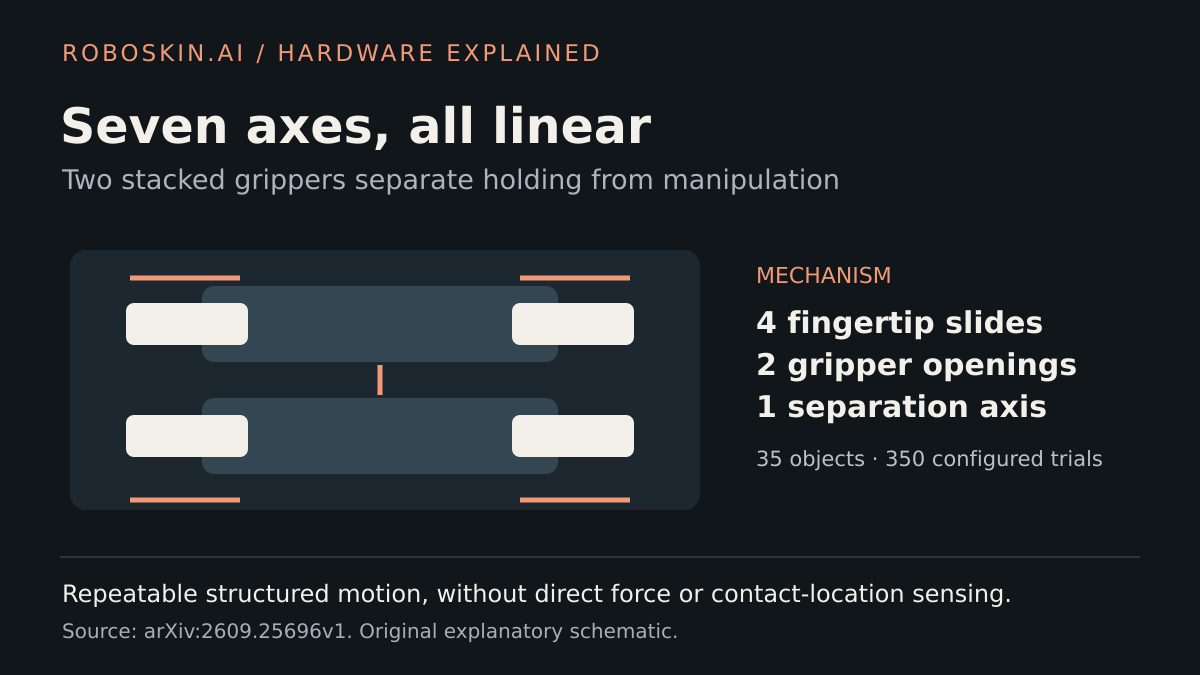
- All seven joints are prismatic: four fingertip slides, two gripper openings and one axis that changes the separation between the grippers.
- The authors report 350 successful trials across 35 configured objects, with 10 trials per object. Objects began from prescribed positions, and new objects within an established category could require up to five setup trials.
- The hand uses joint feedback and contact detection but does not directly measure contact location or contact force. Its strength comes from mechanism-specific motion, not general tactile dexterity. Methods and tests.
What changed
Most dexterous hands add rotary joints so fingers can wrap around objects. The Cartesian Hand assigns separate roles to two simple grippers. One section can hold the body of a bottle, pipette or tool while the other moves a cap, plunger, second handle or trigger. Because every joint translates along a fixed axis, the fingertip position is a linear function of joint position and the Jacobian does not change with configuration.
Seven Feetech-3915 servos drive rack-and-pinion stages and dovetail slides. The paper reports 65 millimeters of fingertip travel, 52 millimeters for each gripper opening and inter-gripper separation, and joint speeds around 60 millimeters per second. The closed assembly is approximately 166 by 100 by 76 millimeters. One gripper held a 2-kilogram bottle in a static test.
The authors estimate about USD 500 for a complete hand. Structural printing is estimated at roughly USD 30 in PLA or USD 50 in SLS Nylon 12, and PLA assembly takes about two hours after printing. These are author estimates, not independently audited production costs. A theoretical rack force near 170 N derives from rated servo stall torque before transmission losses; it is not a measured continuous fingertip force.
What the 350 trials establish
The evaluation covers cap opening and closing, pipetting, pumping, two-handle tools, screwdrivers, triggers and in-grasp reorientation. Ten trials on each of 35 objects all succeeded after object-specific parameters were configured. During the in-hand procedure, the Franka Panda arm remains stationary and an external holder no longer supports the object after lift.
That repeatability is meaningful for a structured mechanism, but it is not zero-shot generalization. Initial object poses are prescribed. A new object in an existing mechanism category reuses the procedure, then changes settings such as grasp height, stroke or force limit; the paper allows up to five setup trials to find them.
The project also shows two Cartesian Hands on Duke Humanoid V2 uncapping a tube, pipetting and recapping. This is a qualitative transfer demonstration. The paper does not report a second 350-trial evaluation on the humanoid.
What this means for robotics
RoboSkin analysis: dexterity does not always require anthropomorphic fingers. Many industrial and laboratory objects already constrain motion through threads, hinges and guides. Designing a hand around those mechanisms can simplify planning and make a small library of primitives reusable. The result belongs alongside underactuated and anthropomorphic designs in any robot hand comparison.
It also highlights where touch would add value. Joint thresholds can detect resistance, but they cannot identify which surface made contact or separate desired tool load from a collision. Adding compact tactile sensors could support automatic parameter selection, slip detection and safer force limiting without changing the linear kinematics.
Limitations and availability
This is an arXiv v1 preprint and RoboSkin.ai has not built the hand. The object set is structured, the starting poses are controlled, and the procedures use manually selected parameters. The platform does not observe object pose, contact location or contact force. Claims should therefore remain about repeatable mechanism-specific manipulation, not open-world hand autonomy.
The paper says software and hardware design will be open-sourced. The official project page currently exposes specifications, videos and a link labeled Code to github.com/generalroboticslab/Cartesian_Hand. On September 23 that repository returned 404 through both the public GitHub page and API, so no files, revision or license could be verified. A future-release statement is not a current open-source release.
Sources
Continue the topic