Berkeley QUAD Hand trades finger symmetry for backdrivability and sustained force
The Berkeley QUAD Hand couples its middle and ring fingers so a larger quasi-direct-drive motor can provide closure and thermal headroom. Hardware tests show broad static grasp coverage, but not autonomous task performance.
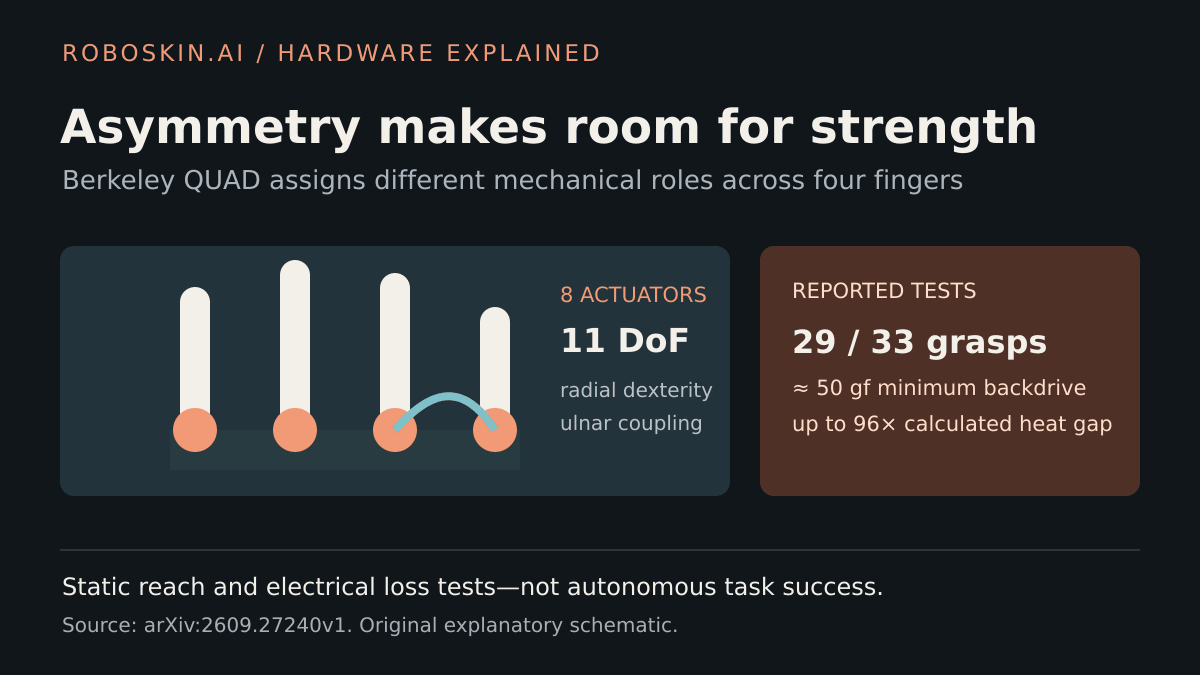
Benjamin Davis, Chase Kidder and Hannah S. Stuart released the Berkeley QUAD Hand on September 23, 2026. The arXiv v1 hardware design uses four fingers, 11 degrees of freedom and eight actuators, assigning independent quasi-direct-drive motion to the radial side of the hand while mechanically coupling the middle and ring fingers around one larger motor. The prototype reached 29 of 33 Feix grasp-taxonomy poses and required as little as about 50 gram-force to backdrive some base joints. Paper and version record.
Key takeaways
- QUAD stands for Quasi-direct-drive, Underactuated, Asymmetric Design. The approximately 1-kilogram hand uses independent thumb and index motion for dexterity and a compliant middle-ring linkage for strength and enclosure.
- Static hardware tests reached 29 of 33 Feix grasps and 10 of 11 Kapandji opposition poses. These tests establish reachable postures, not autonomous manipulation success.
- The reported reduction of up to 96 times is calculated resistive heat energy under a five-minute sustained-load setup, not a universal efficiency advantage across tasks. Hardware evaluation.
What changed
Most anthropomorphic hands make every finger mechanically similar. The QUAD Hand starts from the observation that human fingers play different roles. Its thumb, index and middle fingers handle more varied motion, while the ulnar side contributes closure and load support.
The thumb and index use compact SteadyWin GIM3505-08 quasi-direct-drive motors at their bases. A larger CubeMars AKE60-8 drives the middle and ring fingers through a preloaded six-bar transmission. Under light load, the ring finger mirrors the middle finger. When middle-fingertip load exceeds an approximately 3.2 N spring threshold, the linkage deflects and sweeps the ring finger inward toward the palm. The threshold is tunable through spring preload rather than a fixed sensor limit.
Distal joints on the actively controlled fingers use high-reduction servos, so the design is hybrid rather than fully direct drive. The underactuated ring finger adds flexion and cupping without another actuator, freeing enough palm volume for the larger ulnar motor.
What the hardware tests establish
The grasp-taxonomy and Kapandji evaluations test kinematic coverage. QUAD formed 29 of 33 standardized grasps. It missed one Kapandji posture because the design has no fifth finger. These results support broad opposition and enclosure, but the poses were demonstrated statically and do not include perception, object uncertainty or dynamic task completion.
For backdrivability, a force gauge pressed each fingertip until the actuator visibly rotated, with 15 trials per tested joint. Thumb and index base joints averaged around 50 gram-force. The coupled middle and ring fingers were near 250 gram-force. The paper presents these values as a lower bound for active force sensitivity, not calibrated tactile sensing.
The sustained-load test applied 3 N at one fingertip for five minutes, plus a 6 N condition with both ulnar fingers loaded. Resistive heating was derived from measured quadrature-axis current and manufacturer phase resistance. Because the larger ulnar motor's phase resistance is much lower, the design reported up to a 96-fold reduction in calculated heat energy per finger. The comparison is specific to those actuators, loads, positions and the electrical-loss model.
What this means for robotics
RoboSkin analysis: the interesting contribution is architectural, not a new grasp controller. Asymmetry gives the designer another way to allocate mass, palm volume and thermal capacity. Passive linkage behavior can respond immediately to contact, while backdrivable joints make active compliance easier to observe and control. This can complement robot-hand tactile systems rather than replace them.
The approach also creates coupled-control questions. One actuator influences two fingers, and linkage geometry changes mechanical advantage across the workspace. A learning policy or controller must model that state-dependent coupling. Adding fingertip or palm tactile sensing would help separate commanded motion from actual contact, which the authors identify as future work.
Limitations and availability
This is an arXiv v1 preprint, and RoboSkin.ai has not reproduced the prototype. The hand was rapidly prototyped with 3D-printed ulnar transmission parts that yield before the larger motor reaches stall torque. Force tests cover one position per joint even though linkage mechanics vary with position. Peak fingertip force was deliberately not compared, and the approximately 5-kilogram lift shown in supplemental media is an example rather than a repeated benchmark.
The official project page provides videos, design illustrations, an interactive grasp viewer and the paper. On September 24 it did not expose a CAD download, bill of materials, control repository or hardware license. The paper is distributed under a Creative Commons manuscript license, but that does not license unprovided design files. Current availability is therefore documentation and media, not an open build package.
Sources
Continue the topic