Robotics assurance pillar
Robot safety: standards, sensing and validation
Understand industrial and humanoid robot safety, ISO 10218 scope, risk reduction, collision and contact sensing, validation, and robot-skin evidence boundaries.
Published | Updated by RoboSkin.ai Editorial Team
- 6
- sections
- 4
- questions
- 9
- next routes
Short answer
What you need to know
- 1
Robot safety is a system-level discipline covering hazard identification, risk assessment, inherently safer design, protective measures, validated controls, integration, operating procedures, maintenance, and incident response. No single sensor makes a robot safe.
- 2
ISO 10218-1:2025 addresses industrial robots, while ISO 10218-2:2025 addresses industrial robot applications and robot cells. Their scope should not be applied automatically to every service, medical, public-space, or research humanoid system.
- 3
Robot skin and tactile sensors can contribute contact or collision information, but their safety role depends on coverage, detection threshold, latency, diagnostics, failure behavior, control integration, validation, and the applicable regulatory and standards context.
Topic 01
Safety is a layered system, not a sensor feature
A complete robot-safety argument starts with the intended use and foreseeable misuse, identifies hazards throughout the lifecycle, estimates risk, applies risk-reduction measures, and verifies that the resulting system behaves as required. Mechanical limits, motion planning, control architecture, protective equipment, sensing, human procedures, and maintenance can all contribute.
Terms such as collaborative, compliant, soft, force-limited, autonomous, or covered in robot skin are not safety certifications. They describe possible design properties whose effect must be evaluated in the final application and environment.
| Layer | Role | Evidence to retain |
|---|---|---|
| Intended use and hazard analysis | Define people, tasks, environment, lifecycle, misuse, and hazardous events | Assumptions, hazard log, risk assessment method, and unresolved risks |
| Inherently safer design | Reduce hazard through geometry, mass, energy, speed, force, access, or mechanical constraints | Design requirements, calculations, drawings, and test records |
| Protective and control measures | Limit or stop hazardous behavior and detect relevant conditions | Architecture, performance requirements, diagnostics, latency, fault tests, and validation |
| Information and operations | Set training, procedures, inspection, maintenance, and residual-risk communication | Manuals, training records, checklists, change control, and incident records |
Topic 02
What ISO 10218:2025 covers
The public ISO record describes ISO 10218-1:2025 as safety requirements for industrial robots and ISO 10218-2:2025 as the companion standard for industrial robot applications and robot cells. The ISO robotics overview also lists ISO/TS 15066:2016 for collaborative industrial robot applications.
Scope matters. The public ISO 10218-1 page lists exclusions, including service and medical applications. A humanoid used in a factory cell may intersect industrial-robot requirements differently from a service humanoid in a home, hospital, or public space. Determine the applicable edition, jurisdiction, product category, integrator responsibilities, and conformity route with qualified safety and legal professionals.
This page is a technical research map, not legal advice, a risk assessment, or a certification decision. The full paid standards and applicable local rules—not this summary—control formal compliance work.
Topic 03
Industrial, collaborative, and humanoid safety are not interchangeable
Industrial robot safety often assumes a defined application, cell, tooling, workpiece, integration, and operating mode. Collaborative applications require evaluation of how people and the robot share a workspace. A mobile or humanoid platform can add locomotion, balance, batteries, whole-body contact, changing environments, general-purpose tools, learned behavior, and human proximity.
Those added capabilities broaden the hazard and validation surface. A humanoid benchmark can help make performance measurable, but performance benchmarking is not the same as demonstrating safety compliance.
| Context | Typical system boundary | Additional questions |
|---|---|---|
| Industrial robot application | Robot, end effector, workpiece, cell, safeguards, and operating procedures | Who integrated the cell, which modes exist, and how are changes validated? |
| Collaborative industrial application | Shared or sequential workspace with specified collaborative operations | Which hazards, contact cases, speeds, forces, separation functions, and foreseeable misuse were assessed? |
| Mobile or humanoid robot | Whole mobile body, manipulation, environment, software, people, and changing tasks | How are falls, balance loss, body contact, tool use, learned behavior, communications, and recovery handled? |
Topic 04
Where collision, force, and robot-skin sensing fit
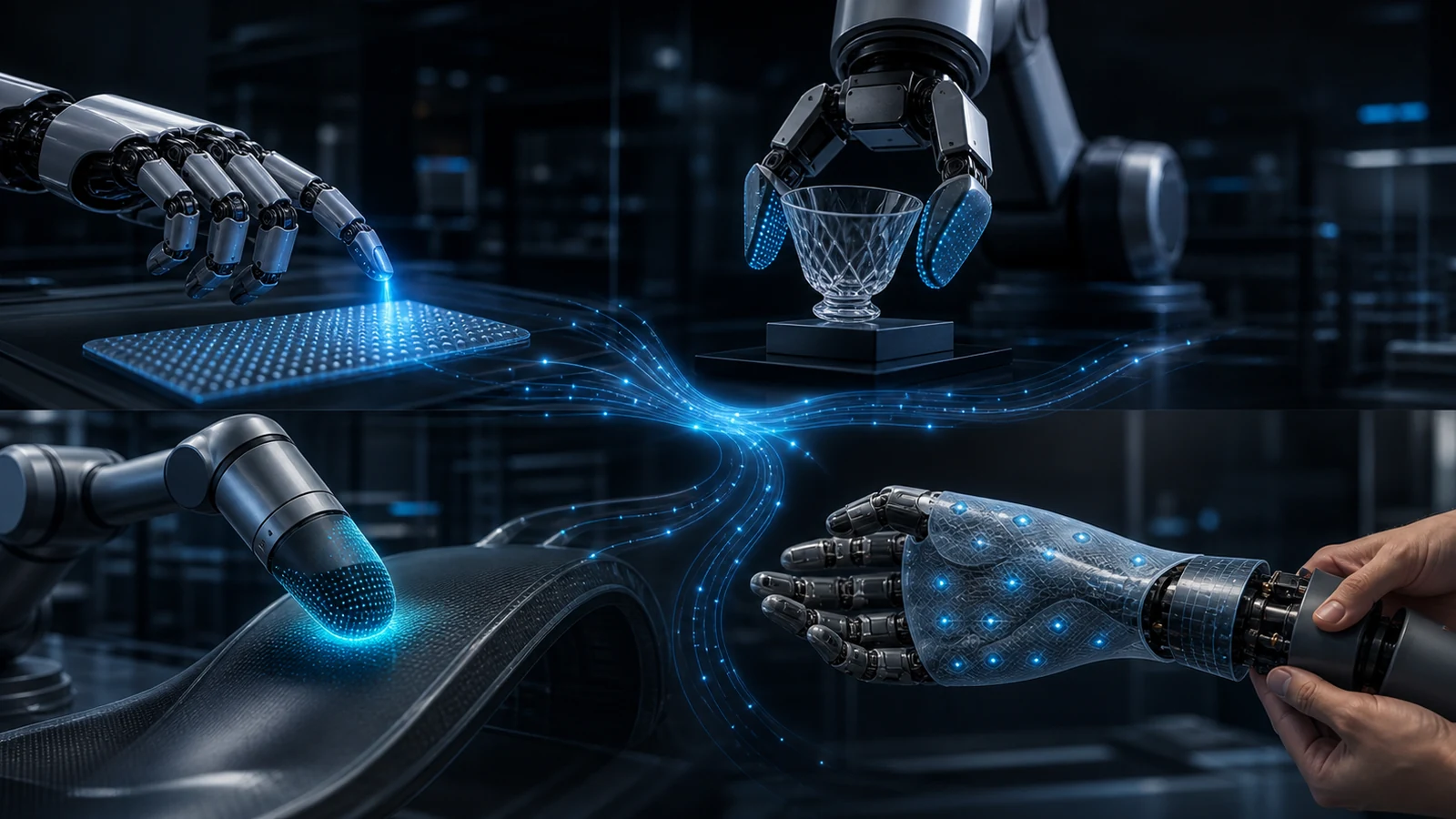
External perception can monitor people and obstacles before contact. Joint torque, motor current, force-torque sensors, proximity sensors, bumpers, and surface tactile arrays can expose different parts of a collision or contact event. Their coverage and failure modes differ, so they may complement one another.
Robot skin is particularly relevant to distributed surface contact that a wrist sensor may not localize. But a research tactile array should not be described as a safety-rated protective device unless its claimed function, architecture, diagnostics, fault response, and validation satisfy the applicable requirements.
- Map blind spots, joints, seams, tools, carried objects, hands, feet, and replaceable covers
- Measure detection threshold, spatial coverage, response time, end-to-end stopping response, drift, wear, and fault behavior
- Test expected contact as well as sensor disconnection, saturation, partial damage, timing faults, and communication loss
- Validate the complete sensing-to-control chain in the final robot application
Topic 05
Evidence and benchmark boundaries
NIST’s Humanoid Robot Baseline Performance Benchmark project proposes low-footprint locomotion and manipulation tasks with quantifiable performance metrics and common comparison. It can improve measurement discipline and adoption readiness, but NIST does not present that project page as a safety certification scheme.
Research papers can establish sensor behavior or robot performance under named conditions. Manufacturer material can document intended features. A conformity assessment, application risk assessment, and validated safety function answer different questions. RoboSkin.ai labels these evidence levels instead of combining them into one safety claim.
Topic 06
Robot-safety validation checklist
Validation should trace each safety-related requirement to a method, acceptance criterion, result, and retained record. Software, model, payload, tooling, speed, environment, sensor, network, and operating-mode changes may invalidate earlier assumptions and need controlled review.
- Name the applicable standard, edition, clause-owned requirement, local rule, and responsible party
- Trace hazards to design measures, protective measures, residual risks, and verification evidence
- Test normal operation, foreseeable misuse, faults, recovery, maintenance, and degraded sensing
- Retain versioned configurations, calibration, test equipment, raw logs, failures, interventions, and approvals
Common questions
FAQ for this topic
What does robot safety include?
Robot safety includes intended-use definition, hazard analysis, risk assessment, inherently safer design, protective measures, validated controls, integration, procedures, maintenance, and incident response.
Does ISO 10218:2025 cover every humanoid robot?
No. ISO 10218-1:2025 covers industrial robots and ISO 10218-2:2025 covers industrial robot applications and cells. The applicable requirements for a humanoid depend on its use, product category, jurisdiction, integration, and other standards or regulations.
Can robot skin make a humanoid safe?
Robot skin can contribute contact information, but no single sensor makes a humanoid safe. Its role depends on coverage, latency, diagnostics, failure response, control integration, validation, and the rest of the risk-reduction system.
Is a humanoid performance benchmark a safety certification?
No. A performance benchmark can make locomotion or manipulation results comparable. Safety certification and application risk assessment address different requirements and evidence.