Robot skin and tactile sensing questions
Contact ->Public copy stays conservative. If a detail depends on robot platform, geometry, or environment, treat it as source-specific rather than a RoboSkin.ai product claim.
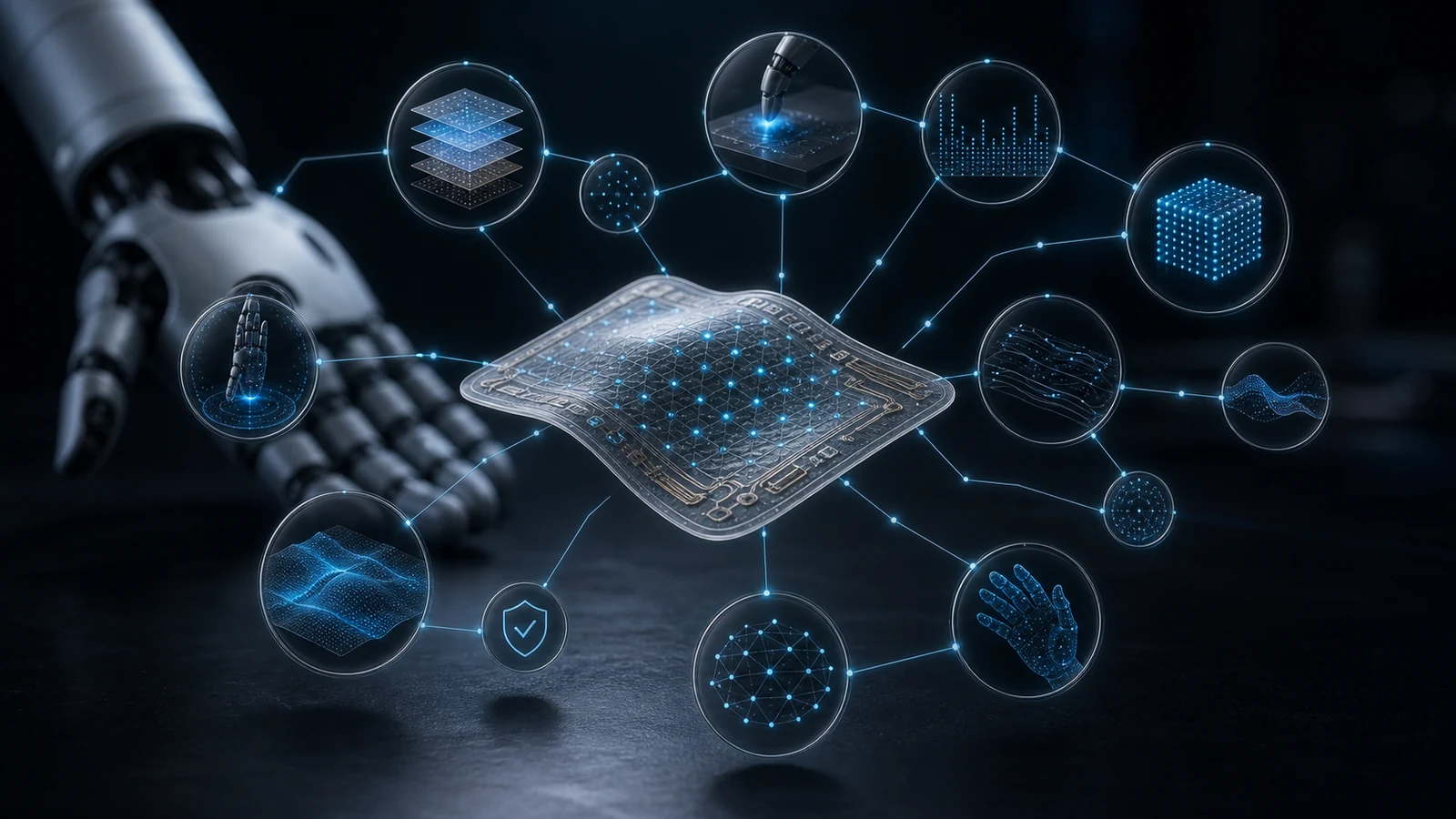
What is the difference between robot skin and a tactile sensor?
A tactile sensor measures contact at an element or array. Robot skin is the integrated surface: sensors, mounting, electronics, data handling, and the robot response. A single fingertip sensor is not whole-body skin.
Compare robot skin and tactile sensors ->When is a simple touch sensor enough?
A binary contact event can be sufficient for a state transition. Contact location, force distribution, or slip detection may need richer measurements and a separately validated processing pipeline.
Compare contact switches and tactile sensing ->How do I choose a tactile sensor for a robot?
Start with the task and contact geometry. Compare measured outputs, coverage, timing, calibration, replacement, software access, and task-level evidence. No sensing principle is best for every robot.
Use the sensor selection guide ->Does a tactile image directly measure force?
An optical tactile sensor captures the appearance of its deformable surface. Geometry reconstruction or force estimation needs an appropriate model and calibration; image resolution alone is not force accuracy.
Review calibration requirements ->What should I record when testing slip detection?
Record the reference slip onset, detector output, false alarms, action timing, and whether the object was retained. Correct detection and successful recovery are different outcomes.
Plan a slip-detection evaluation ->Where can I find tactile datasets with usable downloads?
The dataset directory distinguishes verified files from paper-described collections. Check each provider link, data license, sensor modality, task, and train/test split before reuse.
Check tactile dataset access ->Can I learn tactile data processing without a robot?
Yes. The Python tutorial uses synthetic CSV samples to practice inspection, plotting, and contact-event analysis. The ROS 2 tutorial adds message and replay exercises. These are learning exercises, not hardware benchmarks.
Start the programming tutorials ->How does touch fit into Physical AI?
Physical AI connects perception, decision-making, and action in a physical machine. Touch supplies contact feedback that a controller or learned policy can combine with vision and robot state.
Read the Physical AI explainer ->Does RoboSkin.ai sell robot skin hardware?
RoboSkin.ai publishes independent research guides and offers scoped research services. Sensor references describe third-party hardware and research; they are not claims of stock, compatibility, or manufacturer support.
About RoboSkin.ai ->How can I correct a claim or suggest a source?
Send the page URL, the statement to review, and a primary paper or official document. The editorial policy explains attribution and the separation between reported results and our interpretation.
Send a source or correction ->Need a clearer route?
Choose research, glossary, or contact depending on whether you need learning context, a correction, or a source suggestion.