Research guide
Robot skin papers and tactile sensing research index
Browse source-backed robot skin papers and research routes for tactile sensing, e-skin, soft robotic skin, robot hands, and tactile AI.
Updated 2026-06-06 by RoboSkin.ai Editorial Team

- 3
- sections
- 3
- questions
- 6
- next routes
Short answer
What you need to know
- 1
This page organizes RoboSkin.ai research routes for robot skin, tactile AI, e-skin, soft robotic skin, tactile arrays, and robot hand sensing.
- 2
It is not a claim that RoboSkin.ai produced the original papers. It is a source-backed editorial index that links public sources to practical robotics interpretation.
- 3
Use it as a starting point for understanding which papers map to materials, sensor arrays, full-hand sensing, software pipelines, and application constraints.
Topic 01
How to read robot skin papers
A strong robot skin paper usually combines material behavior, sensor geometry, signal interpretation, and a use case. A weak reading only looks at the headline claim that robots can feel.
Readers should separate reported experimental results from deployment assumptions. Performance in a lab sample does not automatically transfer to a full humanoid hand or industrial gripper.
- Identify what signal is measured: pressure, shear, slip, temperature, damage, or multimodal input
- Check whether the result is shown on a flat sample, fingertip, full hand, gripper, or body surface
- Look for calibration, drift, durability, latency, and data-interface details
- Ask whether the tactile signal changes a robot behavior or only demonstrates sensing
Topic 02
Research lanes to explore
Useful research lanes include materials and e-skin, robot hand tactile sensing, tactile AI software, datasets and benchmarks, and application-specific evaluation.
Each lane gives readers a distinct path through materials, sensing, integration, and robot-learning evidence.
Topic 03
Why source boundaries matter
This index keeps public source claims separate from RoboSkin.ai editorial analysis. That protects credibility and avoids implying product availability, customer use, benchmark values, or certification claims that are not published.
Visible source boundaries and concrete evaluation questions also make the analysis easier to verify and cite than a generic summary.
Paper routes
Start with source-backed RoboSkin briefs
 Tactile Hardware / 2026-05-14Graphene and liquid metal 3D force sensing for robot fingertipsA source-backed technical brief on miniaturized tactile sensors that separate normal force, shear force, slip, and texture signals for dexterous robot hands.
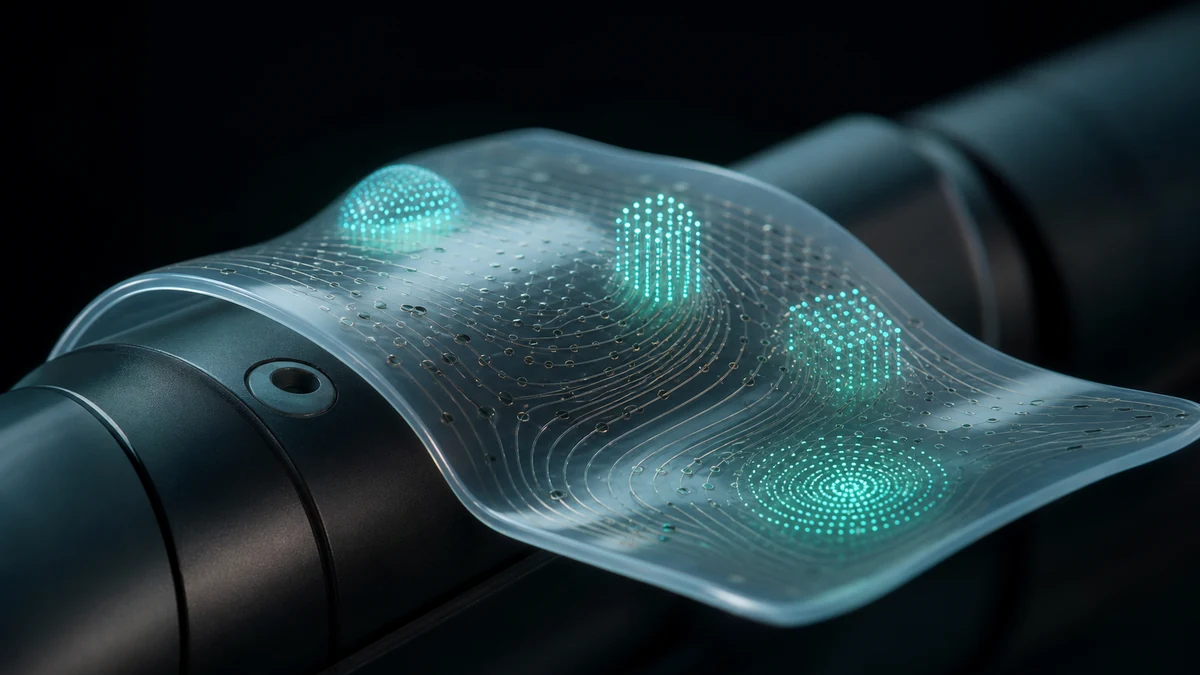 Soft E-Skin / 2026-08-22Single-material soft robotic skin for multimodal e-skin sensingA peer-reviewed single-material robotic skin uses wrist-mounted EIT electrodes and data-driven channel selection to interpret touch, strain, heat, damage, environment, and proprioception across a soft hand.
 Dexterous Manipulation / 2026-05-14Full-hand tactile sensing for adaptive dexterous graspingA research-oriented explanation of why full-hand tactile coverage matters for adaptive grasping, occluded manipulation, and contact-aware robot hands.
Common questions
FAQ for this topic
Is this a complete database of robot skin papers?
No. It is an initial research route that can incorporate new source-backed briefs organized by material, sensor type, software stack, and application.
What papers should be added first?
Prioritize papers that explain full-hand tactile sensing, soft e-skin materials, large-area tactile arrays, ROS 2 or robot middleware pipelines, and tactile datasets.
Why use a research index?
A research index gives readers one source-backed route for comparing papers, sensing methods, evidence levels, and implementation limits.